
Mapping the Intellectual Core of Technology Adoption in Digital Startups: A Bibliometric Analysis via Bibliographic Coupling and Co‑Word Networks
Article Sidebar
Main Article Content
Abstract
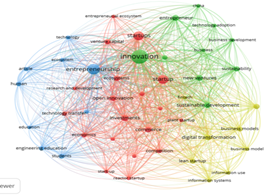
Digital startups are reshaping markets through the use of AI, cloud computing, and blockchain; however, scholarship on how these firms adopt technology remains fragmented. This study systematically maps the intellectual structure and thematic fronts of research on technology adoption in digital startups. A field-tagged Scopus search conducted in September 2025 (coverage 2000–2025) was cleaned and harmonized using a VOSviewer. After de-duplication, 2,243 documents were analyzed via bibliographic coupling (knowledge structure) and co-word analysis (thematic). Four coherent clusters emerge. Strategic innovation and leadership function as the governance backbone that shapes adoption decisions and risk appetite. Sustainable, data-driven business models translate adoption into performance outcomes through analytics capability and value capture. Corporate entrepreneurship within innovation ecosystems bridges firm-level capability with external partners, investors, and accelerators, linking adoption speed to ecosystem embeddedness. Digital business transformation operationalizes AI/cloud investments into processes and customer journeys. Cross-cutting co-word foci, such as perceived usefulness/user experience and organizational readiness, act as mechanisms connecting individual cognition with organizational capability. Emergent topics in policy, regulation, and platform governance appear as boundary conditions that enable or constrain adoption trajectories. The mapping provides an integrative lens organized along two axes: cognitive evaluation and organizational capability that jointly explain adoption in digital startups. It identifies gaps in external enablers and capability maturation paths. A forward-looking agenda is proposed, featuring multi-level models that link cognition, capability, and growth, as well as quasi-experimental evaluations of interface simplification and onboarding, cross-country comparisons of regulatory regimes, and longitudinal tracking of platform transitions.
Downloads
Article Details

This work is licensed under a Creative Commons Attribution-ShareAlike 4.0 International License.
Authors who publish with this journal agree to the following terms:
- Copyright of the published article belongs to the authors and grant the journal right of first publication with the work simultaneously licensed under a Creative Commons Attribution-ShareAlike 4.0 (CC BY SA) International License that allows others to share the work with an acknowledgment of the work's authorship and initial publication in this journal.
- Authors are able to enter into separate, additional contractual arrangements for the non-exclusive distribution of the journal's published version of the work (e.g., post it to an institutional repository or publish it in a book), with an acknowledgment of its initial publication in this journal.
- Authors are permitted and encouraged to post their work online (e.g., in institutional repositories or on their website) prior to and during the submission process, as it can lead to productive exchanges, as well as earlier and greater citation of published work (See the Effect of Open Access).
References
[1] N. Al Shehab and A. Hamdan, “Artificial intelligence and women empowerment in bahrain,” Stud. Comput. Intell., vol. 954, pp. 101–121, 2021, https://doi.org/10.1007/978-3-030-72080-3_6
[2] M. Garbuio and N. Lin, “Artificial intelligence as a growth engine for health care startups: Emerging business models,” Calif. Manage. Rev., vol. 61, no. 2, pp. 59–83, 2019, https://doi.org/10.1177/0008125618811931
[3] D. Dellermann, P. Ebel, N. Lipusch, K. M. Popp, and J. M. Leimeister, “Finding the Unicorn: Predicting Early Stage Startup Success through a Hybrid Intelligence Method,” in ICIS 2017: Transforming Society with Digital Innovation, 2018. https://doi.org/10.2139/ssrn.3159123
[4] K. Burton, M. Heath, and W. Luse, “Digital health startups: growth financing and valuation drivers that signal strength for investors,” J. Strateg. Manag., vol. 17, no. 4, pp. 587–606, 2024, https://doi.org/10.1108/JSMA-11-2023-0294
[5] G. Gupta and I. Bose, “Digital transformation in entrepreneurial firms through information exchange with operating environment,” Inf. Manag., vol. 59, no. 3, 2022, https://doi.org/10.1016/j.im.2019.103243
[6] B. Meessen, “The role of digital strategies in financing health care for universal health coverage in low- and middle-income countries,” Glob. Heal. Sci. Pract., vol. 6, pp. S29–S40, 2018, https://doi.org/10.9745/GHSP-D-18-00271
[7] M. Carlson and N. Usher, “News Startups as Agents of Innovation: For-profit digital news startup manifestos as metajournalistic discourse,” Digit. Journal., vol. 4, no. 5, pp. 563–581, 2016, https://doi.org/10.1080/21670811.2015.1076344
[8] G. Remane, B. Hildebrandt, A. Hanelt, and L. M. Kolbe, “Discovering new digital business model types - A study of technology startups from the mobility sector,” in Pacific Asia Conference on Information Systems, PACIS 2016 - Proceedings, 2016.
[9] G. N. Chandler, M. S. McLeod, J. C. Broberg, A. McKelvie, and D. R. DeTienne, “Customer engagement patterns and new venture outcomes,” Small Bus. Econ., vol. 63, no. 3, pp. 1117–1138, 2024, https://doi.org/10.1007/s11187-023-00843-6
[10] K. J. Wang, J. Widagdo, Y. S. Lin, H. L. Yang, and S. L. Hsiao, “A service innovation framework for start-up firms by integrating service experience engineering approach and capability maturity model,” Serv. Bus., vol. 10, no. 4, pp. 867–916, 2016, https://doi.org/10.1007/s11628-015-0294-x
[11] P. V. X. Pinheiro, P. R. Pinheiro, and C. H. L. de Carvalho, “A Multicriteria Model Applied to Customer Service in an E-Commerce Startup,” in Lecture Notes in Networks and Systems, 2023, vol. 722 LNNS, pp. 586–594. https://doi.org/10.1007/978-3-031-35311-6_56
[12] Q. Zhao, P. H. Tsai, and J. L. Wang, “Improving financial service innovation strategies for enhancing China’s banking industry competitive advantage during the fintech revolution: A hybrid MCDM model,” Sustain., vol. 11, no. 5, 2019, https://doi.org/10.3390/su11051419
[13] L. Çallı and B. A. Çallı, “Value-centric analysis of user adoption for sustainable urban micro-mobility transportation through shared e-scooter services,” Sustain. Dev., vol. 32, no. 6, pp. 6408–6433, 2024, https://doi.org/10.1002/sd.3032
[14] M. Hadizadeh, J. Ghaffari Feyzabadi, Z. Fardi, S. M. Mortazavi, V. Braga, and A. Salamzadeh, “Digital Platforms as a Fertile Ground for the Economic Sustainability of Startups: Assaying Scenarios, Actions, Plans, and Players,” Sustain., vol. 16, no. 16, 2024, https://doi.org/10.3390/su16167139
[15] E. H. Prasetyo, “Legitimacy building of digital platforms in the informal economy: evidence from Indonesia,” J. Entrep. Emerg. Econ., vol. 14, no. 6, pp. 1168–1187, 2022, https://doi.org/10.1108/JEEE-02-2021-0073
[16] I. Gernego, O. Tymoshenko, M. Dyba, S. Urvantseva, and L. Petrenko, “Digitalization in Venture Capital Relocation in Wartime,” in Proceedings - International Conference on Advanced Computer Information Technologies, ACIT, 2024, pp. 275–279. https://doi.org/10.1109/ACIT62333.2024.10712604
[17] E. Bastian, A. Piliang, and Meutia, “Effect of learning culture and management control system on innovation performance: Evidence from startup companies in Indonesia,” Probl. Perspect. Manag., vol. 22, no. 3, pp. 251–262, 2024, https://doi.org/10.21511/ppm.22(3).2024.20
[18] V. Corvello, A. M. Felicetti, S. Ammirato, C. Troise, and A. Ključnikov, “The rules of courtship: What drives a start-up to collaborate with a large company?,” Technol. Forecast. Soc. Change, vol. 200, 2024, https://doi.org/10.1016/j.techfore.2023.123092
[19] A. Wormald, R. Agarwal, S. Braguinsky, and S. K. Shah, “David overshadows Goliath: Specializing in generality for internationalization in the global mobile money industry,” Strateg. Manag. J., vol. 42, no. 8, pp. 1459–1489, 2021, https://doi.org/10.1002/smj.3270
[20] P. Agstner, “New Legal Forms and Rules for Italian Innovative Enterprises,” Eur. Bus. Law Rev., vol. 35, no. 7, pp. 1065–1082, 2024, https://doi.org/10.54648/EULR2024054
[21] S. Harlow and M. Chadha, “Indian Entrepreneurial Journalism: Building a typology of how founders’ social identity shapes innovation and sustainability,” Journal. Stud., vol. 20, no. 6, pp. 891–910, 2019, https://doi.org/10.1080/1461670X.2018.1463170
[22] S. de Falco, “From Silicon Valley to Africa Valley: which paradigms are needed in the transition from II to IV industrial revolution? Knowledge roadmap and technological track,” Innov. Eur. J. Soc. Sci. Res., vol. 35, no. 4, pp. 675–703, 2022, https://doi.org/10.1080/13511610.2019.1595538
[23] V. dos Santos, I. M. Beuren, D. C. Bernd, and N. Fey, “Use of management controls and product innovation in startups: intervention of knowledge sharing and technological turbulence,” J. Knowl. Manag., vol. 27, no. 2, pp. 264–284, 2023, https://doi.org/10.1108/JKM-08-2021-0629
[24] A. Greven, P. Rasche, C. Droege, and A. Mertens, “Digital Health Engineering and Entrepreneurial Innovation – Education for the Development of ICT for Older Adults,” in Lecture Notes in Computer Science (including subseries Lecture Notes in Artificial Intelligence and Lecture Notes in Bioinformatics), 2020, vol. 12426 LNCS, pp. 538–548. https://doi.org/10.1007/978-3-030-60149-2_41
[25] N. Marangunić and A. Granić, “Technology acceptance model: a literature review from 1986 to 2013,” Univers. access Inf. Soc., vol. 14, no. 1, pp. 81–95, 2015.
[26] M. Molino, C. G. Cortese, and C. Ghislieri, “The promotion of technology acceptance and work engagement in industry 4.0: From personal resources to information and training,” Int. J. Environ. Res. Public Health, vol. 17, no. 7, 2020, https://doi.org/10.3390/ijerph17072438
[27] U. S. Thathsarani and W. Jianguo, “Do Digital Finance and the Technology Acceptance Model Strengthen Financial Inclusion and SME Performance?,” Inf., vol. 13, no. 8, 2022, https://doi.org/10.3390/info13080390
[28] F. Fitria, M. Yahya, M. I. Ali, P. Purnamawati, and A. M. Mappalotteng, “The Impact of System Quality and User Satisfaction: The Mediating Role of Ease of Use and Usefulness in E-Learning Systems,” Int. J. Environ. Eng. Educ., vol. 6, no. 2, pp. 119–131, Aug. 2024,
https://doi.org/10.55151/ijeedu.v6i2.134
[29] R. B. Seno Wulung, K. Takahashi, and K. Morikawa, “A model for selecting appropriate technology for incubator-university collaboration by considering the technology transfer mechanism,” Int. J. Prod. Res., vol. 56, no. 6, pp. 2309–2321, 2018, https://doi.org/10.1080/00207543.2017.1374569
[30] A. P. Srivastava and R. L. Dhar, “Technology leadership and predicting travel agent performance,” Tour. Manag. Perspect., vol. 20, pp. 77–86, 2016, https://doi.org/10.1016/j.tmp.2016.07.009
[31] R. Sureka, S. Kumar, S. Kumar Mangla, and F. Hourneaux Junior, “Fifteen years of international journal of productivity and performance management (2004–2018),” Int. J. Product. Perform. Manag., vol. 70, no. 5, pp. 1092–1117, 2020, https://doi.org/10.1108/IJPPM-11-2019-0530
[32] J. A. Wani and S. A. Ganaie, “The scientific outcome in the domain of grey literature: bibliometric mapping and visualisation using the R-bibliometrix package and the VOSviewer,” Libr. Hi Tech, vol. 42, no. 1, pp. 309–330, 2024, https://doi.org/10.1108/LHT-01-2022-0012
[33] A. Klarin, “How to conduct a bibliometric content analysis: Guidelines and contributions of content co-occurrence or co-word literature reviews,” Int. J. Consum. Stud., vol. 48, no. 2, p. e13031, 2024, https://doi.org/10.1111/ijcs.13031
[34] Z. Javaid, A. Ilyas, S. U. Rahman, and M. Ali, “A Scientometxic Map Illustrating Sustainable Performance Through Bibliometric Analysis,” iRASD J. Econ., vol. 5, no. 3, pp. 746–764, 2023, https://doi.org/10.52131/joe.2023.0503.0158
[35] A. Rehman Sherief, “Bibliometric Analysis of Neuromarketing and Consumer Behaviour: A Comprehensive Review From 2000 To 2023,” Educ. Adm. Theory Pract., pp. 3294–3315, 2024, https://doi.org/10.53555/kuey.v30i6.6071
[36] S. Rajumesh, “Promoting sustainable and human-centric industry 5.0: a thematic analysis of emerging research topics and opportunities,” J. Bus. Socio-economic Dev., vol. 4, no. 2, pp. 111–126, 2024, https://doi.org/10.1108/JBSED-10-2022-0116
[37] C. Li et al., “A Bibliometric Analysis of Global Research on Climate Change and Agriculture from 1985 to 2023,” Agronomy, vol. 14, no. 11, p. 2729, 2024, https://doi.org/10.3390/agronomy14112729
[38] J. P. Qiu, K. Dong, and H. Q. Yu, “Comparative study on structure and correlation among author co-occurrence networks in bibliometrics,” Scientometrics, vol. 101, no. 2, pp. 1345–1360, 2014, https://doi.org/10.1007/s11192-014-1315-6
[39] A. Perianes-Rodriguez, L. Waltman, and N. J. van Eck, “Constructing bibliometric networks: A comparison between full and fractional counting,” J. Informetr., vol. 10, no. 4, pp. 1178–1195, 2016, https://doi.org/10.1016/j.joi.2016.10.006
[40] T. Arar and G. Yurdakul, “Bibliometric Review on the Business Management Field,” Sci. Ann. Econ. Bus., vol. 70, no. 2, pp. 301–334, 2023, https://doi.org/10.47743/saeb-2023-0002
[41] Darman, L. Judijanto, I. Harsono, and A. S. B. Putra, “Bibliometric Analysis of Human Resource Development: Trends, Research Focuses, and Recent Developments,” West Sci. J. Econ. Entrep., vol. 1, no. 11, pp. 329–338, 2023,
https://doi.org/10.58812/wsjee.v1i11.373
[42] S. Palmas, A. Vacca, and L. Mais, “Bibliometric analysis on the papers dedicated to microplastics in wastewater treatments,” Catalysts, vol. 11, no. 8, p. 913, 2021, https://doi.org/10.3390/catal11080913
[43] J. Baas, M. Schotten, A. Plume, G. Côté, and R. Karimi, “Scopus as a curated, high-quality bibliometric data source for academic research in quantitative science studies,” Quant. Sci. Stud., vol. 1, no. 1, pp. 377–386, 2020, https://doi.org/10.1162/qss_a_00019
[44] V. K. Singh, P. Singh, M. Karmakar, J. Leta, and P. Mayr, “The journal coverage of Web of Science, Scopus and Dimensions: A comparative analysis,” Scientometrics, vol. 126, no. 6, pp. 5113–5142, 2021, https://doi.org/10.1007/s11192-021-03948-5
[45] R. Pranckutė, “Web of Science (WoS) and Scopus: the titans of bibliographic information in today’s academic world,” Publications, vol. 9, no. 1, p. 12, 2021, https://doi.org/10.3390/publications9010012
[46] V. P. Guerrero-Bote, Z. Chinchilla-Rodríguez, A. Mendoza, and F. de Moya-Anegón, “Comparative Analysis of the Bibliographic Data Sources Dimensions and Scopus: An Approach at the Country and Institutional Levels,” Front. Res. Metrics Anal., vol. 5, p. 593494, 2020,
https://doi.org/10.3389/frma.2020.593494
[47] J. H. Culbert et al., “Reference coverage analysis of OpenAlex compared to Web of Science and Scopus,” Scientometrics, vol. 130, no. 4, pp. 2475–2492, 2025, https://doi.org/10.1007/s11192-025-05293-3
[48] A. Ghezzi, “Digital startups and the adoption and implementation of Lean Startup Approaches: Effectuation, Bricolage and Opportunity Creation in practice,” Technol. Forecast. Soc. Change, vol. 146, pp. 945–960, 2019, https://doi.org/10.1016/j.techfore.2018.09.017
[49] R. M. McDonald and K. M. Eisenhardt, “Parallel Play: Startups, Nascent Markets, and Effective Business-model Design,” Adm. Sci. Q., vol. 65, no. 2, pp. 483–523, 2020, https://doi.org/10.1177/0001839219852349
[50] L. A. D. Gomes, M. S. Salerno, R. Phaal, and D. R. Probert, “How entrepreneurs manage collective uncertainties in innovation ecosystems,” Technol. Forecast. Soc. Change, vol. 128, pp. 164–185, 2018, https://doi.org/10.1016/j.techfore.2017.11.016
[51] R. McDonald and C. Gao, “Pivoting isn’t enough? Managing strategic reorientation in new ventures,” Organ. Sci., vol. 30, no. 6, pp. 1289–1318, 2019, https://doi.org/10.1287/orsc.2019.1287
[52] D. Buccieri, R. G. Javalgi, and E. Cavusgil, “International new venture performance: Role of international entrepreneurial culture, ambidextrous innovation, and dynamic marketing capabilities,” Int. Bus. Rev., vol. 29, no. 2, 2020, https://doi.org/10.1016/j.ibusrev.2019.101639
[53] F. J. van Rijnsoever, “Meeting, mating, and intermediating: How incubators can overcome weak network problems in entrepreneurial ecosystems,” in Research Policy, 2020, vol. 49, no. 1. https://doi.org/10.1016/j.respol.2019.103884
[54] E. Autio, “Strategic Entrepreneurial Internationalization: A Normative Framework,” Strateg. Entrep. J., vol. 11, no. 3, pp. 211–227, 2017, https://doi.org/10.1002/sej.1261
[55] Z. J. Ács, D. B. Audretsch, E. E. Lehmann, and G. Licht, “National systems of entrepreneurship,” Small Bus. Econ., vol. 46, no. 4, pp. 527–535, 2016, https://doi.org/10.1007/s11187-016-9705-1
[56] W. An, X. Zhao, Z. Cao, J. Zhang, and H. Liu, “How Bricolage Drives Corporate Entrepreneurship: The Roles of Opportunity Identification and Learning Orientation,” J. Prod. Innov. Manag., vol. 35, no. 1, pp. 49–65, 2018, https://doi.org/10.1111/jpim.12377
[57] N. M. P. Bocken, C. S. C. Schuit, and C. Kraaijenhagen, “Experimenting with a circular business model: Lessons from eight cases,” Environ. Innov. Soc. Transitions, vol. 28, pp. 79–95, 2018, https://doi.org/10.1016/j.eist.2018.02.001
[58] B. Baldassarre, G. Calabretta, N. M. P. Bocken, and T. Jaskiewicz, “Bridging sustainable business model innovation and user-driven innovation: A process for sustainable value proposition design,” J. Clean. Prod., vol. 147, pp. 175–186, 2017, https://doi.org/10.1016/j.jclepro.2017.01.081
[59] O. Baumann, J. Schmidt, and N. Stieglitz, “Effective Search in Rugged Performance Landscapes: A Review and Outlook,” J. Manage., vol. 45, no. 1, pp. 285–318, 2019, https://doi.org/10.1177/0149206318808594
[60] F. Cosenz and G. Noto, “A dynamic business modelling approach to design and experiment new business venture strategies,” Long Range Plann., vol. 51, no. 1, pp. 127–140, 2018, https://doi.org/10.1016/j.lrp.2017.07.001
[61] R. B. Bouncken, S. M. Laudien, V. Fredrich, and L. Görmar, “Coopetition in coworking-spaces: value creation and appropriation tensions in an entrepreneurial space,” Rev. Manag. Sci., vol. 12, no. 2, pp. 385–410, 2018, https://doi.org/10.1007/s11846-017-0267-7
[62] R. Bouncken, M. Ratzmann, R. Barwinski, and S. Kraus, “Coworking spaces: Empowerment for entrepreneurship and innovation in the digital and sharing economy,” J. Bus. Res., vol. 114, pp. 102–110, 2020, https://doi.org/10.1016/j.jbusres.2020.03.033
[63] C. Doblinger, K. Surana, and L. D. Anadón, “Governments as partners: The role of alliances in U.S. cleantech startup innovation,” Res. Policy, vol. 48, no. 6, pp. 1458–1475, 2019, https://doi.org/10.1016/j.respol.2019.02.006
[64] J. C. Gawke, M. J. Gorgievski, and A. B. Bakker, “Measuring intrapreneurship at the individual level: Development and validation of the Employee Intrapreneurship Scale (EIS),” Eur. Manag. J., vol. 37, no. 6, pp. 806–817, 2019, https://doi.org/10.1016/j.emj.2019.03.001
[65] M. A. Kirchberger and L. Pohl, “Technology commercialization: a literature review of success factors and antecedents across different contexts,” J. Technol. Transf., vol. 41, no. 5, pp. 1077–1112, 2016, https://doi.org/10.1007/s10961-016-9486-3
[66] D. J. Miller and Z. J. Ács, “The campus as entrepreneurial ecosystem: the University of Chicago,” Small Bus. Econ., vol. 49, no. 1, pp. 75–95, 2017, https://doi.org/10.1007/s11187-017-9868-4
[67] E. M. Giménez-Fernández, F. D. Sandulli, and M. Bogers, “Unpacking liabilities of newness and smallness in innovative start-ups: Investigating the differences in innovation performance between new and older small firms,” Res. Policy, vol. 49, no. 10, 2020, https://doi.org/10.1016/j.respol.2020.104049
[68] D. F. Kuratko, J. S. McMullen, J. S. Hornsby, and C. Jackson, “Is your organization conducive to the continuous creation of social value? Toward a social corporate entrepreneurship scale,” Bus. Horiz., vol. 60, no. 3, pp. 271–283, 2017, https://doi.org/10.1016/j.bushor.2016.12.003
[69] D. F. Kuratko, G. Fisher, J. M. Bloodgood, and J. S. Hornsby, “The paradox of new venture legitimation within an entrepreneurial ecosystem,” Small Bus. Econ., vol. 49, no. 1, pp. 119–140, 2017, https://doi.org/10.1007/s11187-017-9870-x
[70] B. Spigel and R. Harrison, “Toward a process theory of entrepreneurial ecosystems,” Strateg. Entrep. J., vol. 12, no. 1, pp. 151–168, 2018, https://doi.org/10.1002/sej.1268
[71] J. M. York, P. Shah, F. Pragga, and M. Toscani, “Technology and Competitive Assessment for a BioneedleTM Drug Vaccine Platform: A Biotech Business Development Technology Case Study,” J. Commer. Biotechnol., vol. 27, no. 1, pp. 58–76, 2022, https://doi.org/10.5912/jcb1009
[72] P. T. Prochazkova, “Alternative ways of financing new ventures,” in Proceedings of the 29th International Business Information Management Association Conference - Education Excellence and Innovation Management through Vision 2020: From Regional Development Sustainability to Global Economic Growth, 2017, pp. 901–909.
[73] A. Tkalich, N. B. Moe, and R. Ulfsnes, “Making Internal Software Startups Work: How to Innovate Like a Venture Builder?,” in Lecture Notes in Business Information Processing, 2021, vol. 434 LNBIP, pp. 152–167. https://doi.org/10.1007/978-3-030-91983-2_12
[74] E. Bruni and A. Comacchio, “Configuring a new business model through conceptual combination: The rise of the Huffington Post,” Long Range Plann., vol. 56, no. 1, 2023, https://doi.org/10.1016/j.lrp.2022.102249
[75] K. Frankenberger and W. Stam, “Entrepreneurial copycats: A resource orchestration perspective on the link between extra-industry business model imitation and new venture growth,” Long Range Plann., vol. 53, no. 4, 2020, https://doi.org/10.1016/j.lrp.2019.02.005
[76] J. Y. Kim and H. D. Park, “Early CVC funding and the tradeoff between innovation performance and IPO likelihood for new ventures,” in Academy of Management Annual Meeting Proceedings, 2016, pp. 59–64. https://doi.org/10.5465/AMBPP.2016.35
[77] A. Tewari, J. Gabarro, J. Sole, B. Lapouble, and L. Montull, “Artificial Intelligence Based Decision Making for Venture Capital Platform,” in Lecture Notes in Business Information Processing, 2020, vol. 384 LNBIP, pp. 136–149. https://doi.org/10.1007/978-3-030-46224-6_11
[78] M. Ababneh and A. Aljarrah, “Role of Artificial Intelligence in Data Protection for Digital Asset Systems: A Review of Recent Development,” TEM J., vol. 13, no. 4, pp. 3431–3444, 2024, https://doi.org/10.18421/TEM134-76
[79] M. Azzam, T. Khalil, and N. Sami, “Technology disruption for development and peace,” in 26th International Association for Management of Technology Conference, IAMOT 2017, 2020, pp. 146–165.
[80] X. Kang, K. Chaivirutnukul, and Y. Zeng, “The Influence of Entrepreneurial Bricolage on Opportunity Recognition for New Ventures Based on Artificial Intelligence,” J. Inf. Syst. Eng. Manag., vol. 8, no. 4, 2023, https://doi.org/10.55267/iadt.07.13782
[81] A. Trikha and J. Singh, “Tech Titans of Tomorrow: India’s Leading Artificial Intelligence Startups,” in Lecture Notes in Networks and Systems, 2024, vol. 1007 LNNS, pp. 1–11. https://doi.org/10.1007/978-981-97-5146-4_1
[82] E. B. DeJeu, “The Topoi of Small Business Entrepreneurship,” Writ. Commun., vol. 40, no. 4, pp. 1144–1184, 2023, https://doi.org/10.1177/07410883231171866
[83] M. Almeida and B. Terra, “Technological strategies and sustainable management for small businesses in the Brazilian innovation context,” Int. J. Innov. Sustain. Dev., vol. 13, no. 1, pp. 20–35, 2019, https://doi.org/10.1504/IJISD.2019.096703
[84] J. Drzewiecki and K. Olek, “Impact of management toolbox on startups’ strategy and business models - research results,” in Procedia Computer Science, 2024, vol. 246, no. C, pp. 5565–5574. https://doi.org/10.1016/j.procs.2024.09.711
[85] M. Igami and J. Subrahmanyam, “Patent Statistics as an Innovation Indicator? Evidence from the Hard Disk Drive Industry,” Japanese Econ. Rev., vol. 70, no. 3, pp. 308–330, 2019, https://doi.org/10.1111/jere.12234
[86] R. M. Aldaba and F. T. Aldaba, “Industrial policy for innovation: why does it matter?,” Philipp. Rev. Econ., vol. 61, no. 2, pp. 85–109, 2024, https://doi.org/10.37907/7ERP4202D
[87] D. Ilas-Panganiban and R. Mitra-Ventanilla, “The New Philippine Innovation Laws: A Response to the Call of MSMEs and Start-Ups,” GRUR Int., vol. 69, no. 7, pp. 693–705, 2020, https://doi.org/10.1093/grurint/ikaa082
[88] S. K. Arora, Y. Li, J. Youtie, and P. Shapira, “Measuring dynamic capabilities in new ventures: exploring strategic change in US green goods manufacturing using website data,” J. Technol. Transf., vol. 45, no. 5, pp. 1451–1480, 2020, https://doi.org/10.1007/s10961-019-09751-y
[89] Y. Xu, “Entrepreneurial social capital, cognitive orientation and new venture innovation,” Manag. Res. Rev., vol. 39, no. 5, pp. 498–520, 2016, https://doi.org/10.1108/MRR-06-2014-0132
[90] K. Ding, L. Shu, and H. Li, “The Impact of Social Capital on the Entrepreneurial Performance of University Business Incubators: The Moderating Roles of Entrepreneurs’ Risk-taking and Managers’ Proactive Behavior,” Asian J. Bus. Res., vol. 13, no. 3, pp. 138–159, 2023, https://doi.org/10.14707/ajbr.230161
[91] W. Zhang, S. White, L. Wang, Y. Zhao, and Q. Ye, “How does a new venture build a new product’s legitimacy? Evidence from digital innovations in an established industry,” Int. J. Technol. Manag., vol. 87, no. 2–4, pp. 284–314, 2021, https://doi.org/10.1504/IJTM.2021.120928
[92] H. M. J. Bertels, “Startup on a budget: winning new customers without breaking the bank,” CASE J., vol. 15, no. 2, pp. 109–130, 2019, https://doi.org/10.1108/TCJ-08-2018-0097
[93] S. J. Teixeira and J. J. M. Ferreira, “Entrepreneurial artisan products as regional tourism competitiveness,” Int. J. Entrep. Behav. Res., vol. 25, no. 4, pp. 652–673, 2019, https://doi.org/10.1108/IJEBR-01-2018-0023
[94] J. Schindler, A. Kallmuenzer, and M. Valeri, “Entrepreneurial culture and disruptive innovation in established firms – how to handle ambidexterity,” Bus. Process Manag. J., vol. 30, no. 2, pp. 366–387, 2024, https://doi.org/10.1108/BPMJ-02-2023-0117
[95] A. Nguyen-Duc, K. K. Kemell, and P. Abrahamsson, “The entrepreneurial logic of startup software development: A study of 40 software startups,” Empir. Softw. Eng., vol. 26, no. 5, 2021, https://doi.org/10.1007/s10664-021-09987-z
[96] M. El Omari, M. Erramdani, and R. Hajbi, “For formed entrepreneurial culture,” in Advances in Intelligent Systems and Computing, 2017, vol. 520, pp. 459–467. https://doi.org/10.1007/978-3-319-46568-5_47
[97] N. Ulderico Re, A. Ghezzi, R. Balocco, and A. Rangone, “Digital Maturity Models for SMEs: A Systematic Literature Review,” in International Conference on Enterprise Information Systems, ICEIS - Proceedings, 2023, vol. 2, pp. 530–537. https://doi.org/10.5220/0011828100003467
[98] H. Zaheer, Y. Breyer, J. Dumay, and M. Enjeti, “The entrepreneurial journeys of digital start-up founders,” Technol. Forecast. Soc. Change, vol. 179, 2022, https://doi.org/10.1016/j.techfore.2022.121638
[99] A. K. Sharma, P. Singh, P. Vats, and D. Jain, “Deep Learning and Machine Intelligence for Operational Management of Strategic Planning,” in Lecture Notes in Networks and Systems, 2023, vol. 421, pp. 475–485. https://doi.org/10.1007/978-981-19-1142-2_38
[100] N. Symeonidou and N. Nicolaou, “Resource orchestration in start-ups: Synchronizing human capital investment, leveraging strategy, and founder start-up experience,” Strateg. Entrep. J., vol. 12, no. 2, pp. 194–218, 2018,
https://doi.org/10.1002/sej.1269
[101] G. Barboza, A. Capocchi, and S. Trejos, “Knowledge Spillover Effects and Employment Productivity in the Innovative Startups: Evidence from Italy,” Rev. Reg. Stud., vol. 53, no. 2, pp. 156–181, 2023, https://doi.org/10.52324/001c.87671
[102] G. Remane, B. Hildebrandt, A. Hanelt, and L. M. Kolbe, “Discovering new digital business model types - A study of technology startups from the mobility sector,” in Pacific Asia Conference on Information Systems, PACIS 2016 - Proceedings, 2016.
[103] G. A. de Waal and A. Maritz, “A disruptive model for delivering higher education programs within the context of entrepreneurship education,” Educ. Train., vol. 64, no. 1, pp. 126–140, 2022, https://doi.org/10.1108/ET-03-2021-0102
[104] C. Senivongse and A. Bennet, “University-as-a-service: Designing thinking approach for Bangkok University business innovation curriculum and service development,” Innov. Educ. Teach. Int., vol. 61, no. 5, pp. 1101–1124, 2024, https://doi.org/10.1080/14703297.2023.2253251
[105] J. D. Lavonne Reimer, “Humanitarian Technology Due Diligence, Part II, United Nations SDGs 5 (gender equity) and 8 and 10 (economic equality),” in 2022 IEEE Global Humanitarian Technology Conference, GHTC 2022, 2022, pp. 385–386. https://doi.org/10.1109/GHTC55712.2022.9911029