
Explaining Post-Adoption Mobile Banking Usage in Indonesia Using an Integrated Technology Acceptance Model and IS Success Model: Evidence from PLS-SEM
Article Sidebar
Main Article Content
Abstract
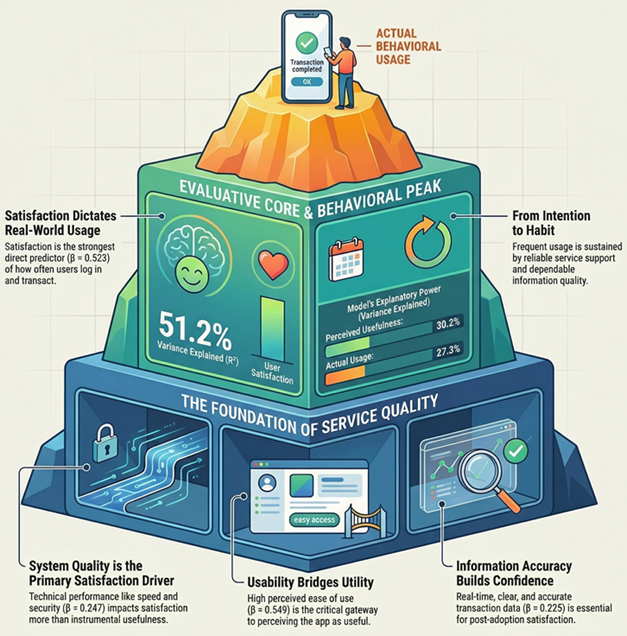
Mobile banking has become a primary channel for retail financial services in emerging economies; however, prior research has focused predominantly on initial adoption intention rather than post-adoption usage behavior. This study addresses that gap by integrating the Technology Acceptance Model and the DeLone and McLean IS Success Model to explain post-adoption mobile banking usage in Indonesia. A quantitative cross-sectional survey was conducted with 544 active users of mobile banking applications from four Indonesian state-owned banks, and the data were analyzed using PLS-SEM. The results indicate that perceived ease of use significantly enhances perceived usefulness (β = 0.549, t = 14.213, p < 0.001). In turn, perceived usefulness (β = 0.192, p < 0.001), system quality (β = 0.247, p < 0.001), information quality (β = 0.225, p = 0.001), and service quality (β = 0.195, p < 0.001) positively affect user satisfaction. User satisfaction, in turn, emerges as the strongest direct predictor of self-reported actual usage (β = 0.523, t = 12.044, p < 0.001). The model explains 30.2% of the variance in perceived usefulness, 51.2% of the variance in user satisfaction, and 27.3% of the variance in actual usage. These findings indicate that post-adoption mobile banking usage is shaped not only by cognitive acceptance beliefs but also by users’ evaluations of system performance, information quality, and service support. This study contributes to post-adoption digital banking research by demonstrating that satisfaction is the central evaluative mechanism linking acceptance beliefs and service-quality perceptions to sustained behavioral usage.
Downloads
Article Details

This work is licensed under a Creative Commons Attribution-ShareAlike 4.0 International License.
Authors who publish with this journal agree to the following terms:
- Copyright of the published article belongs to the authors and grant the journal right of first publication with the work simultaneously licensed under a Creative Commons Attribution-ShareAlike 4.0 (CC BY SA) International License that allows others to share the work with an acknowledgment of the work's authorship and initial publication in this journal.
- Authors are able to enter into separate, additional contractual arrangements for the non-exclusive distribution of the journal's published version of the work (e.g., post it to an institutional repository or publish it in a book), with an acknowledgment of its initial publication in this journal.
- Authors are permitted and encouraged to post their work online (e.g., in institutional repositories or on their website) prior to and during the submission process, as it can lead to productive exchanges, as well as earlier and greater citation of published work (See the Effect of Open Access).
References
[1] C. Neves, T. Oliveira, F. Santini, and L. Gutman, “Adoption and use of digital financial services: A meta analysis of barriers and facilitators,” Int. J. Inf. Manag. Data Insights, vol. 3, no. 2, p. 100201, 2023, https://doi.org/10.1016/j.jjimei.2023.100201
[2] G. Baptista and T. Oliveira, “Understanding mobile banking: The unified theory of acceptance and use of technology combined with cultural moderators,” Comput. Human Behav., vol. 50, pp. 418–430, 2015, https://doi.org/10.1016/j.chb.2015.04.024
[3] C. Tam and T. Oliveira, “Understanding the impact of m-banking on individual performance: DeLone & McLean and TTF perspective,” Comput. Human Behav., vol. 61, pp. 233–244, 2016, https://doi.org/10.1016/j.chb.2016.03.016
[4] R. F. Malaquias and Y. Hwang, “An empirical study on trust in mobile banking: A developing country perspective,” Comput. Human Behav., vol. 54, pp. 453–461, 2016, https://doi.org/10.1016/j.chb.2015.08.039
[5] Y. Kim, L. Wang, J. Noh, and T. Roh, “Exploring the role of innovation diffusion and trust transfer on technology acceptance: intention to use drone delivery service in China,” Asian Bus. Manag., vol. 24, no. 3, pp. 357–384, 2025, https://doi.org/10.1057/s41291-025-00302-y
[6] A. Bhattacherjee, “Understanding information systems continuance: An expectation-confirmation model,” MIS Q. Manag. Inf. Syst., vol. 25, no. 3, pp. 351–370, 2001, https://doi.org/10.2307/3250921
[7] M. K. Anam, A. Yunianta, H. J. Alyamani, Erlin, A. Zamsuri, and M. B. Firdaus, “Analysis and Identification of Non-Impact Factors in Smart City Readiness Using Technology Acceptance Analysis: a Case Study in Kampar District, Indonesia,” J. Appl. Eng. Technol. Sci., vol. 5, no. 1, pp. 1–17, 2023, https://doi.org/10.37385/jaets.v5i1.2401
[8] Syaifullah, S. A. Ariffin, and N. M. Nordin, “Mobile Tourism Research and Practices: a Comprehensive Bibliometric Exploration and Future Study Direction,” J. Appl. Eng. Technol. Sci., vol. 6, no. 1, pp. 21–47, 2024, https://doi.org/10.37385/jaets.v6i1.4970
[9] N. Souiden, R. Ladhari, and W. Chaouali, “Mobile banking adoption: a systematic review,” Int. J. Bank Mark., vol. 39, no. 2, pp. 214–241, 2021, https://doi.org/10.1108/IJBM-04-2020-0182
[10] C. Tam and T. Oliveira, “Literature review of mobile banking and individual performance,” Int. J. Bank Mark., vol. 35, no. 7, pp. 1042–1065, 2017, https://doi.org/10.1108/IJBM-09-2015-0143
[11] M. Naeem, S. T. Jawaid, and S. Mustafa, “Evolution of modified TAM associated with e-banking services adoption: a systematic PRISMA review from 1975 to 2021,” J. Model. Manag., vol. 18, no. 3, pp. 942–972, 2023, https://doi.org/10.1108/JM2-10-2021-0251
[12] J. P. Shaji, K. S. Shyna, G. R. Maria, and S. Rohit, “Technology Adoption in Banking Sector: A Systematic Literature Review of TAM and UTAUT Models,” Stud. Syst. Decis. Control, vol. 236, pp. 205–211, 2025, https://doi.org/10.1007/978-3-031-86712-5_17
[13] H. Ho, S. M. Han, J. Cha, and L. Pham, “Mobile Banking Customer Satisfaction and Loyalty: The Roles of Technology Readiness,” J. Risk Financ. Manag., vol. 18, no. 7, p. 403, 2025, https://doi.org/10.3390/jrfm18070403
[14] M. Ghobakhloo and M. Fathi, “Modeling the success of application-based mobile banking,” Economies, vol. 7, no. 4, p. 114, 2019, https://doi.org/10.3390/economies7040114
[15] N. Bui, Z. Moore, H. Wimmer, and L. Pham, “Predicting Customer Loyalty in the Mobile Banking Setting: An Integrated Approach,” Int. J. E-Services Mob. Appl., vol. 14, no. 1, pp. 1–22, 2022, https://doi.org/10.4018/IJESMA.296576
[16] F. D. Davis, “Perceived usefulness, perceived ease of use, and user acceptance of information technology,” MIS Q. Manag. Inf. Syst., vol. 13, no. 3, pp. 319–339, 1989, https://doi.org/10.2307/249008
[17] V. Venkatesh and F. D. Davis, “Theoretical extension of the Technology Acceptance Model: Four longitudinal field studies,” Manage. Sci., vol. 46, no. 2, pp. 186–204, 2000, https://doi.org/10.1287/mnsc.46.2.186.11926
[18] W. H. DeLone and E. R. McLean, “Information Systems Success Measurement,” Inf. Syst. Success Meas., vol. 2, no. 1, pp. 1–116, 2016, https://doi.org/10.1561/9781680831436
[19] S. Petter, W. DeLone, and E. McLean, “Measuring information systems success: Models, dimensions, measures, and interrelationships,” Eur. J. Inf. Syst., vol. 17, no. 3, pp. 236–263, 2008, https://doi.org/10.1057/ejis.2008.15
[20] Y. S. Wang and Y. W. Liao, “Assessing eGovernment systems success: A validation of the DeLone and McLean model of information systems success,” Gov. Inf. Q., vol. 25, no. 4, pp. 717–733, 2008, https://doi.org/10.1016/j.giq.2007.06.002
[21] N. Gorla, T. M. Somers, and B. Wong, “Organizational impact of system quality, information quality, and service quality,” J. Strateg. Inf. Syst., vol. 19, no. 3, pp. 207–228, 2010, https://doi.org/10.1016/j.jsis.2010.05.001
[22] M. Jun and S. Palacios, “Examining the key dimensions of mobile banking service quality: an exploratory study,” Int. J. Bank Mark., vol. 34, no. 3, pp. 307–326, 2016, https://doi.org/10.1108/IJBM-01-2015-0015
[23] A. G. Khan, R. P. Lima, and M. S. Mahmud, “Understanding the Service Quality and Customer Satisfaction of Mobile Banking in Bangladesh: Using a Structural Equation Model,” Glob. Bus. Rev., vol. 22, no. 1, pp. 85–100, 2021, https://doi.org/10.1177/0972150918795551
[24] S. Kamboj, M. Sharma, and B. Sarmah, “Impact of mobile banking failure on bank customers’ usage behaviour: the mediating role of user satisfaction,” Int. J. Bank Mark., vol. 40, no. 1, pp. 128–153, 2022, https://doi.org/10.1108/IJBM-10-2020-0534
[25] M. Arcand, S. PromTep, I. Brun, and L. Rajaobelina, “Mobile banking service quality and customer relationships,” Int. J. Bank Mark., vol. 35, no. 7, pp. 1066–1087, 2017, https://doi.org/10.1108/IJBM-10-2015-0150
[26] T. Orehovački, L. Blašković, and M. Kurevija, “Evaluating the Perceived Quality of Mobile Banking Applications in Croatia: An Empirical Study,” Futur. Internet, vol. 15, no. 1, p. 8, 2023, https://doi.org/10.3390/fi15010008
[27] P. Kumar, S. Chauhan, S. Kumar, and P. Gupta, “A meta-analysis of satisfaction in mobile banking: a contextual examination,” Int. J. Bank Mark., vol. 42, no. 3, pp. 357–388, 2024, https://doi.org/10.1108/IJBM-04-2023-0236
[28] N. Palamidovska-Sterjadovska et al., “Service quality in mobile banking,” Int. J. Bank Mark., vol. 43, no. 6, pp. 1195–1230, 2025, https://doi.org/10.1108/IJBM-02-2024-0105
[29] S. K. Sharma, “Integrating cognitive antecedents into TAM to explain mobile banking behavioral intention: A SEM-neural network modeling,” Inf. Syst. Front., vol. 21, no. 4, pp. 815–827, 2019, https://doi.org/10.1007/s10796-017-9775-x
[30] P. Raman and K. Aashish, “To continue or not to continue: a structural analysis of antecedents of mobile payment systems in India,” Int. J. Bank Mark., vol. 39, no. 2, pp. 242–271, 2021, https://doi.org/10.1108/IJBM-04-2020-0167
[31] X. Chen and S. Li, “Understanding continuance intention of mobile payment services: An empirical study,” J. Comput. Inf. Syst., vol. 57, no. 4, pp. 287–298, 2017, https://doi.org/10.1080/08874417.2016.1180649
[32] S. Yuan, L. Liu, B. Su, and H. Zhang, “Determining the antecedents of mobile payment loyalty: Cognitive and affective perspectives,” Electron. Commer. Res. Appl., vol. 41, p. 100971, 2020, https://doi.org/10.1016/j.elerap.2020.100971
[33] W. H. DeLone and E. R. McLean, “The DeLone and McLean model of information systems success: A ten-year update,” J. Manag. Inf. Syst., vol. 19, no. 4, pp. 9–30, 2003, https://doi.org/10.1080/07421222.2003.11045748
[34] S. K. Sharma and M. Sharma, “Examining the role of trust and quality dimensions in the actual usage of mobile banking services: An empirical investigation,” Int. J. Inf. Manage., vol. 44, pp. 65–75, 2019, https://doi.org/10.1016/j.ijinfomgt.2018.09.013
[35] F. D. Davis, R. P. Bagozzi, and P. R. Warshaw, “User Acceptance of Computer Technology: A Comparison of Two Theoretical Models,” Manage. Sci., vol. 35, no. 8, pp. 982–1003, 1989.
[36] A. Jeyaraj, “DeLone & McLean models of information system success: Critical meta-review and research directions,” Int. J. Inf. Manage., vol. 54, p. 102139, 2020, https://doi.org/10.1016/j.ijinfomgt.2020.102139
[37] Q. Zhou et al., “A study on factors affecting service quality and loyalty intention in mobile banking,” J. Retail. Consum. Serv., vol. 60, p. 102424, 2021, https://doi.org/10.1016/j.jretconser.2020.102424
[38] J.-C. Gu, S.-C. Lee, and Y.-H. Suh, “Determinants of behavioral intention to mobile banking,” Expert Syst. Appl., vol. 36, no. 9, pp. 11605–11616, 2009, https://doi.org/10.1016/j.eswa.2009.03.024
[39] M. T. Lu, G. H. Tzeng, H. Cheng, and C. C. Hsu, “Exploring mobile banking services for user behavior in intention adoption: using new hybrid MADM model,” Serv. Bus., vol. 9, no. 3, pp. 541–565, 2015, https://doi.org/10.1007/s11628-014-0239-9
[40] V. Venkatesh and H. Bala, “Technology acceptance model 3 and a research agenda on interventions,” Decis. Sci., vol. 39, no. 2, pp. 273–315, 2008, https://doi.org/10.1111/j.1540-5915.2008.00192.x
[41] L. M. Maruping, H. Bala, V. Venkatesh, and S. A. Brown, “Going beyond intention: Integrating behavioral expectation into the unified theory of acceptance and use of technology,” J. Assoc. Inf. Sci. Technol., vol. 68, no. 3, pp. 623–637, 2017, https://doi.org/10.1002/asi.23699
[42] A. S. Al-Adwan, N. Li, A. Al-Adwan, G. A. Abbasi, N. A. Albelbisi, and A. Habibi, ““Extending the Technology Acceptance Model (TAM) to Predict University Students’ Intentions to Use Metaverse-Based Learning Platforms”,” Educ. Inf. Technol., vol. 28, no. 11, pp. 15381–15413, 2023, https://doi.org/10.1007/s10639-023-11816-3
[43] A. T. Lee, R. K. Ramasamy, and A. Subbarao, “Understanding Psychosocial Barriers to Healthcare Technology Adoption: A Review of TAM Technology Acceptance Model and Unified Theory of Acceptance and Use of Technology and UTAUT Frameworks,” in Healthcare (Switzerland), 2025, vol. 13, no. 3, p. 250. https://doi.org/10.3390/healthcare13030250
[44] S. H. Alshammari and E. Babu, “The mediating role of satisfaction in the relationship between perceived usefulness, perceived ease of use and students’ behavioural intention to use ChatGPT,” Sci. Rep., vol. 15, no. 1, p. 7169, 2025, https://doi.org/10.1038/s41598-025-91634-4
[45] S. Kumar, S. Chawla, P. Kumar, and A. Arora, “An empirical investigation on mobile payments users’ experience: insights using PLS-SEM approach,” TQM J., pp. 1–26, 2025, https://doi.org/10.1108/TQM-01-2025-0044
[46] J. Schrank, “The impact of artificial intelligence on behavioral intentions to use mobile banking in the post-COVID-19 era,” Front. Artif. Intell., vol. 8, p. 1649392, 2025, https://doi.org/10.3389/frai.2025.1649392
[47] Y. T. H. Nguyen, T. Tapanainen, and H. T. T. Nguyen, “Reputation and its consequences in Fintech services: the case of mobile banking,” Int. J. Bank Mark., vol. 40, no. 7, pp. 1364–1397, 2022, https://doi.org/10.1108/IJBM-08-2021-0371
[48] C. H. Sampaio, W. J. Ladeira, and F. D. O. Santini, “Apps for mobile banking and customer satisfaction: a cross-cultural study,” Int. J. Bank Mark., vol. 35, no. 7, pp. 1131–1151, 2017, https://doi.org/10.1108/IJBM-09-2015-0146
[49] T. Zhang, C. Lu, and M. Kizildag, “Banking ‘on-the-go’: examining consumers’ adoption of mobile banking services,” Int. J. Qual. Serv. Sci., vol. 10, no. 3, pp. 279–295, 2018.
[50] A. A. Shaikh and H. Karjaluoto, “Mobile banking adoption: A literature review,” Telemat. Informatics, vol. 32, no. 1, pp. 129–142, 2015, https://doi.org/10.1016/j.tele.2014.05.003
[51] D. Suhartanto, D. Dean, T. A. T. Ismail, and R. Sundari, “Mobile banking adoption in Islamic banks: Integrating TAM model and religiosity-intention model,” J. Islam. Mark., vol. 11, no. 6, pp. 1405–1418, 2020, https://doi.org/10.1108/JIMA-05-2019-0096
[52] E. M. Abu-Taieh et al., “Continued Intention to Use of M-Banking in Jordan by Integrating UTAUT, TPB, TAM and Service Quality with ML,” J. Open Innov. Technol. Mark. Complex., vol. 8, no. 3, p. 120, 2022, https://doi.org/10.3390/joitmc8030120
[53] A. M. Baabdullah, A. A. Alalwan, N. P. Rana, H. Kizgin, and P. Patil, “Consumer use of mobile banking (M-Banking) in Saudi Arabia: Towards an integrated model,” Int. J. Inf. Manage., vol. 44, pp. 38–52, 2019, https://doi.org/10.1016/j.ijinfomgt.2018.09.002
[54] A. Geebren and A. Jabbar, “Antecedents of Trust in Mobile Banking: Do They Differ Across Gender, Customer Experience and Frequency of Use?,” Inf. Syst. Manag., vol. 42, no. 4, pp. 598–621, 2025, https://doi.org/10.1080/10580530.2025.2506365
[55] L. Pokhrel, A. K C, and B. K. Shrestha, “Does mobile banking service quality matter? A two-staged structural equation modeling-artificial neural network approach,” J. Mark. Anal., p. 1, 2024, https://doi.org/10.1057/s41270-024-00363-6
[56] A. Bhattacherjee, “Understanding information systems continuance,” MIS Q., vol. 25, no. 3, pp. 351–370, 2001, https://doi.org/10.2307/3250921
[57] P. Pietrzak and M. Roman, “Examining the role of trust in the usage of mobile banking services: An empirical investigation from Poland,” Trust Digit. Bus. Theory Pract., vol. 44, pp. 245–255, 2022, https://doi.org/10.4324/9781003266525-21
[58] N. Urbach and B. Müller, “The Updated DeLone and McLean Model of Information Systems Success,” in Information Systems Theory: Explaining and Predicting Our Digital Society, Vol. 1, Springer, 2012, pp. 1–18. https://doi.org/10.1007/978-1-4419-6108-2_1
[59] J. F. Hair Jr., L. M. Matthews, R. L. Matthews, and M. Sarstedt, “PLS-SEM or CB-SEM: updated guidelines on which method to use,” Int. J. Multivar. Data Anal., vol. 1, no. 2, p. 107, 2017, https://doi.org/10.1504/ijmda.2017.10008574
[60] J. F. Hair, B. J. Babin, R. E. Anderson, and W. C. Black, Multivariate Data Analysis. Belmont, CA: Cengage Learning, 2022.
[61] M. Sarstedt, C. M. Ringle, and J. F. Hair, Partial Least Squares Structural Equation Modeling. Asheboro, USA: Statistical Publishing Associates, 2021. https://doi.org/10.1007/978-3-319-57413-4_15
[62] J. F. Hair, G. T. M. Hult, C. M. Ringle, and M. Sarstedt, A Primer on Partial Least Squares Structural Equation Modeling (PLS-SEM), 3rd ed. Thousand Oaks, CA: SAGE Publications Inc., 2021.
[63] G. O. Boateng, T. B. Neilands, E. A. Frongillo, H. R. Melgar-Quiñonez, and S. L. Young, “Best Practices for Developing and Validating Scales for Health, Social, and Behavioral Research: A Primer,” Front. Public Heal., vol. 6, p. 149, 2018, https://doi.org/10.3389/fpubh.2018.00149
[64] D. C. Miller and N. J. Salkind, Handbook of Research Design & Social Measurement. London, United Kingdom: SAGE Publications, 2002.
[65] P. M. Podsakoff, S. B. MacKenzie, J. Y. Lee, and N. P. Podsakoff, “Common Method Biases in Behavioral Research: A Critical Review of the Literature and Recommended Remedies,” J. Appl. Psychol., vol. 88, no. 5, pp. 879–903, 2003, https://doi.org/10.1037/0021-9010.88.5.879
[66] World Medical Association, “World Medical Association Declaration of Helsinki: ethical principles for medical research involving human subjects,” Jama, vol. 310, no. 20, pp. 2191–2194, 2013.
[67] P. M. Podsakoff, S. B. MacKenzie, and N. P. Podsakoff, “Sources of method bias in social science research and recommendations on how to control it,” Annu. Rev. Psychol., vol. 63, no. 1, pp. 539–569, 2012, https://doi.org/10.1146/annurev-psych-120710-100452
[68] J. F. Hair, W. C. Black, B. J. Babin, R. E. Anderson, and R. L. Tatham, Multivariate Data Analysis, 8th ed. Edinburgh Gate, Harlow: Pearson Education Limited, 2019.
[69] C. M. Ringle, S. Wende, and J.-M. Becker, “SmartPLS 4,” Bönningstedt: SmartPLS, 2024. https://www.smartpls.com
[70] J. F. Hair, J. J. Risher, M. Sarstedt, and C. M. Ringle, “When to use and how to report the results of PLS-SEM,” Eur. Bus. Rev., vol. 31, no. 1, pp. 2–24, 2019, https://doi.org/10.1108/EBR-11-2018-0203
[71] C. Fornell and D. F. Larcker, “Evaluating Structural Equation Models with Unobservable Variables and Measurement Error,” J. Mark. Res., vol. 18, no. 1, p. 39, 1981, https://doi.org/10.2307/3151312
[72] J. Henseler, C. M. Ringle, and M. Sarstedt, “A new criterion for assessing discriminant validity in variance-based structural equation modeling,” J. Acad. Mark. Sci., vol. 43, no. 1, pp. 115–135, 2015, https://doi.org/10.1007/s11747-014-0403-8
[73] P. W. Fombelle et al., “Customer deviance: A framework, prevention strategies, and opportunities for future research,” J. Bus. Res., vol. 116, pp. 387–400, 2020, https://doi.org/10.1016/j.jbusres.2019.09.012
[74] K. Kohli, B. Kumar, P. Kohli, and M. Kashyap, “Examining the factors affecting mobile banking adoption among users in the Himalayan region of Uttarakhand: an extension of the technology acceptance model through structural equation modelling,” Int. J. Electron. Bank., vol. 4, no. 3, pp. 294–317, 2024, https://doi.org/10.1504/ijebank.2024.139221
[75] C. Tam and T. Oliveira, “Understanding mobile banking individual performance: The DeLone & McLean model and the moderating effects of individual culture,” Internet Res., vol. 27, no. 3, pp. 538–562, 2017, https://doi.org/10.1108/IntR-05-2016-0117
[76] S. Syaifullah, S. A. Ariffin, and N. M. Nordin, “Acceptance of Culture Mobile Tourism Among Tourist: A Model Development Study,” J. Appl. Eng. Technol. Sci., vol. 7, no. 1, pp. 356–375, 2025, https://doi.org/10.37385/jaets.v7i1.7588
[77] S. N. Faizah, L. N. A. B. Dina, A. Kartiko, M. A. Ma’arif, and M. S. roni Hasan, “Student Acceptance Study of Phet Simulation With an Expanded Technology Acceptance Model Approach,” J. Appl. Eng. Technol. Sci., vol. 5, no. 1, pp. 279–290, 2023, https://doi.org/10.37385/jaets.v5i1.3041
[78] A. A. Zulfahmi, R. Sadikin, and E. H. Hermaliani, “Hybrid Between Pieces Framework and Technology Acceptance Model (TAM) in Quality Testing of Mobile Application Office Automation System (Kemenkeu),” J. Appl. Eng. Technol. Sci., vol. 4, no. 1, pp. 286–306, 2022, https://doi.org/10.37385/jaets.v4i1.1087
[79] A. Shankar, B. Datta, and C. Jebarajakirthy, “Are the Generic Scales Enough to Measure Service Quality of Mobile Banking? A Comparative Analysis of Generic Service Quality Measurement Scales to Mobile Banking Context,” Serv. Mark. Q., vol. 40, no. 3, pp. 224–244, 2019, https://doi.org/10.1080/15332969.2019.1630176
[80] R. B. Mostafa, “Mobile banking service quality: a new avenue for customer value co-creation,” Int. J. Bank Mark., vol. 38, no. 5, pp. 1107–1132, 2020, https://doi.org/10.1108/IJBM-11-2019-0421
[81] A. Geebren, A. Jabbar, and M. Luo, “Examining the role of consumer satisfaction within mobile eco-systems: Evidence from mobile banking services,” Comput. Human Behav., vol. 114, p. 106584, 2021, https://doi.org/10.1016/j.chb.2020.106584
[82] M. Che et al., “Investigating customers’ continuous trust towards mobile banking apps,” Humanit. Soc. Sci. Commun., vol. 10, no. 1, pp. 1–10, 2023, https://doi.org/10.1057/s41599-023-02483-3
[83] L. Pokhrel and A. K.C, “Mobile banking service quality and continuance intention: mediating role of satisfaction: a two-stage structural equation modeling-artificial neural network approach,” Int. J. Bank Mark., vol. 42, no. 3, pp. 389–413, 2024, https://doi.org/10.1108/IJBM-11-2022-0512
[84] S. Kamboj, M. Matharu, W. M. Lim, F. Ali, and S. Kumar, “Consumer adoption of green hotels: understanding the role of value, innovation, and involvement,” J. Hosp. Mark. Manag., vol. 31, no. 7, pp. 819–849, 2022, https://doi.org/10.1080/19368623.2022.2071370
[85] B. H. Leem and S. W. Eum, “Using text mining to measure mobile banking service quality,” Ind. Manag. Data Syst., vol. 121, no. 5, pp. 993–1007, 2021, https://doi.org/10.1108/IMDS-09-2020-0545
[86] L. Çallı, “Exploring mobile banking adoption and service quality features through user-generated content: the application of a topic modeling approach to Google Play Store reviews,” Int. J. Bank Mark., vol. 41, no. 2, pp. 428–454, 2023, https://doi.org/10.1108/IJBM-08-2022-0351
[87] A. Hussain, A. Hannan, and M. Shafiq, “Exploring mobile banking service quality dimensions in Pakistan: a text mining approach,” Int. J. Bank Mark., vol. 41, no. 3, pp. 601–618, 2023, https://doi.org/10.1108/IJBM-08-2022-0379
[88] A. A. Pham and D. Bui, “Understanding mobile Banking Loyalty Among Vietnamese Gen Z and Millennials: The Impact of Service Quality and Relative Advantage,” J. Glob. Inf. Technol. Manag., vol. 28, no. 4, pp. 322–339, 2025, https://doi.org/10.1080/1097198X.2025.2568338
[89] A. Ciunova-Shuleska, N. Palamidovska-Sterjadovska, and J. Prodanova, “What drives m-banking clients to continue using m-banking services?,” J. Bus. Res., vol. 139, pp. 731–739, 2022, https://doi.org/10.1016/j.jbusres.2021.10.024
[90] A. Geebren and A. Jabbar, “Factors that influence customer trust and satisfaction in mobile banking: A problematization approach,” Int. J. E-bus. Res., vol. 17, no. 3, pp. 66–82, 2021, https://doi.org/10.4018/IJEBR.2021070105
[91] J. R. Rodriguez-Barboza et al., “Posthumanist Technologies in Business: AI and Cloud Computing for Global Optimization and Ethical Challenges,” Adv. Sustain. Sci. Eng. Technol., vol. 6, no. 4, 2024, https://doi.org/10.26877/asset.v6i4.1064
[92] N. A. Khumaira and M. T. Safirin, “Impact of Employee Placement, Motivation, and Career Development on Performance and Productivity at Bank XYZ Using PLS-SEM,” Adv. Sustain. Sci. Eng. Technol., vol. 7, no. 1, 2025, https://doi.org/10.26877/asset.v7i1.662