
Effect of Vortex-Generator Planform and Height on the Trade-Off between Lift Enhancement and Wake Contraction around a Circular Cylinder
Article Sidebar
Main Article Content
Abstract
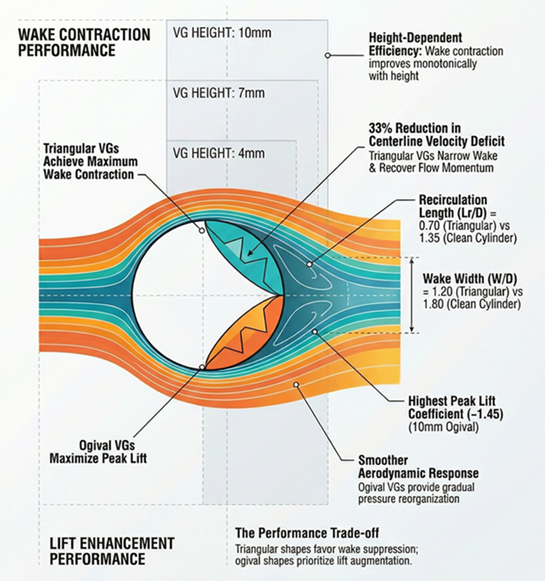
Passive flow control of circular-cylinder wakes remains important because wake organizations govern aerodynamic loading, force fluctuations, and vortex-induced response. This study examines how vortex-generator (VG) planform and height affect lift behavior and near-wake structure around a circular cylinder. Triangular and ogival VGs with heights of 4, 7, and 10 mm were mounted at the cylinder apex and evaluated using three-dimensional transient URANS simulations with the SST k–ω model at Re = 53,000. Supporting wind-tunnel force measurements were also performed to assess whether the numerical trends were qualitatively reproduced experimentally. All VG-equipped configurations reduced the recirculation region, narrowed the wake, and decreased the centerline velocity deficit relative to the clean cylinder. Among the triangular cases, the 10 mm VG produced the strongest wake contraction, reducing the recirculation length from 1.35D to 0.70D. Among the ogival cases, the 10 mm VG generated the highest peak lift coefficient (approximately 1.45), although its wake contraction remained slightly weaker than that of the corresponding triangular configuration. These results show that the geometry yielding the strongest wake suppression is not identical to that giving the highest lift enhancement. The wind-tunnel measurements reproduced the overall ranking trends. However, because the experimental inflow conditions were not Reynolds-number matched to the numerical setup, the comparison is interpreted as qualitative trend support rather than strict validation. The results demonstrate that the VG planform and height jointly control the trade-off between wake contraction and lift enhancement.
Downloads
Article Details

This work is licensed under a Creative Commons Attribution-ShareAlike 4.0 International License.
Authors who publish with this journal agree to the following terms:
- Copyright of the published article belongs to the authors and grant the journal right of first publication with the work simultaneously licensed under a Creative Commons Attribution-ShareAlike 4.0 (CC BY SA) International License that allows others to share the work with an acknowledgment of the work's authorship and initial publication in this journal.
- Authors are able to enter into separate, additional contractual arrangements for the non-exclusive distribution of the journal's published version of the work (e.g., post it to an institutional repository or publish it in a book), with an acknowledgment of its initial publication in this journal.
- Authors are permitted and encouraged to post their work online (e.g., in institutional repositories or on their website) prior to and during the submission process, as it can lead to productive exchanges, as well as earlier and greater citation of published work (See the Effect of Open Access).
References
[1] B. L. Storms and C. S. Jang, “Lift enhancement of an airfoil using a Gurney flap and vortex generators,” J. Aircr., vol. 31, no. 3, pp. 542–547, 1994, https://doi.org/10.2514/3.46528
[2] B. Gardarin, L. Jacquin, and P. Geffroy, “Flow separation control with vortex generators,” in 4th AIAA Flow Control Conference, 2008, p. 3773. https://doi.org/10.2514/6.2008-3773
[3] D. Baldacchino, C. Ferreira, D. De Tavernier, W. A. Timmer, and G. J. W. van Bussel, “Experimental parameter study for passive vortex generators on a 30% thick airfoil,” Wind Energy, vol. 21, no. 9, pp. 745–765, 2018, https://doi.org/10.1002/we.2191
[4] W. J. Crowther, M. Jabbal, and S. C. Liddle, “Flow control fallacies: A review of commonpitfalls in flow control research,” Proc. Inst. Mech. Eng. Part G J. Aerosp. Eng., vol. 225, no. 1, pp. 1–11, 2011, https://doi.org/10.1243/09544100JAERO761
[5] S. Lee et al., “A Review of Flow Control Strategies for Supersonic/Hypersonic Fluid Dynamics,” Aerosp. Res. Commun., vol. 2, p. 13149, 2024, https://doi.org/10.3389/arc.2024.13149
[6] J. Wang et al., “Low Drag Automotive Mirrors Using Passive Jet Flow Control,” SAE Int. J. Passeng. Cars - Mech. Syst., vol. 7, no. 2, pp. 538–549, 2014, https://doi.org/10.4271/2014-01-0584
[7] M. J. Bloxham and J. P. Bons, “A global approach to turbomachinery flow control: Passage vortex control,” J. Turbomach., vol. 136, no. 4, p. 41003, 2013, https://doi.org/10.1115/1.4024686
[8] M. G. De Giorgi, F. Marra, E. Pescini, and A. Ficarella, “Experimental and numerical analysis of a micro plasma actuator for active flow control in turbomachinery,” in Proceedings of the ASME Turbo Expo, 2014, vol. 2A, p. V02AT37A011. https://doi.org/10.1115/GT2014-25337
[9] H. Hatoum and L. P. Dasi, “Reduction of Pressure Gradient and Turbulence Using Vortex Generators in Prosthetic Heart Valves,” Ann. Biomed. Eng., vol. 47, no. 1, pp. 85–96, 2019, https://doi.org/10.1007/s10439-018-02128-6
[10] J. B. R. Rose, S. G. Natarajan, and V. T. Gopinathan, “Biomimetic flow control techniques for aerospace applications: a comprehensive review,” Rev. Environ. Sci. Biotechnol., vol. 20, no. 3, pp. 645–677, 2021, https://doi.org/10.1007/s11157-021-09583-z
[11] T. R. Johnson and P. N. Joubert, “The influence of vortex generators on the drag and heat transfer from a circular cylinder normal to an airstream,” J. Heat Transfer, vol. 91, no. 1, pp. 91–99, 1969, https://doi.org/10.1115/1.3580126
[12] M. Saleem, A. Karnam, O. Rodriguez, J. Liu, and E. Gutmark, “Flow and acoustic fields investigation of noise reduction by micro vortex generators in supersonic nozzles,” Phys. Fluids, vol. 35, no. 10, 2023, https://doi.org/10.1063/5.0170104
[13] T. Igarashi, “Effect of Tripping Wires on the Flow Around a Circular Cylinder Normal To an Airstream.,” Bull. JSME, vol. 29, no. 255, pp. 2917–2924, 1986, https://doi.org/10.1299/jsme1958.29.2917
[14] R. M. J. Groh and J. Croll, “Towards Tolerance Specifications for the Elastic Buckling Design of Axially Loaded Cylinders,” J. Appl. Mech. Trans. ASME, vol. 91, no. 1, p. 11004, 2024, https://doi.org/10.1115/1.4063032
[15] D. C. McCormick, “Boundary layer separation control with directed synthetic jets,” in 38th Aerospace Sciences Meeting and Exhibit, 2000, p. 519. https://doi.org/10.2514/6.2000-519
[16] M. Abdollahzadeh, J. C. Pascoa, and P. J. Oliveira, “Comparison of DBD plasma actuators flow control authority in different modes of actuation,” Aerosp. Sci. Technol., vol. 78, pp. 183–196, 2018, https://doi.org/10.1016/j.ast.2018.04.013
[17] K. Jayanarasimhan and N. K. Balasubramanian, “Passive flow control in wind turbine blade by geometrical optimization of vortex generator,” in E3S Web of Conferences, 2023, vol. 399, p. 3006. https://doi.org/10.1051/e3sconf/202339903006
[18] K. S. Choi, “Smart flow control with riblets,” Adv. Mater. Res., vol. 745, pp. 27–40, 2013, https://doi.org/10.4028/www.scientific.net/AMR.745.27
[19] T. Igarashi, “Effect of Vortex Generators on the Flow Around a Circular Cylinder Normal To an Airstream.,” in Bulletin of the JSME, 1985, vol. 28, no. 236, pp. 274–282. https://doi.org/10.1299/jsme1958.28.274
[20] D. Shiels, A. Leonard, and A. Roshko, “Flow-induced vibration of a circular cylinder at limiting structural parameters,” J. Food Compos. Anal., vol. 15, no. 1, pp. 3–21, 2002.
[21] H. C. Lim and S. J. Lee, “Flow control of a circular cylinder with O-rings,” Fluid Dyn. Res., vol. 35, no. 2, pp. 107–122, 2004, https://doi.org/10.1016/j.fluiddyn.2004.05.001
[22] J. Wang and Y. Zhao, “Heat and fluid flow characteristics of a rectangular channel with a small diameter circular cylinder as vortex generator,” Int. J. Therm. Sci., vol. 92, pp. 1–13, 2015, https://doi.org/10.1016/j.ijthermalsci.2015.01.018
[23] A. Izhar, A. H. Qureshi, and S. Khushnood, “Simulation of vortex-induced vibrations of a cylinder using ANSYS CFX rigid body solver,” China Ocean Eng., vol. 31, no. 1, pp. 79–90, 2017, https://doi.org/10.1007/s13344-017-0010-9
[24] H. Yu, W. L. Chen, H. Li, F. Auteri, and D. Gao, “Control of cylinder wake dynamics with symmetric synthetic jets near the flow separation points,” Exp. Fluids, vol. 67, no. 2, p. 16, 2026, https://doi.org/10.1007/s00348-026-04171-9
[25] H. Jiang, “Separation angle for flow past a circular cylinder in the subcritical regime,” Phys. Fluids, vol. 32, no. 1, 2020, https://doi.org/10.1063/1.5139479
[26] A. K. Soti and A. De, “Vortex-induced vibrations of a confined circular cylinder for efficient flow power extraction,” Phys. Fluids, vol. 32, no. 3, 2020, https://doi.org/10.1063/1.5131334
[27] M. Chatzimanolakis, P. Weber, and P. Koumoutsakos, “Vortex separation cascades in simulations of the planar flow past an impulsively started cylinder up to,” J. Fluid Mech., vol. 953, p. R2, 2022, https://doi.org/10.1017/jfm.2022.988
[28] M. Gong and B. Dally, “Dynamic response of a cylinder-plate-cylinder system coupling wake-induced and interference effects,” Phys. Fluids, vol. 37, no. 10, 2025, https://doi.org/10.1063/5.0289251
[29] B. Li, Y. Li, and T. Li, “Numerical investigation on the flow past circular cylinders with modification of partially covered V-shaped riblets in the subcritical regime using large eddy simulation,” Phys. Fluids, vol. 38, no. 2, 2026, https://doi.org/10.1063/5.0311108
[30] U. Fernandez-Gamiz, I. Errasti, R. Gutierrez-Amo, A. Boyano, and O. Barambones, “Computational modelling of rectangular sub-boundary layer vortex generators,” Appl. Sci., vol. 8, no. 1, p. 138, 2018, https://doi.org/10.3390/app8010138
[31] H. D. Taylor, “Design Criteria For And Applications Of The Vortex Generator Mixing Principal,” National Advisory Committee for Aeronautics, 1948. [Online]. Available: https://ntrs.nasa.gov/api/citations/19680068324/downloads/19680068324_Update.pdf
[32] G. W. Gyatt, “Development and testing of vortex generators for small horizontal axis wind turbines,” AeroVironment, Inc., Monrovia, CA (USA), 1986. [Online]. Available: http://www.osti.gov/energycitations/product.biblio.jsp?osti_id=6801076
[33] M. Kobayashi and H. Maekawa, “Turbulent flow accompanied by Taylor-Goertler vortices in a two-dimensional curved channel,” Flow Meas. Instrum., vol. 6, no. 2, pp. 93–100, 1995.
[34] U. O. Ünal and M. Atlar, “An experimental investigation into the effect of vortex generators on the near-wake flow of a circular cylinder,” Exp. Fluids, vol. 48, no. 6, pp. 1059–1079, 2010, https://doi.org/10.1007/s00348-009-0791-6
[35] A. Aziz, Y. Zhang, and C. Gang, “Computational Studies of Passive Vortex Generators for Flow Control on High-Speed Train,” in Sustainable Civil Infrastructures, 2021, vol. Part 32, pp. 95–108. https://doi.org/10.1007/978-3-030-79641-9_7
[36] K. Jayanarasimhan and N. K. Balasubramanian, “An overview of flow control in aerodynamic surfaces using vortex generators,” Phys. Fluids, vol. 37, no. 3, 2025, https://doi.org/10.1063/5.0260937
[37] N. K. Balasubramanian, K. Jayanarasimhan, M. Nagaraj, and M. Sivasankari, “Computational Optimization of Flow Control over Aircraft Wing Section using Vortex Generators,” Int. J. Adv. Sci. Eng., vol. 12, no. 1, pp. 5007–5016, 2025, https://doi.org/10.29294/IJASE.12.1.2025.5007-5016
[38] M. T. Baissi, A. Brima, K. Aoues, R. Khanniche, and N. Moummi, “Thermal behavior in a solar air heater channel roughened with delta-shaped vortex generators,” Appl. Therm. Eng., vol. 165, p. 113563, 2020, https://doi.org/10.1016/j.applthermaleng.2019.03.134
[39] R. Maouedj, Y. Menni, M. Inc, Y. M. Chu, H. Ameur, and G. Lorenzini, “Simulating the Turbulent Hydrothermal Behavior of Oil/MWCNT Nanofluid in a Solar Channel Heat Exchanger Equipped with Vortex Generators,” C. - Comput. Model. Eng. Sci., vol. 126, no. 3, pp. 855–889, 2021, https://doi.org/10.32604/cmes.2021.014524
[40] A. Okbaz, M. H. Aksoy, N. Kurtulmuş, and A. B. Çolak, “Flow control over a circular cylinder using vortex generators: Particle image velocimetry analysis and machine-learning-based prediction of flow characteristics,” Ocean Eng., vol. 288, p. 116055, 2023, https://doi.org/10.1016/j.oceaneng.2023.116055
[41] M. H. Aksoy, “Flow characteristics and passive flow control of circular cylinders with triangular vortex generators: An experimental investigation,” Appl. Ocean Res., vol. 142, p. 103836, 2024, https://doi.org/10.1016/j.apor.2023.103836
[42] Y. Wang, J. Wang, W. Zhang, and Z. Zhao, “Performance optimization of plate-fin heat exchanger with curved vortex generators based on response surface method,” Int. J. Therm. Sci., vol. 210, p. 109659, 2025, https://doi.org/10.1016/j.ijthermalsci.2024.109659
[43] S. Muddada and B. S. V. Patnaik, “An active flow control strategy for the suppression of vortex structures behind a circular cylinder,” Eur. J. Mech. B/Fluids, vol. 29, no. 2, pp. 93–104, 2010, https://doi.org/10.1016/j.euromechflu.2009.11.002
[44] J. C. Schulmeister, J. M. Dahl, G. D. Weymouth, and M. S. Triantafyllou, “Flow control with rotating cylinders,” J. Fluid Mech., vol. 825, pp. 743–763, 2017, https://doi.org/10.1017/jfm.2017.395
[45] A. Jirásek, “Vortex-generator model and its application to flow control,” J. Aircr., vol. 42, no. 6, pp. 1486–1491, 2005, https://doi.org/10.2514/1.12220
[46] M. L. Shur, M. K. Strelets, A. K. Travin, and P. R. Spalart, “Evaluation of vortex generators for separation control in a transcritical cylinder flow,” AIAA J., vol. 53, no. 10, pp. 2967–2977, 2015, https://doi.org/10.2514/1.J053851
[47] D. Heine, K. Ehrenfried, G. Heine, and S. Huntgeburth, “Experimental and theoretical study of the pressure wave generation in railway tunnels with vented tunnel portals,” J. Wind Eng. Ind. Aerodyn., vol. 176, pp. 290–300, 2018, https://doi.org/10.1016/j.jweia.2018.03.020
[48] M. Matejka, P. Pick, J. Nozicka, and P. Prochazka, “Experimental study of influence of active methods of flow control on the flow field past a cylinder,” J. Flow Vis. Image Process., vol. 16, no. 4, pp. 353–366, 2009, https://doi.org/10.1615/JFlowVisImageProc.v16.i4.60
[49] F. R. Menter, “Two-equation eddy-viscosity turbulence models for engineering applications,” AIAA J., vol. 32, no. 8, pp. 1598–1605, 1994, https://doi.org/10.2514/3.12149
[50] F. R. Menter, M. Kuntz, and R. Langtry, “Ten Years of Industrial Experience with the SST Turbulence Model Turbulence heat and mass transfer,” Cfd.Spbstu.Ru, vol. 4, no. July 2014, pp. 625–632, 2003, [Online]. Available: http://cfd.mace.manchester.ac.uk/flomania/pds_papers/file_pds-1068134610Menter-SST-paper.pdf
[51] E. C. Maskell, “A Theory of Blockage Effects on Bulff Bodies and Stalled Wings in a Closed Wind Tunnel,” London, United Kingdom, 1965. [Online]. Available: https://reports.aerade.cranfield.ac.uk/handle/1826.2/3982
[52] Y. X. Huang, P. H. Chung, K. M. Chung, and C. Y. Huang, “Downstream influence of turbulent flow past vortex generators,” J. Mech., vol. 39, pp. 471–479, 2023, https://doi.org/10.1093/jom/ufad039
[53] X. K. Li, W. Liu, T. J. Zhang, P. M. Wang, and X. D. Wang, “Experimental and numerical analysis of the effect of vortex generator installation angle on flow separation control,” Energies, vol. 12, no. 23, p. 959, 2019, https://doi.org/10.3390/en12234583
[54] S. Wang and S. Ghaemi, “Effect of vane sweep angle on vortex generator wake,” Exp. Fluids, vol. 60, no. 1, p. 24, 2019, https://doi.org/10.1007/s00348-018-2666-1
[55] S. Wang and S. Ghaemi, “Three-dimensional wake of nonconventional vortex generators,” AIAA J., vol. 57, no. 3, pp. 949–961, 2019, https://doi.org/10.2514/1.J057420
[56] H. Palanivel and R. Mukherjee, “Airfoil-shaped vortex generators for separation control and drag reduction on wind turbine blades,” Acta Mech., vol. 235, no. 12, pp. 7765–7787, 2024, https://doi.org/10.1007/s00707-024-04126-3