
Technology-Supported Student-Centered Science Learning and Digital Competence Development in Upper Secondary Classrooms
Article Sidebar
Main Article Content
Abstract
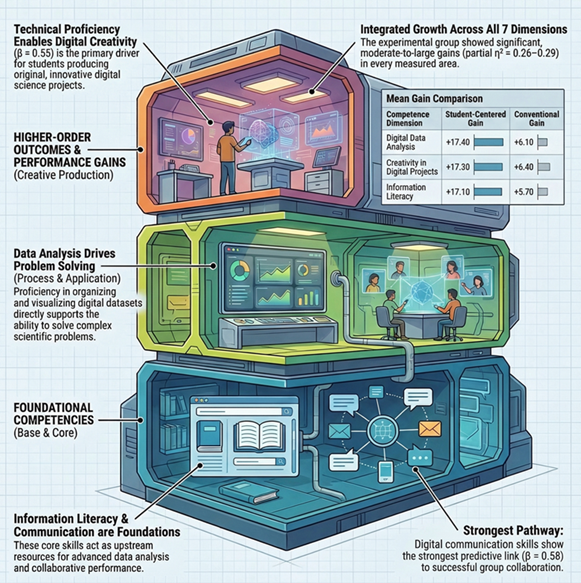
Digital competence is increasingly recognized as a core outcome of science education, yet evidence remains limited. This study examined whether technology-supported science instruction was associated with stronger multidimensional digital competence than conventional instruction and explored how seven competence dimensions were structurally related. A quasi-experimental pretest-posttest non-equivalent control group design was conducted with 180 Grade 11 students from four intact classes in two public schools. Over eight weeks, the experimental group engaged in inquiry- and project-based digital science learning, whereas the comparison group received instruction. Digital competence was assessed using a 28-item questionnaire and seven performance-based tasks. The experimental group showed larger gains across all dimensions, with significant baseline-adjusted differences across all outcomes (all p < 0.001) and moderate-to-large effects (partial η² = 0.26-0.29). More importantly, the pattern suggests that technology-supported student-centered science learning is associated not only with stronger technical performance but also with an integrated competence profile spanning information handling, data interpretation, communication, collaboration, problem-solving, creativity, and operational fluency. The structural findings further suggest that information literacy and digital communication may function as foundational competencies supporting analytical, collaborative, technical, and creative performance, with the strongest pathway from Digital Communication Skills to Collaborative Technology Use (β = 0.58). These findings imply that digital competence in science is best fostered when digital tools are embedded in inquiry, communication, collaboration, and production tasks rather than taught as isolated technical skills. Because the study involved only four intact classes, the findings should be interpreted as comparative and exploratory rather than definitive causal evidence.
Downloads
Article Details

This work is licensed under a Creative Commons Attribution-ShareAlike 4.0 International License.
Authors who publish with this journal agree to the following terms:
- Copyright of the published article belongs to the authors and grant the journal right of first publication with the work simultaneously licensed under a Creative Commons Attribution-ShareAlike 4.0 (CC BY SA) International License that allows others to share the work with an acknowledgment of the work's authorship and initial publication in this journal.
- Authors are able to enter into separate, additional contractual arrangements for the non-exclusive distribution of the journal's published version of the work (e.g., post it to an institutional repository or publish it in a book), with an acknowledgment of its initial publication in this journal.
- Authors are permitted and encouraged to post their work online (e.g., in institutional repositories or on their website) prior to and during the submission process, as it can lead to productive exchanges, as well as earlier and greater citation of published work (See the Effect of Open Access).
References
[1] Eurydice and European Commission / EACEA / Eurydice, Structural indicators for monitoring education and training systems in Europe 2023 – Early leaving from education and training. Publications Office of the European Union, 2023. https://doi.org/doi/10.2797/886074
[2] J. Fraillon, An International Perspective on Digital Literacy. Springer Nature, 2025. https://doi.org/10.1007/978-3-031-87722-3
[3] Y. Vourikari, R., Kluzer, S., Punie, DigComp 2.2: The digital competence framework for citizens – With new examples of knowledge, skills and attitudes. Luxembourg: Publications Office of the European Union, 2023. https://doi.org/10.2760/115376
[4] L. von Kotzebue et al., “The framework DiKoLan (Digital competencies for teaching in science education) as basis for the self-assessment tool dikolan-grid,” Educ. Sci., vol. 11, no. 12, p. 775, 2021, https://doi.org/10.3390/educsci11120775
[5] M. Son and M. Ha, “Development of a digital literacy measurement tool for middle and high school students in the context of scientific practice,” Educ. Inf. Technol., vol. 30, no. 4, pp. 4583–4606, 2025, https://doi.org/10.1007/s10639-024-12999-z
[6] J. A. Greene, D. Z. Copeland, V. M. Deekens, and S. B. Yu, “Beyond knowledge: Examining digital literacy’s role in the acquisition of understanding in science,” Comput. Educ., vol. 117, pp. 141–159, 2018, https://doi.org/10.1016/j.compedu.2017.10.003
[7] W. Fan and Y. Li, “Assessment of postgraduate digital research literacy: current competencies, desired skills, and enhancement strategies,” Educ. Inf. Technol., vol. 30, no. 15, pp. 21551–21571, 2025, https://doi.org/10.1007/s10639-025-13622-5
[8] Sulistiyawati, F. Hanum, T. Aminatun, and C. Yanuarief, “Enhancing Biology Students’ Mastery of Animal Anatomy with a Web-Based Electronic Atlas: Toward Sustainable Digital Learning Tools,” Adv. Sustain. Sci. Eng. Technol., vol. 7, no. 3, 2025, https://doi.org/10.26877/asset.v7i3.1952
[9] M. R. Che Abdul Rahman, U. A. A. Rauf, and S. Sinniah, “Oil Palm Smallholders Entrepreneurs and Financial Literacy: Technology Adoption,” J. Appl. Eng. Technol. Sci., vol. 6, no. 1, pp. 656–667, 2024, https://doi.org/10.37385/jaets.v6i1.6168
[10] B. Shehata, A. Tlili, R. Huang, M. A. Adarkwah, M. Liu, and T. Chang, “How are we doing with student-centered learning facilitated by educational technologies? A systematic review of literature reviews,” Educ. Inf. Technol., vol. 29, no. 7, pp. 7813–7854, 2024, https://doi.org/10.1007/s10639-023-12112-w
[11] Z. Ješková, S. Lukáč, Ľ. Šnajder, J. Guniš, D. Klein, and M. Kireš, “Active Learning in STEM Education with Regard to the Development of Inquiry Skills,” Educ. Sci., vol. 12, no. 10, p. 686, 2022, https://doi.org/10.3390/educsci12100686
[12] F. Chen and G. Chen, “Technology-Enhanced Collaborative Inquiry in K–12 Classrooms: A Systematic Review of Empirical Studies,” Sci. Educ., vol. 34, no. 3, pp. 1731–1773, 2025, https://doi.org/10.1007/s11191-024-00538-8
[13] S. Bilici and R. M. Yilmaz, “The effects of using collaborative digital storytelling on academic achievement and skill development in biology education,” Educ. Inf. Technol., vol. 29, no. 15, pp. 20243–20266, 2024, https://doi.org/10.1007/s10639-024-12638-7
[14] F. Ayu, Ganefri, D. Irfan, A. Huda, and D. Suryani, “Is It Practical Digital Learning Application for Learning 3D Graphic Design Based on Augmented Reality?,” J. Appl. Eng. Technol. Sci., vol. 5, no. 1, pp. 595–607, 2023, https://doi.org/10.37385/jaets.v5i1.1785
[15] A. A. Purwati and M. L. Hamzah, “Instrument Readiness Analysis of Technology-Based Businesses,” J. Appl. Eng. Technol. Sci., vol. 4, no. 1, pp. 611–617, 2022, https://doi.org/10.37385/jaets.v4i1.1434
[16] F. Amastini, D. K. S. Sekarhati, and M. Puspitasari, “Advancing Adaptive and Personalized E-Learning Systems: A Systematic Literature Review,” Adv. Sustain. Sci. Eng. Technol., vol. 7, no. 2, 2025, https://doi.org/10.26877/m82zg802
[17] I. F. Royana et al., “‘My Javelin Throw’ Android-based Javelin Throw Learning Application,” Adv. Sustain. Sci. Eng. Technol., vol. 5, no. 1, pp. 0230104-01-0230104–07, 2023, https://doi.org/10.26877/asset.v5i1.16849
[18] F. Reichert, J. Zhang, N. W. Y. Law, G. K. W. Wong, and J. de la Torre, “Exploring the structure of digital literacy competence assessed using authentic software applications,” Educ. Technol. Res. Dev., vol. 68, no. 6, pp. 2991–3013, 2020, https://doi.org/10.1007/s11423-020-09825-x
[19] E. Porat, I. Blau, and A. Barak, “Measuring digital literacies: Junior high-school students’ perceived competencies versus actual performance,” Comput. Educ., vol. 126, pp. 23–36, 2018, https://doi.org/10.1016/j.compedu.2018.06.030
[20] F. de L. González-Mujico, “Measuring student and educator digital competence beyond self-assessment: Developing and validating two rubric-based frameworks,” Educ. Inf. Technol., vol. 29, no. 11, pp. 13299–13324, 2024, https://doi.org/10.1007/s10639-023-12363-7
[21] M. Pedaste, K. Kallas, and A. Baucal, “Digital competence test for learning in schools: Development of items and scales,” Comput. Educ., vol. 203, p. 104830, 2023, https://doi.org/10.1016/j.compedu.2023.104830
[22] J. Mattar, D. K. Ramos, and M. R. Lucas, “DigComp-Based Digital competence Assessment Tools: Literature Review and Instrument Analysis,” Educ. Inf. Technol., vol. 27, no. 8, pp. 10843–10867, 2022, https://doi.org/10.1007/s10639-022-11034-3
[23] A. Henne, P. Möhrke, L. J. Thoms, and J. Huwer, “Implementing Digital Competencies in University Science Education Seminars Following the DiKoLAN Framework,” Educ. Sci., vol. 12, no. 5, p. 356, 2022, https://doi.org/10.3390/educsci12050356
[24] H. Hairida et al., “Evaluating Digital Literacy of Pre-service Chemistry Teachers: Multidimensional Rasch Analysis,” J. Sci. Educ. Technol., vol. 32, no. 5, pp. 643–654, 2023, https://doi.org/10.1007/s10956-023-10070-z
[25] L. De León, R. Corbeil, and M. E. Corbeil, “The development and validation of a teacher education digital literacy and digital pedagogy evaluation,” J. Res. Technol. Educ., vol. 55, no. 3, pp. 477–489, 2023, https://doi.org/10.1080/15391523.2021.1974988
[26] R. E. Wulansari, R. H. Sakti, H. Saputra, A. D. Samala, R. Novalia, and H. M. Tun, “Multimodal Analysis of Augmented Reality in Basic Programming Course: Innovation Learning in Modern Classes,” J. Appl. Eng. Technol. Sci., vol. 6, no. 1, pp. 115–137, 2024, [Online]. Available: https://www.scopus.com/inward/record.uri?eid=2-s2.0-85213322699&partnerID=40&md5=b2f25bf0e4fbc4c1620ac4472739d211
[27] S. N. Faizah, L. N. A. B. Dina, A. Kartiko, M. A. Ma’arif, and M. S. roni Hasan, “Student Acceptance Study of Phet Simulation With an Expanded Technology Acceptance Model Approach,” J. Appl. Eng. Technol. Sci., vol. 5, no. 1, pp. 279–290, 2023, https://doi.org/10.37385/jaets.v5i1.3041
[28] C. Thangave et al., “Students’ Activeness Measure in Moodle Learning Management System Using Machine Learning,” J. Appl. Eng. Technol. Sci., vol. 6, no. 1, pp. 744–753, 2024, https://doi.org/10.37385/jaets.v6i1.6128
[29] A. Buchori, P. Z. Cahya, T. I. Wardani, N. Khoiri, and S. Osman, “Design and Development of an Interactive Scouting Educational Game Using the MDLC Approach,” Adv. Sustain. Sci. Eng. Technol., vol. 7, no. 2, 2025, https://doi.org/10.26877/asset.v7i2.991
[30] M. A. Brito, M. Aguiar, S. Araújo, J. Varajão, and C. Santos, “Revitalizing STEM Education: integrating STEM into National curricula with active learning,” Res. Sci. Technol. Educ., pp. 1–24, 2025, https://doi.org/10.1080/02635143.2025.2533193
[31] N. Yannier, S. E. Hudson, and K. R. Koedinger, “Active Learning is About More Than Hands-On: A Mixed-Reality AI System to Support STEM Education,” Int. J. Artif. Intell. Educ., vol. 30, no. 1, pp. 74–96, 2020, https://doi.org/10.1007/s40593-020-00194-3
[32] N. Apkarian, C. Henderson, M. Stains, J. Raker, E. Johnson, and M. Dancy, “What really impacts the use of active learning in undergraduate STEM education? Results from a national survey of chemistry, mathematics, and physics instructors,” PLoS One, vol. 16, no. 2 February, p. e0247544, 2021, https://doi.org/10.1371/journal.pone.0247544
[33] J. S. Bruner, “The act of discovery.,” Harv. Educ. Rev., 1961.
[34] M. Neo, “Web-enhanced learning: Engaging students in constructivist learning,” Campus-Wide Inf. Syst., vol. 22, no. 1, pp. 4–14, 2005, https://doi.org/10.1108/10650740510574375
[35] G. Anthony, “Active learning in a constructivist framework,” Educ. Stud. Math., vol. 31, no. 4, pp. 349–369, 1996, https://doi.org/10.1007/BF00369153
[36] R. E. Mayer, “Rote versus meaningful learning,” Theory Pract., vol. 41, no. 4, pp. 226–232, 2002, https://doi.org/10.1207/s15430421tip4104_4
[37] L. S. Vygotsky, “Socio-cultural theory,” Mind Soc., vol. 6, no. 3, pp. 23–43, 1978.
[38] R. B. Toma, I. Yánez-Pérez, and J. Á. Meneses-Villagrá, “Towards a Socio-Constructivist Didactic Model for Integrated STEM Education,” Interchange, vol. 55, no. 1, pp. 75–91, 2024, https://doi.org/10.1007/s10780-024-09513-2
[39] C. Chalmers, M. (Lyn) Carter, T. Cooper, and R. Nason, “Implementing ‘Big Ideas’ to Advance the Teaching and Learning of Science, Technology, Engineering, and Mathematics (STEM),” Int. J. Sci. Math. Educ., vol. 15, no. Suppl 1, pp. 25–43, 2017, https://doi.org/10.1007/s10763-017-9799-1
[40] M. A. Sarvary and J. M. Ruesch, “A Multistep Science Literacy Training Framework in an Introductory Biology Classroom: Teaching How to Find, Evaluate, Comprehend, and Cite Scientific Evidence,” J. Microbiol. Biol. Educ., vol. 24, no. 1, pp. e00197-22, 2023, https://doi.org/10.1128/jmbe.00197-22
[41] O. Spektor-Levy, B. S. Eylon, and Z. Scherz, “Teaching scientific communication skills in science studies: Does it make a difference?,” Int. J. Sci. Math. Educ., vol. 7, no. 5, pp. 875–903, 2009, https://doi.org/10.1007/s10763-009-9150-6
[42] B. M. Hand, V. Prain, and L. Yore, “Sequential Writing Tasks’ Influence on Science Learning,” in Writing as a learning tool: Integrating theory and practice, Springer, 2001, pp. 105–129. https://doi.org/10.1007/978-94-010-0740-5_7
[43] T. D. Sadler, W. L. Romine, and M. S. Topçu, “Learning science content through socio-scientific issues-based instruction: a multi-level assessment study,” Int. J. Sci. Educ., vol. 38, no. 10, pp. 1622–1635, 2016, https://doi.org/10.1080/09500693.2016.1204481
[44] N. C. Kelp, M. McCartney, M. A. Sarvary, J. F. Shaffer, and M. J. Wolyniak, “Developing Science Literacy in Students and Society: Theory, Research, and Practice,” Journal of Microbiology & Biology Education, vol. 24, no. 2. American Society for Microbiology 1752 N St., NW, Washington, DC, pp. e00058-23, 2023. https://doi.org/10.1128/jmbe.00058-23
[45] M. E. Washburn, R. A. Shanks, M. McCartney, C. L. Robertson, and M. Segura-Totten, “Discussion of Annotated Research Articles Results in Increases in Scientific Literacy within a Cell Biology Course,” J. Microbiol. Biol. Educ., vol. 24, no. 1, pp. e00154-22, 2023, https://doi.org/10.1128/jmbe.00154-22
[46] Y. Chung, J. Yoo, S. W. Kim, H. Lee, and D. L. Zeidler, “Enhancing Students’ Communication Skills in the Science Classroom Through Socioscientific Issues,” Int. J. Sci. Math. Educ., vol. 14, no. 1, pp. 1–27, 2016, https://doi.org/10.1007/s10763-014-9557-6
[47] R. Shivni, C. Cline, M. Newport, S. Yuan, and H. E. Bergan-Roller, “Establishing a baseline of science communication skills in an undergraduate environmental science course,” Int. J. STEM Educ., vol. 8, no. 1, p. 47, 2021, https://doi.org/10.1186/s40594-021-00304-0
[48] L. T. Klaver, J. H. Walma van der Molen, P. H. M. Sins, and L. J. F. Guérin, “Students’ engagement with Socioscientific issues: Use of sources of knowledge and attitudes,” J. Res. Sci. Teach., vol. 60, no. 5, pp. 1125–1161, 2023, https://doi.org/10.1002/tea.21828
[49] H. Lee, H. Lee, and D. L. Zeidler, “Examining tensions in the socioscientific issues classroom: Students’ border crossings into a new culture of science,” J. Res. Sci. Teach., vol. 57, no. 5, pp. 672–694, 2020, https://doi.org/10.1002/tea.21600
[50] A. Bach and F. Thiel, “Collaborative online learning in higher education—quality of digital interaction and associations with individual and group-related factors,” in Frontiers in Education, 2024, vol. 9, p. 1356271. https://doi.org/10.3389/feduc.2024.1356271
[51] E. Kalmar et al., “The COVID-19 paradox of online collaborative education: when you cannot physically meet, you need more social interactions,” Heliyon, vol. 8, no. 1, 2022, https://doi.org/10.1016/j.heliyon.2022.e08823
[52] S. Fabriz, J. Mendzheritskaya, and S. Stehle, “Impact of Synchronous and Asynchronous Settings of Online Teaching and Learning in Higher Education on Students’ Learning Experience During COVID-19,” Front. Psychol., vol. 12, p. 733554, 2021, https://doi.org/10.3389/fpsyg.2021.733554
[53] M. C. Kim, M. J. Hannafin, and L. A. Bryan, “Technology-enhanced inquiry tools in science education: An emerging pedagogical framework for classroom practice,” Sci. Educ., vol. 91, no. 6, pp. 1010–1030, 2007, https://doi.org/10.1002/sce.20219
[54] S. Blanc, A. Conchado, J. V. Benlloch-Dualde, A. Monteiro, and L. Grindei, “Digital competence development in schools: a study on the association of problem-solving with autonomy and digital attitudes,” Int. J. STEM Educ., vol. 12, no. 1, p. 13, 2025, https://doi.org/10.1186/s40594-025-00534-6
[55] L. Scheel, G. Vladova, and A. Ullrich, “The influence of digital competences, self-organization, and independent learning abilities on students’ acceptance of digital learning,” Int. J. Educ. Technol. High. Educ., vol. 19, no. 1, p. 44, 2022, https://doi.org/10.1186/s41239-022-00350-w
[56] P. N. T. Nguyen and D. Van Vo, “Exploring digital competence and its relationship with problem-solving self-efficacy in undergraduate students,” Asian Educ. Dev. Stud., vol. 15, no. 1, pp. 1–16, 2025, https://doi.org/10.1108/AEDS-12-2024-0299
[57] M. Cabezas-González, S. Casillas-Martín, and A. García-Valcárcel Muñoz-Repiso, “Theoretical Models Explaining the Level of Digital Competence in Students,” Computers, vol. 12, no. 5, p. 100, 2023, https://doi.org/10.3390/computers12050100
[58] Cosgrove and Cachia, “DigComp 3.0 European Digital Competence Framework,” Publications Office of the European Union, Joint Research Centre (JRC). Publications Office of the European Union, pp. 1–123, 2025. https://doi.org/10.2760/0001149
[59] A. Ferrari, Y. Punie, and B. N. Bre, “DIGCOMP : A Framework for Developing and Understanding Digital Competence in Europe.” Publications Office of the European Union, Luxembourg, 2013. https://doi.org/10.2788/52966
[60] OECD, “PISA 2025: Learning in the digital world—Assessment and analytical framework (Second draft).” OECD Publishing, 2023. [Online]. Available: https://www.oecd.org/en/topics/sub-issues/learning-in-the-digital-world/pisa-2025-learning-in-the-digital-world.html
[61] D. Hillmayr, L. Ziernwald, F. Reinhold, S. I. Hofer, and K. M. Reiss, “The potential of digital tools to enhance mathematics and science learning in secondary schools: A context-specific meta-analysis,” Comput. Educ., vol. 153, p. 103897, 2020, https://doi.org/10.1016/j.compedu.2020.103897
[62] M. J. Chen, H. C. She, and P. Y. Tsai, “The effects of online simulation-based collaborative problem-solving on students’ problem-solving, communication and collaboration attitudes,” Educ. Inf. Technol., vol. 29, no. 14, pp. 19141–19162, 2024, https://doi.org/10.1007/s10639-024-12609-y
[63] D. Grošelj, A. J. A. M. van Deursen, V. Dolničar, T. Burnik, and A. Petrovčič, “Measuring internet skills in a general population: A large-scale validation of the short Internet Skills Scale in Slovenia,” Inf. Soc., vol. 37, no. 2, pp. 63–81, 2020, https://doi.org/10.1080/01972243.2020.1862377
[64] E. O. Bereczki and A. Kárpáti, “Technology-enhanced creativity: A multiple case study of digital technology-integration expert teachers’ beliefs and practices,” Think. Ski. Creat., vol. 39, p. 100791, 2021, https://doi.org/10.1016/j.tsc.2021.100791
[65] D. Henriksen, E. Creely, M. Henderson, and P. Mishra, “Creativity and technology in teaching and learning: a literature review of the uneasy space of implementation,” Educ. Technol. Res. Dev., vol. 69, no. 4, pp. 2091–2108, 2021, https://doi.org/10.1007/s11423-020-09912-z
[66] Marcel, Meyliana, S. W. H. L. Hendric, and T. N. Mursitama, “The Role of Communities of Practice in Increasing Organizational Maturity Levels Towards Digital Transformation: Case Study of Employee Cooperative,” J. Appl. Eng. Technol. Sci., vol. 6, no. 2, pp. 1377–1396, 2025, https://doi.org/10.37385/jaets.v6i2.5539
[67] Y. Li, M. Kim, and J. Palkar, “Using emerging technologies to promote creativity in education: A systematic review,” Int. J. Educ. Res. Open, vol. 3, p. 100177, 2022, https://doi.org/10.1016/j.ijedro.2022.100177
[68] S. A. Soomro, V. Nanjappan, H. Casakin, and G. V. Georgiev, “Fostering technical skills and creativity in the digital fabrication spaces: an open-ended prototyping approach,” Int. J. Technol. Des. Educ., vol. 35, no. 3, pp. 1081–1102, 2025, https://doi.org/10.1007/s10798-024-09940-3
[69] D. Aguilar and M. P. Turmo, “Promoting social creativity in science education with digital technology to overcome inequalities: A scoping review,” Front. Psychol., vol. 10, no. JULY, p. 1474, 2019, https://doi.org/10.3389/fpsyg.2019.01474
[70] C. Tang, S. Mao, S. E. Naumann, and Z. Xing, “Improving student creativity through digital technology products: A literature review,” Think. Ski. Creat., vol. 44, p. 101032, 2022, https://doi.org/10.1016/j.tsc.2022.101032
[71] D. C. Des Jarlais, “TREND (Transparent Reporting of Evaluations with Nonrandomized Designs),” Guidel. Report. Heal. Res. A User’s Man., pp. 156–168, 2014, https://doi.org/10.1002/9781118715598.ch16
[72] C. Carroll, M. Patterson, S. Wood, A. Booth, J. Rick, and S. Balain, “A conceptual framework for implementation fidelity,” Implement. Sci., vol. 2, no. 1, p. 40, 2007, https://doi.org/10.1186/1748-5908-2-40
[73] C. T. Mowbray, M. C. Holter, G. B. Teague, and D. Bybee, “Fidelity criteria: Development, measurement, and validation,” Am. J. Eval., vol. 24, no. 3, pp. 315–340, 2003.
[74] H. Hasson, “Systematic evaluation of implementation fidelity of complex interventions in health and social care,” Implement. Sci., vol. 5, no. 1, p. 67, 2010, https://doi.org/10.1186/1748-5908-5-67
[75] T. K. Koo and M. Y. Li, “A Guideline of Selecting and Reporting Intraclass Correlation Coefficients for Reliability Research,” J. Chiropr. Med., vol. 15, no. 2, pp. 155–163, 2016, https://doi.org/10.1016/j.jcm.2016.02.012
[76] S. Ferketich, “Internal consistency estimates of reliability,” Res. Nurs. Health, vol. 13, no. 6, pp. 437–440, 1990, https://doi.org/10.1002/nur.4770130612
[77] S. Mehta et al., “Performance of intraclass correlation coefficient (ICC) as a reliability index under various distributions in scale reliability studies,” Stat. Med., vol. 37, no. 18, pp. 2734–2752, 2018, https://doi.org/10.1002/sim.7679
[78] R. B. Kline, Principles and practice of structural equation modeling. Guilford publications, 2023.
[79] E. J. Wolf, K. M. Harrington, S. L. Clark, and M. W. Miller, “Sample Size Requirements for Structural Equation Models: An Evaluation of Power, Bias, and Solution Propriety,” Educ. Psychol. Meas., vol. 73, no. 6, pp. 913–934, 2013, https://doi.org/10.1177/0013164413495237
[80] L. T. Hu and P. M. Bentler, “Cutoff criteria for fit indexes in covariance structure analysis: Conventional criteria versus new alternatives,” Struct. Equ. Model., vol. 6, no. 1, pp. 1–55, 1999, https://doi.org/10.1080/10705519909540118
[81] H. W. Marsh, K. T. Hau, and Z. Wen, “In search of golden rules: Comment on hypothesis-testing approaches to setting cutoff values for fit indexes and dangers in overgeneralizing Hu and Bentler’s (1999) findings,” Struct. Equ. Model., vol. 11, no. 3, pp. 320–341, 2004, https://doi.org/10.1207/s15328007sem1103_2
[82] H. W. Marsh, K. T. Hau, and D. Grayson, “Goodness of fit in structural equation models,” Contemp. Psychom. A Festschrift Roderick P.McDonald, pp. 276–335, 2013, https://doi.org/10.4324/9781410612977
[83] F. Chen and G. Chen, “Learning analytics in inquiry-based learning: a systematic review,” Educ. Technol. Res. Dev., vol. 73, no. 4, pp. 2131–2161, 2025, https://doi.org/10.1007/s11423-025-10507-9
[84] J. E. Hinostroza, S. Armstrong-Gallegos, and M. Villafaena, “Roles of digital technologies in the implementation of inquiry-based learning (IBL): A systematic literature review,” Soc. Sci. Humanit. Open, vol. 9, p. 100874, 2024, https://doi.org/10.1016/j.ssaho.2024.100874
[85] L. F. Gerard, K. Varma, S. B. Corliss, and M. C. Linn, “Professional development for technology-enhanced inquiry science,” Rev. Educ. Res., vol. 81, no. 3, pp. 408–448, 2011, https://doi.org/10.3102/0034654311415121
[86] R. Spronken-Smith, R. Walker, J. Batchelor, B. O’Steen, and T. Angelo, “Evaluating student perceptions of learning processes and intended learning outcomes under inquiry approaches,” Assess. Eval. High. Educ., vol. 37, no. 1, pp. 57–72, 2012, https://doi.org/10.1080/02602938.2010.496531
[87] O. E. Hatlevik and K. A. Christophersen, “Digital competence at the beginning of upper secondary school: Identifying factors explaining digital inclusion,” Comput. Educ., vol. 63, pp. 240–247, 2013, https://doi.org/10.1016/j.compedu.2012.11.015
[88] O. E. Hatlevik, G. B. Guomundsdóttir, and M. Loi, “Digital diversity among upper secondary students: A multilevel analysis of the relationship between cultural capital, self-efficacy, strategic use of information and digital competence,” Comput. Educ., vol. 81, pp. 345–353, 2015, https://doi.org/10.1016/j.compedu.2014.10.019