
Engineering-Oriented Transit QoS and Perceived Value: Predicting Passenger Satisfaction and Behavioral Intentions in Urban Public Transport
Article Sidebar
Main Article Content
Abstract
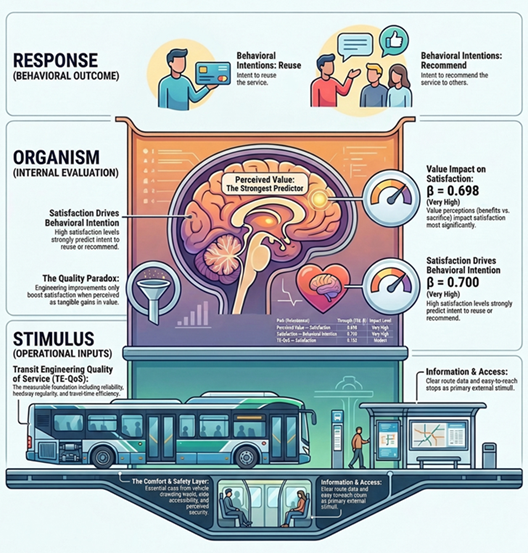
The integration of technology into education has garnered significant interest, particularly for its potential to support environmental sustainability. Urban bus and bus rapid transit (BRT) systems must deliver passenger-centered service quality that is both measurable for operators and meaningful to users. However, service-quality research often relies on generic perceptual scales that are difficult to translate into actionable operational interventions. This study advances an engineering-oriented Stimulus–Organism–Response (S–O–R) framework by conceptualizing Transit Engineering Quality of Service (TE-QoS) as an actionable stimulus and examining its relationships with perceived value, satisfaction, and behavioral intention in the context of urban bus services in Indonesia. Data were collected through an offline intercept survey of Trans Jatim passengers in the Surabaya metropolitan area between June and July 2024, yielding 300 valid responses for analysis. Using CB-SEM (AMOS), the measurement model demonstrated satisfactory reliability and validity. The structural results indicate that perceived value strongly predicts satisfaction (β = 0.698, p < 0.001), whereas TE-QoS exerts a positive, though comparatively modest, direct effect on satisfaction (β = 0.122, p = 0.017). Satisfaction, in turn, strongly predicts behavioral intention (β = 0.700, p < 0.001). The Model explains 50.2% of the variance in satisfaction and 48.9% of the variance in behavioral intention. These findings suggest that operational improvements in reliability, regularity, travel-time efficiency, access, comfort, information, and safety are more likely to strengthen loyalty-related intentions when passengers perceive them as clear gains in value. Future research should integrate objective operational data and formally examine indirect mediation pathways.
Downloads
Article Details

This work is licensed under a Creative Commons Attribution-ShareAlike 4.0 International License.
Authors who publish with this journal agree to the following terms:
- Copyright of the published article belongs to the authors and grant the journal right of first publication with the work simultaneously licensed under a Creative Commons Attribution-ShareAlike 4.0 (CC BY SA) International License that allows others to share the work with an acknowledgment of the work's authorship and initial publication in this journal.
- Authors are able to enter into separate, additional contractual arrangements for the non-exclusive distribution of the journal's published version of the work (e.g., post it to an institutional repository or publish it in a book), with an acknowledgment of its initial publication in this journal.
- Authors are permitted and encouraged to post their work online (e.g., in institutional repositories or on their website) prior to and during the submission process, as it can lead to productive exchanges, as well as earlier and greater citation of published work (See the Effect of Open Access).
References
[1] A. Tirachini, “Ride-hailing, travel behaviour and sustainable mobility: an international review,” Transportation (Amst)., vol. 47, no. 4, pp. 2011–2047, 2020, https://doi.org/10.1007/s11116-019-10070-2
[2] S. Meena and S. K. Singh, “Real-World Emission Assessment of Diesel Passenger Cars in Urban Traffic: A Comparative Analysis of Compliance with Bharat Stage VI Standards,” Adv. Sustain. Sci. Eng. Technol., vol. 7, no. 1, 2025, https://doi.org/10.26877/asset.v7i1.1294
[3] A. M. Arifai and M. F. Arsyad, “Urban Expansion, Climate Vulnerability, and Transportation Resilience: Insights for Sustainable Development,” Adv. Sustain. Sci. Eng. Technol., vol. 7, no. 3, 2025, https://doi.org/10.26877/asset.v7i3.1495
[4] L. Redman, M. Friman, T. Gärling, and T. Hartig, “Quality attributes of public transport that attract car users: A research review,” Transp. Policy, vol. 25, pp. 119–127, 2013, https://doi.org/10.1016/j.tranpol.2012.11.005
[5] L. Dell’Olio, A. Ibeas, and P. Cecin, “The quality of service desired by public transport users,” Transp. Policy, vol. 18, no. 1, pp. 217–227, 2011, https://doi.org/10.1016/j.tranpol.2010.08.005
[6] J. de Groot and L. Steg, “Impact of transport pricing on quality of life, acceptability, and intentions to reduce car use: An exploratory study in five European countries,” J. Transp. Geogr., vol. 14, no. 6, pp. 463–470, 2006, https://doi.org/10.1016/j.jtrangeo.2006.02.011
[7] A. Parasuraman, V. A. Zeithaml, and L. L. Berry, “SERVQUAL: A multiple-item scale for measuring consumer perceptions of service quality,” J. Retail., vol. 64, no. 1, pp. 12–40, 1988.
[8] X. Liu, J. D. Schmöcker, J. Zhao, and X. Yang, “How to make service better? A review on developing service-oriented public transit systems,” Transp. Rev., vol. 45, no. 5, pp. 672–695, 2025, https://doi.org/10.1080/01441647.2025.2502629
[9] S. Kruadsungnoen and A. Upayokin, “Assessing Service Quality and User Satisfaction in University Transit: Evidence from the SERVQUAL Approach,” Sustain., vol. 17, no. 24, p. 11118, 2025, https://doi.org/10.3390/su172411118
[10] A. Tirachini, J. Godachevich, O. Cats, J. C. Muñoz, and J. Soza-Parra, “Headway variability in public transport: a review of metrics, determinants, effects for quality of service and control strategies,” Transp. Rev., vol. 42, no. 3, pp. 337–361, 2022, https://doi.org/10.1080/01441647.2021.1977415
[11] T. M. T. Zulueta, A. K. S. Ong, J. D. German, M. J. J. Gumasing, and J. C. D. Chico, “Implications of the Progression to Sustainable Public Transportation: An Insight into Modern Jeepney Shift from the Philippines,” Sustain. , vol. 16, no. 10, p. 3912, 2024, https://doi.org/10.3390/su16103912
[12] J. De Oña and R. De Oña, “Quality of service in public transport based on customer satisfaction surveys: A review and assessment of methodological approaches,” Transp. Sci., vol. 49, no. 3, pp. 605–622, 2015, https://doi.org/10.1287/trsc.2014.0544
[13] S. Ibrahim, Y. Zhang, and A. Ahmad, “Rail-based public transportation service quality and customer satisfaction: a decade of insights and advances,” Public Transp., vol. 17, no. 1, pp. 45–69, 2025, https://doi.org/10.1007/s12469-024-00382-7
[14] S. Nisumanti, A. Kurniawan, and K. Al Qubroh, “Damage Analysis of Lahat Roads–Fence Natural From Endikat Bridge To Go To Depati H. Duaji Lintas Street Pagaralam–Lahat,” J. Appl. Eng. Technol. Sci., vol. 4, no. 1, pp. 251–262, 2022, https://doi.org/10.37385/jaets.v4i1.1066
[15] Transportation Research Board, Transit Capacity and Quality of Service Manual: TCRP Report 165, 3rd ed. Washington, DC: TRB National Academies Press, 2013. [Online]. Available: https://www.nationalacademies.org/read/24766/chapter/1
[16] [16] European Committee for Standardisation., “Transportation-Logistics and Services-Public Passenger Transport-Service Quality Definition, Targeting and Measurement (BS EN 13816).” CEN London, Brussels, 2002. https://doi.org/10.3403/02561018
[17] N. C. Kresnanto and W. H. Putri, “Transport Demand Management Strategy Priority Assessment Based on Expert Judgment,” J. Appl. Eng. Technol. Sci., vol. 4, no. 2, pp. 795–807, 2023, https://doi.org/10.37385/jaets.v4i2.1701
[18] Transportation Research Board, A Guidebook for Developing a Transit Performance-Measurement System: TCRP Record 88. Washington, DC: TRB National Academies Press, 2003. [Online]. Available: https://onlinepubs.trb.org/onlinepubs/tcrp/tcrp_report_88/guidebook.pdf
[19] Transportation Research Board, Guidelines for the Location and Design of Bus Stops: TCRP 19. Washington, DC: TRB National Academies Press, 1996. [Online]. Available: https://nacto.org/wp-content/uploads/tcrp_report_19.pdf
[20] A. Mehrabian and J. A. Russell, An approach to environmental psychology. MIT Press, 1974.
[21] R. J. Donovan and J. R. Rossiter, “Store Atmosphere: An Environmental Psychology Approach.,” J. Retail., vol. 58, no. 1, pp. 34–57, 1982.
[22] M. J. Bitner, “Servicescapes: The Impact of Physical Surroundings on Customers and Employees,” J. Mark., vol. 56, no. 2, pp. 57–71, 1992, https://doi.org/10.1177/002224299205600205
[23] M. S. Rosenbaum and C. Massiah, “An expanded servicescape perspective,” J. Serv. Manag., vol. 22, no. 4, pp. 471–490, 2011, https://doi.org/10.1108/09564231111155088
[24] W. B. Dodds, K. B. Monroe, and D. Grewal, “Effects of Price, Brand, and Store Information on Buyers’ Product Evaluations,” J. Mark. Res., vol. 28, no. 3, p. 307, 1991, https://doi.org/10.2307/3172866
[25] V. A. Zeithaml, “Consumer Perceptions of Price, Quality, and Value: A Means-End Model and Synthesis of Evidence,” J. Mark., vol. 52, no. 3, p. 2, 1988, https://doi.org/10.2307/1251446
[26] R. L. Oliver, “A Cognitive Model of the Antecedents and Consequences of Satisfaction Decisions,” J. Mark. Res., vol. 17, no. 4, p. 460, 1980, https://doi.org/10.2307/3150499
[27] R. L. Oliver, Satisfaction: A Behavioral Perspective on the Consumer: A Behavioral Perspective on the Consumer, 2nd ed. New York: Routledge, 2010. https://doi.org/10.4324/9781315700892
[28] I. Ajzen, “The theory of planned behavior,” Handbook of Theories of Social Psychology: Volume 1. pp. 438–459, 2012. https://doi.org/10.4135/9781446249215.n22
[29] M. Fishbein and I. Ajzen, Belief, attitude, intention and behavior: An introduction to theory and research. 1975.
[30] J. J. Cronin Jr, M. K. Brady, and G. T. M. Hult, “Assessing the effects of quality, value, and customer satisfaction on consumer behavioral intentions in service environments,” J. Retail., vol. 76, no. 2, pp. 193–218, 2000, https://doi.org/10.1016/S0022-4359(00)00028-2
[31] W. T. Lai and C. F. Chen, “Behavioral intentions of public transit passengers-The roles of service quality, perceived value, satisfaction and involvement,” Transp. Policy, vol. 18, no. 2, pp. 318–325, 2011, https://doi.org/10.1016/j.tranpol.2010.09.003
[32] C. F. Chen and W. H. Chao, “Habitual or reasoned? Using the theory of planned behavior, technology acceptance model, and habit to examine switching intentions toward public transit,” Transp. Res. Part F Traffic Psychol. Behav., vol. 14, no. 2, pp. 128–137, 2011, https://doi.org/10.1016/j.trf.2010.11.006
[33] Y. Shiftan, Y. Barlach, and D. Shefer, “Measuring passenger loyalty to public transport modes,” J. Public Transp., vol. 18, no. 1, pp. 1–16, 2015, https://doi.org/10.5038/2375-0901.18.1.7
[34] M. Fellesson and M. Friman, “Perceived Satisfaction with Public Transport Service in Nine European Cities,” in Journal of the Transportation Research Forum, 2012, vol. 47, no. 3. https://doi.org/10.5399/osu/jtrf.47.3.2126
[35] M. Bordagaray, L. Dell’Olio, A. Ibeas, and P. Cecín, “Modelling user perception of bus transit quality considering user and service heterogeneity,” Transp. A Transp. Sci., vol. 10, no. 8, pp. 705–721, 2014, https://doi.org/10.1080/23249935.2013.823579
[36] L. Dell’Olio, A. Ibeas, and P. Cecín, “Modelling user perception of bus transit quality,” Transp. Policy, vol. 17, no. 6, pp. 388–397, 2010, https://doi.org/10.1016/j.tranpol.2010.04.006
[37] M. Friman and M. Fellesson, “Service Supply and Customer Satisfaction in Public Transportation: The Quality Paradox,” J. Public Transp., vol. 12, no. 4, pp. 57–69, 2009, https://doi.org/10.5038/2375-0901.12.4.4
[38] D. A. Hensher, P. Stopher, and P. Bullock, “Service quality - developing a service quality index in the provision of commercial bus contracts,” Transp. Res. Part A Policy Pract., vol. 37, no. 6, pp. 499–517, 2003, https://doi.org/10.1016/S0965-8564(02)00075-7
[39] L. Eboli and G. Mazzulla, “A methodology for evaluating transit service quality based on subjective and objective measures from the passenger’s point of view,” Transp. Policy, vol. 18, no. 1, pp. 172–181, 2011, https://doi.org/10.1016/j.tranpol.2010.07.007
[40] J. De Oña, R. De Oña, L. Eboli, and G. Mazzulla, “Perceived service quality in bus transit service: A structural equation approach,” Transp. Policy, vol. 29, pp. 219–226, 2013.
[41] Transportation Research Board, A Handbook for Measuring Customer Satisfaction and Service Quality: TCRP Report 47. Washington, DC: TRB National Academies Press, 1999. [Online]. Available: https://www.trb.org/publications/tcrp/tcrp_rpt_47-a.pdf
[42] Transportation Research Board, Using Archived AVL-APC Data to Improve Transit Performance and Management: TCRP Report 113. Washington, DC: TRB National Academies Press, 2006. [Online]. Available: https://trb.org/publications/tcrp/tcrp_rpt_113.pdf
[43] European Committee for Standardization EN 13816, Transportation—Logistics and services—Public passenger transport—Service quality definition, targeting and measuremen. Brussels: European Committee for Standardization, 2002.
[44] A. Mehrabian and J. A. Russell, “The basic emotional impact of environments,” Percept. Mot. Skills, vol. 38, no. 1, pp. 283–301, 1974, https://doi.org/10.2466/pms.1974.38.1.283
[45] V. A. Zeithaml, A. Parasuraman, and L. L. Berry, Delivering quality service: Balancing customer perceptions and expectations. Simon and Schuster, 1990.
[46] J. de Oña, E. Estévez, and R. de Oña, “How does private vehicle users perceive the public transport service quality in large metropolitan areas? A European comparison,” Transp. Policy, vol. 112, pp. 173–188, 2021, https://doi.org/10.1016/j.tranpol.2021.08.005
[47] R. G. Mugion, M. Toni, H. Raharjo, L. Di Pietro, and S. P. Sebathu, “Does the service quality of urban public transport enhance sustainable mobility?,” J. Clean. Prod., vol. 174, pp. 1566–1587, 2018, https://doi.org/10.1016/j.jclepro.2017.11.052
[48] J. de Oña, “Service quality, satisfaction and behavioral intentions towards public transport from the point of view of private vehicle users,” Transportation (Amst)., vol. 49, no. 1, pp. 237–269, 2022, https://doi.org/10.1007/s11116-021-10175-7
[49] J. Soza-Parra, S. Raveau, J. C. Muñoz, and O. Cats, “The underlying effect of public transport reliability on users’ satisfaction,” Transp. Res. Part A Policy Pract., vol. 126, pp. 83–93, 2019, https://doi.org/10.1016/j.tra.2019.06.004
[50] L. H. P. Yaya, M. F. Fortià, C. S. Canals, and F. Marimon, “Service quality assessment of public transport and the implication role of demographic characteristics,” Public Transp., vol. 7, no. 3, pp. 409–428, 2015, https://doi.org/10.1007/s12469-014-0099-7
[51] Transportation Research Board, Transit Capacity and Quality of Service Manual: TCRP Report 100, 2nd ed. Washington, DC: TRB National Academies Press, 2003. [Online]. Available: https://www.trb.org/Publications/Blurbs/153590.aspx
[52] M. Živković and B. Abramović, “Quality of Service Criteria in Integrated Passenger Transport Systems: An Overview,” Appl. Sci., vol. 15, no. 4, p. 2078, 2025, https://doi.org/10.3390/app15042078
[53] E. Sogbe, S. Susilawati, and T. C. Pin, “Scaling up public transport usage: a systematic literature review of service quality, satisfaction and attitude towards bus transport systems in developing countries,” Public Transp., vol. 17, no. 1, pp. 1–44, 2025, https://doi.org/10.1007/s12469-024-00367-6
[54] C. Romero, C. Zamorano, and A. Monzón, “Exploring the role of public transport information sources on perceived service quality in suburban rail,” Travel Behav. Soc., vol. 33, p. 100642, 2023, https://doi.org/10.1016/j.tbs.2023.100642
[55] R. Sánchez-Fernández and M. Á. Iniesta-Bonillo, “Efficiency and quality as economic dimensions of perceived value: Conceptualization, measurement, and effect on satisfaction,” J. Retail. Consum. Serv., vol. 16, no. 6, pp. 425–433, 2009, https://doi.org/10.1016/j.jretconser.2009.06.003
[56] P. Shukla, “Effects of perceived sacrifice, quality, value, and satisfaction on behavioral intentions in the service environment,” Serv. Mark. Q., vol. 31, no. 4, pp. 466–484, 2010, https://doi.org/10.1080/15332969.2010.510730
[57] W. Jen, R. Tu, and T. Lu, “Managing passenger behavioral intention: An integrated framework for service quality, satisfaction, perceived value, and switching barriers,” Transportation (Amst)., vol. 38, no. 2, pp. 321–342, 2011, https://doi.org/10.1007/s11116-010-9306-9
[58] I. Ajzen, “From Intentions to Actions: A Theory of Planned Behavior,” in Action Control, Springer, 1985, pp. 11–39. https://doi.org/10.1007/978-3-642-69746-3_2
[59] I. Ajzen, “The theory of planned behavior,” Handb. Theor. Soc. Psychol. Vol. 1, vol. 50, no. 2, pp. 438–459, 2012, https://doi.org/10.4135/9781446249215.n22
[60] D. van Lierop and A. El-Geneidy, “Enjoying loyalty: The relationship between service quality, customer satisfaction, and behavioral intentions in public transit,” Res. Transp. Econ., vol. 59, pp. 50–59, 2016, https://doi.org/10.1016/j.retrec.2016.04.001
[61] Y. Tyrinopoulos and C. Antoniou, “Public transit user satisfaction: Variability and policy implications,” Transp. Policy, vol. 15, no. 4, pp. 260–272, 2008, https://doi.org/10.1016/j.tranpol.2008.06.002
[62] X. mei Fu, J. hua Zhang, and F. T. S. Chan, “Determinants of loyalty to public transit: A model integrating Satisfaction-Loyalty Theory and Expectation-Confirmation Theory,” Transp. Res. Part A Policy Pract., vol. 113, pp. 476–490, 2018, https://doi.org/10.1016/j.tra.2018.05.012
[63] D. van Lierop, M. G. Badami, and A. M. El-Geneidy, “What influences satisfaction and loyalty in public transport? A review of the literature,” Transp. Rev., vol. 38, no. 1, pp. 52–72, 2018, https://doi.org/10.1080/01441647.2017.1298683
[64] S. Sumaedi, I. G. M. Y. Bakti, T. Rakhmawati, N. J. Astrini, T. Widianti, and M. Yarmen, “Factors influencing public transport passengers’ satisfaction: a new model,” Manag. Environ. Qual. An Int. J., vol. 27, no. 5, pp. 585–597, 2016, https://doi.org/10.1108/MEQ-05-2015-0084
[65] J. Allen, J. C. Muñoz, and J. de Dios Ortúzar, “On the effect of operational service attributes on transit satisfaction,” Transportation (Amst)., vol. 47, no. 5, pp. 2307–2336, 2020, https://doi.org/10.1007/s11116-019-10016-8
[66] J. Yang, N. Shiwakoti, and R. Tay, “Passengers’ Perception of Satisfaction and Its Relationship with Travel Experience Attributes: Results from an Australian Survey,” Sustain., vol. 15, no. 8, p. 6645, 2023, https://doi.org/10.3390/su15086645
[67] J. de Oña, R. de Oña, L. Eboli, C. Forciniti, and G. Mazzulla, “Transit passengers’ behavioural intentions: the influence of service quality and customer satisfaction,” Transp. A Transp. Sci., vol. 12, no. 5, pp. 385–412, 2016, https://doi.org/10.1080/23249935.2016.1146365
[68] L. He, D. Yang, and J. Li, “Improving the Service Quality of Public Transit with Exclusive Bus Lanes: A Perspective from Passenger Satisfaction,” J. Adv. Transp., vol. 2021, no. 1, p. 8599256, 2021, https://doi.org/10.1155/2021/8599256
[69] S. Sun and Z. Duan, “Modeling passengers’ loyalty to public transit in a two-dimensional framework: A case study in Xiamen, China,” Transp. Res. Part A Policy Pract., vol. 124, pp. 295–309, 2019, https://doi.org/10.1016/j.tra.2019.04.007
[70] J. W. Creswell and J. D. Creswell, Research Design: Qualitative, Quantitative, and Mixed Methods Approaches, 6th ed. SAGE Publications, 2023.
[71] J. F. Hair, W. C. Black, B. J. Babin, R. E. Anderson, and R. L. Tatham, Multivariate Data Analysis, 8th ed. Edinburgh Gate, Harlow: Pearson Education Limited, 2019.
[72] P. W. Lei and Q. Wu, “An NCME instructional module on: Introduction to structural equation modeling: Issues and practical considerations,” Educ. Meas. Issues Pract., vol. 26, no. 3, pp. 33–43, 2007, https://doi.org/10.1111/j.1745-3992.2007.00099.x
[73] G. R. Hancock and R. O. Mueller, Structural Equation Modeling: A Second Course, vol. 60, no. 2. Emerald Group Publishing, 2007. https://doi.org/10.1111/j.1744-6570.2007.00081_13.x
[74] L. J. Jobst, M. Bader, and M. Moshagen, “A Tutorial on Assessing Statistical Power and Determining Sample Size for Structural Equation Models,” Psychol. Methods, vol. 28, no. 1, pp. 207–221, 2021, https://doi.org/10.1037/met0000423
[75] A. Boomsma and J. J. Hoogland, “The Robustness of LISREL Modeling Revisited,” Struct. Equ. Model. Present Futur., vol. 2, no. 3, pp. 139–168, 2001.
[76] J. Christopher Westland, “Lower bounds on sample size in structural equation modeling,” Electron. Commer. Res. Appl., vol. 9, no. 6, pp. 476–487, 2010, https://doi.org/10.1016/j.elerap.2010.07.003
[77] E. J. Wolf, K. M. Harrington, S. L. Clark, and M. W. Miller, “Sample Size Requirements for Structural Equation Models: An Evaluation of Power, Bias, and Solution Propriety,” Educ. Psychol. Meas., vol. 73, no. 6, pp. 913–934, 2013, https://doi.org/10.1177/0013164413495237
[78] J. S. Tanaka, “‘How Big Is Big Enough?’: Sample Size and Goodness of Fit in Structural Equation Models with Latent Variables,” Child Dev., vol. 58, no. 1, p. 134, 1987, https://doi.org/10.2307/1130296
[79] World Medical Association, “World Medical Association Declaration of Helsinki: ethical principles for medical research involving human subjects,” Jama, vol. 310, no. 20, pp. 2191–2194, 2013.
[80] D. A. Dillman, J. D. Smyth, and L. M. Christian, Internet, phone, mail, and mixed-mode surveys: The tailored design method. John Wiley & Sons, 2014.
[81] M. J. Stern, I. Bilgen, and D. A. Dillman, “The State of Survey Methodology: Challenges, Dilemmas, and New Frontiers in the Era of the Tailored Design,” Field methods, vol. 26, no. 3, pp. 284–301, 2014, https://doi.org/10.1177/1525822X13519561
[82] J. de Oña, “The role of involvement with public transport in the relationship between service quality, satisfaction and behavioral intentions,” Transp. Res. Part A Policy Pract., vol. 142, pp. 296–318, 2020, https://doi.org/10.1016/j.tra.2020.11.006
[83] C. H. Wen, L. W. Lan, and H. L. Cheng, “Structural equation modeling to determine passenger loyalty toward intercity bus services,” Transp. Res. Rec., vol. 1927, no. 1927, pp. 249–255, 2005, https://doi.org/10.3141/1927-28
[84] J. C. Anderson and D. W. Gerbing, “Structural Equation Modeling in Practice: A Review and Recommended Two-Step Approach,” Psychol. Bull., vol. 103, no. 3, pp. 411–423, 1988, https://doi.org/10.1037/0033-2909.103.3.411
[85] R. B. Kline, Principles and practice of structural equation modeling. Guilford publications, 2023.
[86] J. F. Hair Jr., L. M. Matthews, R. L. Matthews, and M. Sarstedt, “PLS-SEM or CB-SEM: updated guidelines on which method to use,” Int. J. Multivar. Data Anal., vol. 1, no. 2, p. 107, 2017, https://doi.org/10.1504/ijmda.2017.10008574
[87] C. Fornell and D. F. Larcker, “Evaluating Structural Equation Models with Unobservable Variables and Measurement Error,” J. Mark. Res., vol. 18, no. 1, p. 39, 1981, https://doi.org/10.2307/3151312
[88] L. J. Cronbach, “Coefficient alpha and the internal structure of tests,” Psychometrika, vol. 16, no. 3, pp. 297–334, 1951, https://doi.org/10.1007/BF02310555
[89] J. F. Hair, W. C. Black, B. J. Babin, and R. E. Anderson, Multivariate Data Analysis, 7th ed. Harlow, England: Pearson New International Edition, 2014. https://doi.org/10.1038/259433b0
[90] J. Henseler, C. M. Ringle, and M. Sarstedt, “A new criterion for assessing discriminant validity in variance-based structural equation modeling,” J. Acad. Mark. Sci., vol. 43, no. 1, pp. 115–135, 2015, https://doi.org/10.1007/s11747-014-0403-8
[91] L. T. Hu and P. M. Bentler, “Cutoff criteria for fit indexes in covariance structure analysis: Conventional criteria versus new alternatives,” Struct. Equ. Model., vol. 6, no. 1, pp. 1–55, 1999, https://doi.org/10.1080/10705519909540118
[92] K. Schermelleh-Engel, H. Moosbrugger, and H. Müller, “Evaluating the fit of structural equation models: Tests of significance and descriptive goodness-of-fit measures,” Methods Psychol. Res. online, vol. 8, no. 2, pp. 23–74, 2003.
[93] N. K. Malhotra, Marketing Research An Applied Orientation, 7th ed. London: Pearson Education, 2019.
[94] J. W. Creswell and J. D. Creswell, Research design: Qualitative, quantitative, and mixed methods approaches. Sage publications, 2017.
[95] R. P. Bagozzi and Y. Yi, “Specification, evaluation, and interpretation of structural equation models,” J. Acad. Mark. Sci., vol. 40, no. 1, pp. 8–34, 2012, https://doi.org/10.1007/s11747-011-0278-x
[96] J. C. Nunnally and I. H. Bernstein, “The Assessment of Reliability,” in Psychometric Theory, 3rd ed., New York, USA: McGraw-Hill Education, 1994, pp. 248–292.
[97] J. M. Cortina, “What Is Coefficient Alpha? An Examination of Theory and Applications,” J. Appl. Psychol., vol. 78, no. 1, pp. 98–104, 1993, https://doi.org/10.1037/0021-9010.78.1.98
[98] D. Gefen, D. Straub, and M.-C. Boudreau, “Structural Equation Modeling and Regression: Guidelines for Research Practice,” Commun. Assoc. Inf. Syst., vol. 4, no. 1, p. 7, 2000, https://doi.org/10.17705/1cais.00407
[99] E. Carmines and J. McIver, “Analyzing models with unobserved variables: Analysis of covariance structures,” in Social measurement: Current issues, G. W. Bohr., vol. 80, Beverly Hills: Sage Publications, 1981, pp. 65–115.
[100] R. E. Schumacker and R. G. Lomax, A Beginner’s Guide to Structural Equation Modeling, 3rd ed. Mahwah, NJ: Lawrence Erlbaum Associates, 2015. https://doi.org/10.4324/9781315749105
[101] P. Wood, Confirmatory Factor Analysis for Applied Research, 2nd ed., vol. 62, no. 1. New York: The Guilford Press, 2008. https://doi.org/10.1198/tas.2008.s98
[102] P. M. Bentler and L. T. Hu, “Evaluating model fit,” in Structural equation modeling: Concepts, issues, and applications, Thousand Oaks, CA: SAGE Publications, 1995, pp. 76–99.
[103] L. J. Williams and E. O’Boyle, “The myth of global fit indices and alternatives for assessing latent variable relations,” Organ. Res. Methods, vol. 14, no. 2, pp. 350–369, 2011, https://doi.org/10.1177/1094428110391472
[104] F. Chen, P. J. Curran, K. A. Bollen, J. Kirby, and P. Paxton, “An empirical evaluation of the use of fixed cutoff points in RMSEA test statistic in structural equation models,” Sociol. Methods Res., vol. 36, no. 4, pp. 462–494, 2008, https://doi.org/10.1177/0049124108314720
[105] M. W. Browne and R. Cudeck, “Alternative ways of assessing model fit,” Sage Focus Ed., vol. 154, p. 136, 1993.
[106] B. M. Byrne, Structural equation modeling with AMOS: Basic concepts, applications, and programming, 2nd ed. New York: Routledge, 2016.
[107] R. P. Bagozzi and Y. Yi, “On the evaluation of structural equation models,” J. Acad. Mark. Sci., vol. 16, no. 1, pp. 74–94, 1988.
[108] J. Cohen, Statistical power analysis for the behavioral sciences, 2nd ed. Hillsdale, New Jersey: Lawrence Erlbaum Associates, 1988.
[109] R. B. Kline, Principles and practice of structural equation modeling, 4th ed. New York, United States: Guilford publications, 2015.
[110] R. B. Woodruff, “Customer value: The next source for competitive advantage,” J. Acad. Mark. Sci., vol. 25, no. 2, pp. 139–153, 1997, https://doi.org/10.1007/BF02894350
[111] A. Parasuraman and D. Grewal, “The impact of technology on the quality-value-loyalty chain: A research agenda,” J. Acad. Mark. Sci., vol. 28, no. 1, pp. 168–174, 2000, https://doi.org/10.1177/0092070300281015
[112] T. Widianti, S. Sumaedi, I. G. M. Y. Bakti, T. Rakhmawati, N. J. Astrini, and M. Yarmen, “Factors influencing the behavioral intention of public transport passengers,” Int. J. Qual. Reliab. Manag., vol. 32, no. 7, pp. 666–692, 2015, https://doi.org/10.1108/IJQRM-01-2013-0002
[113] S. Sumaedi, I. G. Mahatma, Y. Bakti, and M. Yarmen, “The empirical study of public transport passengers’ behavioral intentions: The roles of service quality, perceived sacrifice, perceived value, and satisfaction (case study: paratransit passengers in Jakarta, Indonesia),” Int. J. Traffic Transp. Eng., vol. 2, no. 1, pp. 83–97, 2012, [Online]. Available: http://www.ijtte.com/uploads/2012-03-20/d4c8811d-88a5-92b1p8.pdf
[114] S. Mitric and R. Carruthers, “The concept of affordability of urban public transport services for low-income passengers,” Urban Transp. Poverty, 2005, [Online]. Available: https://documents1.worldbank.org/curated/en/351071468326691158/pdf/841780WP0affor0Box0382094B00PUBLIC0.pdf
[115] S. Mitric, “Urban transport lending by the World Bank: The last decade,” Res. Transp. Econ., vol. 40, no. 1, pp. 19–33, 2013, https://doi.org/10.1016/j.retrec.2012.06.036
[116] R. Parsons, “The potential influences of environmental perception on human health,” J. Environ. Psychol., vol. 11, no. 1, pp. 1–23, 1991, https://doi.org/10.1016/S0272-4944(05)80002-7
[117] L. Eboli and G. Mazzulla, “A stated preference experiment for measuring service quality in public transport,” Transp. Plan. Technol., vol. 31, no. 5, pp. 509–523, 2008, https://doi.org/10.1080/03081060802364471
[118] S. Sun, H. Zhang, L. Zhou, and K. Wang, “Is the relationship between the perceived service quality and passenger loyalty linear or non-linear? A novel model-independent interpretation method is applied,” Transp. Policy, vol. 144, pp. 65–79, 2023,
https://doi.org/10.1016/j.tranpol.2023.10.003
[119] M. Wardman, “Public transport values of time,” Transp. Policy, vol. 11, no. 4, pp. 363–377, 2004, https://doi.org/10.1016/j.tranpol.2004.05.001
[120] J. B. Ingvardson and O. A. Nielsen, “The relationship between norms, satisfaction and public transport use: A comparison across six European cities using structural equation modelling,” Transp. Res. Part A Policy Pract., vol. 126, pp. 37–57, 2019, https://doi.org/10.1016/j.tra.2019.05.016
[121] V. A. Zeithaml, L. L. Berry, and A. Parasuraman, “The Behavioral Consequences of Service Quality,” J. Mark., vol. 60, no. 2, pp. 31–46, 1996, https://doi.org/10.1177/002224299606000203
[122] N. Schirmer, C. M. Ringle, S. P. Gudergan, and M. S. G. Feistel, “The link between customer satisfaction and loyalty: the moderating role of customer characteristics,” J. Strateg. Mark., vol. 26, no. 4, pp. 298–317, 2018, https://doi.org/10.1080/0965254X.2016.1240214
[123] R. Gifford, “Environmental Psychology,” Encycl. Hum. Behav. Second Ed., vol. 1, no. 1, pp. 54–60, 2012, https://doi.org/10.1016/B978-0-12-375000-6.00150-6
[124] H. C. Ho, Venessa, and B. M. Sopha, “Redesigning Passenger Distribution System of KRL Commuter Line: an Integrative Approach,” J. Appl. Eng. Technol. Sci., vol. 7, no. 1, pp. 84–100, 2025, https://doi.org/10.37385/jaets.v7i1.6954
[125] C. Fornell, “A National Customer Satisfaction Barometer: The Swedish Experience,” J. Mark., vol. 56, no. 1, p. 6, 1992, https://doi.org/10.2307/1252129
[126] E. W. Anderson and M. W. Sullivan, “The Antecedents and Consequences of Customer Satisfaction for Firms,” Mark. Sci., vol. 12, no. 2, pp. 125–143, 1993, https://doi.org/10.1287/mksc.12.2.125
[127] G. I. Hapsari et al., “Moving Object Activator in Background Subtraction Algorithm for Automatic Passenger Counter System in Public Transportation,” J. Appl. Eng. Technol. Sci., vol. 5, no. 1, pp. 73–87, 2023, https://doi.org/10.37385/jaets.v5i1.1956