
Electrode-Level EEG Assessment of Sequential Taste and Packaging Exposure in Processed Foods: An Exploratory Study
Article Sidebar
Main Article Content
Abstract
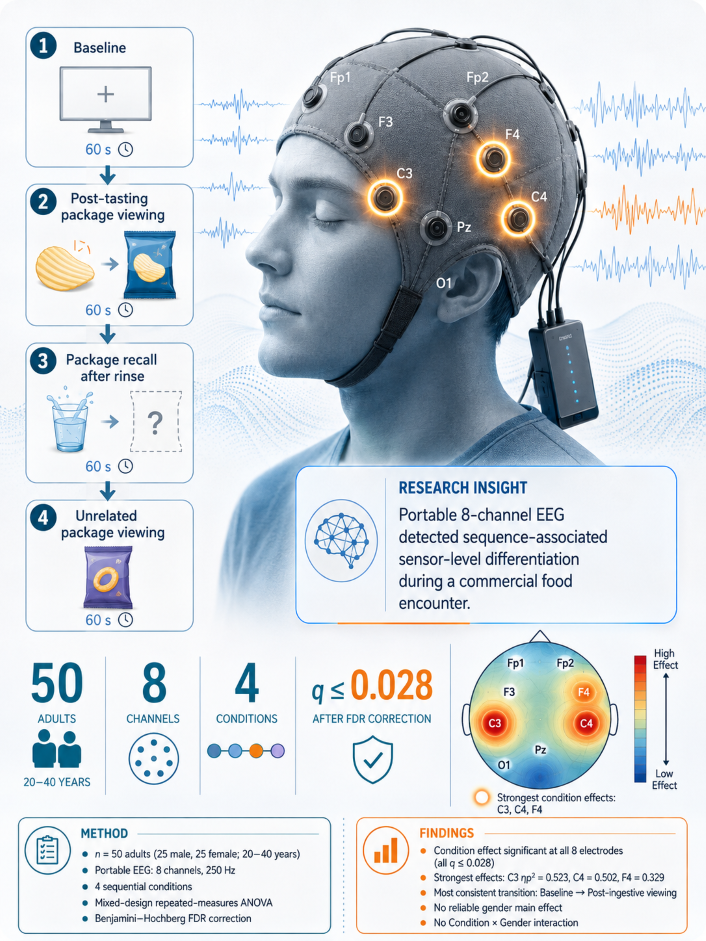
This study examined whether sustained electrode-level neural signals differentiate successive stages of a commercial food encounter and whether response patterns vary by gender. Fifty adults (25 male, 25 female; 20–40 years) completed a fixed protocol comprising a composite baseline, post-ingestive viewing of a branded product while residual flavor remained, later viewing of the same product under a recall instruction, and viewing of an unrelated snack product. Signals were acquired from eight scalp channels using a portable system, filtered at 0.5–45 Hz, notch-filtered at 50 Hz, common-average referenced, and aggregated into participant-level mean device-native amplitudes. Electrode-specific 4 × 2 mixed-design repeated-measures ANOVAs tested Condition, Gender, and their interaction; Greenhouse–Geisser correction addressed sphericity violations, and Benjamini–Hochberg adjustment controlled the false discovery rate. Condition effects were significant at all eight electrodes (all q ≤ 0.028), with partial ηp² ranging from 0.073 at O1 to 0.523 at C3 and the largest effects at C3, C4, and F4. Baseline-to-post-ingestive viewing yielded the broadest adjusted paired differences. Neither the Gender main effect nor the Condition × Gender interaction remained significant after correction, while individual trajectories showed marked heterogeneity. Portable low-density recordings therefore detected sequence-associated sensor-level differentiation across the protocol. Because condition was confounded with serial position, the baseline combined eye states, package stimuli were unmatched, amplitudes were uncalibrated, and behavioral validation was absent, the findings do not establish causal effects of flavor, product identity, recall, preference, cortical source, or consumer choice. Randomized, counterbalanced, behaviorally validated, and higher-density replication is required.
Downloads
Article Details

This work is licensed under a Creative Commons Attribution-ShareAlike 4.0 International License.
Authors who publish with this journal agree to the following terms:
- Copyright of the published article belongs to the authors and grant the journal right of first publication with the work simultaneously licensed under a Creative Commons Attribution-ShareAlike 4.0 (CC BY SA) International License that allows others to share the work with an acknowledgment of the work's authorship and initial publication in this journal.
- Authors are able to enter into separate, additional contractual arrangements for the non-exclusive distribution of the journal's published version of the work (e.g., post it to an institutional repository or publish it in a book), with an acknowledgment of its initial publication in this journal.
- Authors are permitted and encouraged to post their work online (e.g., in institutional repositories or on their website) prior to and during the submission process, as it can lead to productive exchanges, as well as earlier and greater citation of published work (See the Effect of Open Access).
References
[1] M. Auvray and C. Spence, “The multisensory perception of flavor,” Conscious. Cogn., vol. 17, no. 3, pp. 1016–1031, 2008, https://doi.org/10.1016/j.concog.2007.06.005
[2] D. M. Small and J. Prescott, “Odor/taste integration and the perception of flavor,” Exp. Brain Res., vol. 166, no. 3–4, pp. 345–357, 2005, https://doi.org/10.1007/s00221-005-2376-9
[3] C. Spence, “Multisensory Flavor Perception,” Cell, vol. 161, no. 1, pp. 24–35, 2015, https://doi.org/10.1016/j.cell.2015.03.007
[4] C. Spence, “Multisensory flavour perception: Blending, mixing, fusion, and pairing within and between the senses,” Foods, vol. 9, no. 4, 2020, https://doi.org/10.3390/foods9040407
[5] B. Piqueras-Fiszman and C. Spence, “Sensory expectations based on product-extrinsic food cues: An interdisciplinary review of the empirical evidence and theoretical accounts,” Food Qual. Prefer., vol. 40, no. PA, pp. 165–179, 2015, https://doi.org/10.1016/j.foodqual.2014.09.013
[6] A. Krishna, “An integrative review of sensory marketing: Engaging the senses to affect perception, judgment and behavior,” J. Consum. Psychol., vol. 22, no. 3, pp. 332–351, 2012, https://doi.org/10.1016/j.jcps.2011.08.003
[7] C. Spence and C. Velasco, “On the multiple effects of packaging colour on consumer behaviour and product experience in the ‘food and beverage’ and ‘home and personal care’ categories,” Food Qual. Prefer., vol. 68, pp. 226–237, 2018, https://doi.org/10.1016/j.foodqual.2018.03.008
[8] G. Simmonds and C. Spence, “Thinking inside the box: How seeing products on, or through, the packaging influences consumer perceptions and purchase behaviour,” Food Qual. Prefer., vol. 62, pp. 340–351, 2017, https://doi.org/10.1016/j.foodqual.2016.11.010
[9] C. Velasco, A. T. Woods, O. Petit, A. D. Cheok, and C. Spence, “Crossmodal correspondences between taste and shape, and their implications for product packaging: A review,” Food Qual. Prefer., vol. 52, pp. 17–26, 2016, https://doi.org/10.1016/j.foodqual.2016.03.005
[10] G. Ares and R. Deliza, “Studying the influence of package shape and colour on consumer expectations of milk desserts using word association and conjoint analysis,” Food Qual. Prefer., vol. 21, no. 8, pp. 930–937, 2010, https://doi.org/10.1016/j.foodqual.2010.03.006
[11] L. Becker, T. J. L. van Rompay, H. N. J. Schifferstein, and M. Galetzka, “Tough package, strong taste: The influence of packaging design on taste impressions and product evaluations,” Food Qual. Prefer., vol. 22, no. 1, pp. 17–23, 2011, https://doi.org/10.1016/j.foodqual.2010.06.007
[12] N. Mizutani, M. Okamoto, Y. Yamaguchi, Y. Kusakabe, I. Dan, and T. Yamanaka, “Package images modulate flavor perception for orange juice,” Food Qual. Prefer., vol. 21, no. 7, pp. 867–872, 2010, https://doi.org/10.1016/j.foodqual.2010.05.010
[13] H. N. J. Schifferstein, A. Fenko, P. M. A. Desmet, D. Labbe, and N. Martin, “Influence of package design on the dynamics of multisensory and emotional food experience,” Food Qual. Prefer., vol. 27, no. 1, pp. 18–25, 2013, https://doi.org/10.1016/j.foodqual.2012.06.003
[14] S. Xiao, L. Y. Yu, Y. Meng, R. Raisamo, and M. Ziat, “Effects of multisensory packaging on taste perception, emotional responses, and willingness to pay for chocolate,” Sci. Rep., vol. 15, no. 1, 2025, https://doi.org/10.1038/s41598-025-24077-6
[15] S. M. McClure, J. Li, D. Tomlin, K. S. Cypert, L. M. Montague, and P. R. Montague, “Neural correlates of behavioral preference for culturally familiar drinks,” Neuron, vol. 44, no. 2, pp. 379–387, 2004, https://doi.org/10.1016/j.neuron.2004.09.019
[16] S. Kühn and J. Gallinat, “Does Taste Matter? How Anticipation of Cola Brands Influences Gustatory Processing in the Brain,” PLoS One, vol. 8, no. 4, 2013, https://doi.org/10.1371/journal.pone.0061569
[17] H. Plassmann, J. O’Doherty, B. Shiv, and A. Rangel, “Marketing actions can modulate neural representations of experienced pleasantness,” Proc. Natl. Acad. Sci. U. S. A., vol. 105, no. 3, pp. 1050–1054, 2008, https://doi.org/10.1073/pnas.0706929105
[18] I. E. De Araujo, E. T. Rolls, M. I. Velazco, C. Margot, and I. Cayeux, “Cognitive modulation of olfactory processing,” Neuron, vol. 46, no. 4, pp. 671–679, 2005, https://doi.org/10.1016/j.neuron.2005.04.021
[19] F. Grabenhorst, E. T. Rolls, and A. Bilderbeck, “How cognition modulates affective responses to taste and flavor: Top-down influences on the orbitofrontal and pregenual cingulate cortices,” Cereb. Cortex, vol. 18, no. 7, pp. 1549–1559, 2008, https://doi.org/10.1093/cercor/bhm185
[20] H. Plassmann, T. Z. Ramsøy, and M. Milosavljevic, “Branding the brain: A critical review and outlook,” J. Consum. Psychol., vol. 22, no. 1, pp. 18–36, 2012, https://doi.org/10.1016/j.jcps.2011.11.010
[21] H. Plassmann, V. Venkatraman, S. Huettel, and C. Yoon, “Consumer neuroscience: Applications, challenges, and possible solutions,” J. Mark. Res., vol. 52, no. 4, pp. 427–435, 2015, https://doi.org/10.1509/jmr.14.0048
[22] A. Smidts et al., “Advancing consumer neuroscience,” Mark. Lett., vol. 25, no. 3, pp. 257–267, 2014, https://doi.org/10.1007/s11002-014-9306-1
[23] R. A. Poldrack, “Can cognitive processes be inferred from neuroimaging data?,” Trends Cogn. Sci., vol. 10, no. 2, pp. 59–63, 2006, https://doi.org/10.1016/j.tics.2005.12.004
[24] D. Ariely and G. S. Berns, “Neuromarketing: The hope and hype of neuroimaging in business,” Nat. Rev. Neurosci., vol. 11, no. 4, pp. 284–292, 2010, https://doi.org/10.1038/nrn2795
[25] A. Bazzani, S. Ravaioli, L. Trieste, U. Faraguna, and G. Turchetti, “Is EEG Suitable for Marketing Research? A Systematic Review,” Front. Neurosci., vol. 14, 2020, https://doi.org/10.3389/fnins.2020.594566
[26] A. Stasi et al., “Neuromarketing empirical approaches and food choice: A systematic review,” Food Res. Int., vol. 108, pp. 650–664, 2018, https://doi.org/10.1016/j.foodres.2017.11.049
[27] W. D. Hairston et al., “Usability of four commercially-oriented EEG systems,” J. Neural Eng., vol. 11, no. 4, 2014, https://doi.org/10.1088/1741-2560/11/4/046018
[28] C. M. Michel and M. M. Murray, “Towards the utilization of EEG as a brain imaging tool,” Neuroimage, vol. 61, no. 2, pp. 371–385, 2012, https://doi.org/10.1016/j.neuroimage.2011.12.039
[29] M. X. Cohen, “Where Does EEG Come From and What Does It Mean?,” Trends Neurosci., vol. 40, no. 4, pp. 208–218, 2017, https://doi.org/10.1016/j.tins.2017.02.004
[30] C. Pernet et al., “Issues and recommendations from the OHBM COBIDAS MEEG committee for reproducible EEG and MEG research,” Nat. Neurosci., vol. 23, no. 12, pp. 1473–1483, 2020, https://doi.org/10.1038/s41593-020-00709-0
[31] A. Keil et al., “Committee report: Publication guidelines and recommendations for studies using electroencephalography and magnetoencephalography,” Psychophysiology, vol. 51, no. 1, pp. 1–21, 2014, https://doi.org/10.1111/psyp.12147
[32] C. R. Pernet et al., “EEG-BIDS, an extension to the brain imaging data structure for electroencephalography,” Sci. Data, vol. 6, no. 1, 2019, https://doi.org/10.1038/s41597-019-0104-8
[33] N. Bigdely-Shamlo, T. Mullen, C. Kothe, K. M. Su, and K. A. Robbins, “The PREP pipeline: Standardized preprocessing for large-scale EEG analysis,” Front. Neuroinform., vol. 9, no. JUNE, pp. 1–19, 2015, https://doi.org/10.3389/fninf.2015.00016
[34] I. Moya, J. García-Madariaga, and M. F. Blasco, “What can neuromarketing tell us about food packaging?,” Foods, vol. 9, no. 12, 2020, https://doi.org/10.3390/foods9121856
[35] L. N. van der Laan, D. T. D. de Ridder, M. A. Viergever, and P. A. M. Smeets, “The first taste is always with the eyes: A meta-analysis on the neural correlates of processing visual food cues,” Neuroimage, vol. 55, no. 1, pp. 296–303, 2011, https://doi.org/10.1016/j.neuroimage.2010.11.055
[36] U. Toepel, J. F. Knebel, J. Hudry, J. le Coutre, and M. M. Murray, “The brain tracks the energetic value in food images,” Neuroimage, vol. 44, no. 3, pp. 967–974, 2009, https://doi.org/10.1016/j.neuroimage.2008.10.005
[37] J. Stockburger, R. Schmälzle, T. Flaisch, F. Bublatzky, and H. T. Schupp, “The impact of hunger on food cue processing: An event-related brain potential study,” Neuroimage, vol. 47, no. 4, pp. 1819–1829, 2009, https://doi.org/10.1016/j.neuroimage.2009.04.071
[38] C. Coricelli, U. Toepel, M. L. Notter, M. M. Murray, and R. I. Rumiati, “Distinct brain representations of processed and unprocessed foods,” Eur. J. Neurosci., vol. 50, no. 8, pp. 3389–3401, 2019, https://doi.org/10.1111/ejn.14498
[39] J. Blechert, A. Meule, N. A. Busch, and K. Ohla, “Food-pics: An image database for experimental research on eating and appetite,” Front. Psychol., vol. 5, no. JUN, 2014, https://doi.org/10.3389/fpsyg.2014.00617
[40] D. Moerel, J. Psihoyos, and T. A. Carlson, “The Time-Course of Food Representation in the Human Brain,” J. Neurosci., vol. 44, no. 26, 2024, https://doi.org/10.1523/JNEUROSCI.1101-23.2024
[41] J. C. Rojas, M. Contero, M. Vergara, and J. L. Higuera-Trujillo, “Using Event-Related Potentials to Evidence the Visual and Semantic Impact: A Pilot Study with N400 Effect and Food Packaging,” Foods, vol. 13, no. 12, 2024, https://doi.org/10.3390/foods13121876
[42] M. Domracheva and S. Kulikova, “EEG correlates of perceived food product similarity in a cross-modal taste-visual task,” Food Qual. Prefer., vol. 85, 2020, https://doi.org/10.1016/j.foodqual.2020.103980
[43] R. J. Barry, A. R. Clarke, S. J. Johnstone, C. A. Magee, and J. A. Rushby, “EEG differences between eyes-closed and eyes-open resting conditions,” Clin. Neurophysiol., vol. 118, no. 12, pp. 2765–2773, 2007, https://doi.org/10.1016/j.clinph.2007.07.028
[44] J. Wei, T. Chen, C. Li, G. Liu, J. Qiu, and D. Wei, “Eyes-open and eyes-closed resting states with opposite brain activity in sensorimotor and occipital regions: Multidimensional evidences from machine learning perspective,” Front. Hum. Neurosci., vol. 12, 2018, https://doi.org/10.3389/fnhum.2018.00422
[45] V. Khemchandani et al., “Deep Learning-Based Classification of Cognitive Workload Using Functional Connectivity Features,” Adv. Sustain. Sci. Eng. Technol., vol. 8, no. 1, 2026, https://doi.org/10.26877/asset.v8i1.2833
[46] F. Aziz, Jeffry, S. Usman, R. F. Syam, M. N. Arafah, and N. F. Mustamin, “Spatio-Temporal Graph Neural Network Based on Nonlinear Time–Frequency Features for Mu-Erd Classification in Multi-Session Eeg Motor Imagery,” J. Appl. Eng. Technol. Sci., vol. 7, no. 2, pp. 1580–1590, 2026, https://doi.org/10.37385/jaets.v7i2.8679
[47] E. J. Williams, “Experimental Designs Balanced for the Estimation of Residual Effects of Treatments,” Aust. J. Chem., vol. 2, no. 2, pp. 149–168, 1949, https://doi.org/10.1071/CH9490149
[48] D. Alais, D. Burr, and T. A. Carlson, “Positive serial dependence in ratings of food images for appeal and calories,” Curr. Biol., vol. 34, no. 21, pp. 5090-5096.e1, 2024, https://doi.org/10.1016/j.cub.2024.09.012
[49] R. L. Wasserstein and N. A. Lazar, “The ASA’s Statement on p-Values: Context, Process, and Purpose,” Am. Stat., vol. 70, no. 2, pp. 129–133, 2016, https://doi.org/10.1080/00031305.2016.1154108
[50] D. Lakens, “Calculating and reporting effect sizes to facilitate cumulative science: A practical primer for t-tests and ANOVAs,” Front. Psychol., vol. 4, no. NOV, p. 62627, 2013, https://doi.org/10.3389/fpsyg.2013.00863
[51] Y. Benjamini and Y. Hochberg, “Controlling the False Discovery Rate: A Practical and Powerful Approach to Multiple Testing,” J. R. Stat. Soc. Ser. B Stat. Methodol., vol. 57, no. 1, pp. 289–300, 1995, https://doi.org/10.1111/j.2517-6161.1995.tb02031.x
[52] A. Sohrabpour, Y. Lu, P. Kankirawatana, J. Blount, H. Kim, and B. He, “Effect of EEG electrode number on epileptic source localization in pediatric patients,” Clin. Neurophysiol., vol. 126, no. 3, pp. 472–480, 2015, https://doi.org/10.1016/j.clinph.2014.05.038
[53] G. Lantz, R. Grave de Peralta, L. Spinelli, M. Seeck, and C. M. Michel, “Epileptic source localization with high density EEG: How many electrodes are needed?,” Clin. Neurophysiol., vol. 114, no. 1, pp. 63–69, 2003, https://doi.org/10.1016/S1388-2457(02)00337-1
[54] G. Rippon, R. Jordan-Young, A. Kaiser, and C. Fine, “Recommendations for sex/gender neuroimaging research: Key principles and implications for research design, analysis, and interpretation,” Front. Hum. Neurosci., vol. 8, no. AUG, 2014, https://doi.org/10.3389/fnhum.2014.00650
[55] G. H. Klem, H. O. Lüders, H. H. Jasper, and C. Elger, “The ten-twenty electrode system of the International Federation. The International Federation of Clinical Neurophysiology.,” Electroencephalogr. Clin. Neurophysiol. Suppl., vol. 52, pp. 3–6, 1999, [Online]. Available: https://pubmed.ncbi.nlm.nih.gov/10590970/
[56] E. S. Kappenman and S. J. Luck, “The effects of electrode impedance on data quality and statistical significance in ERP recordings,” Psychophysiology, vol. 47, no. 5, pp. 888–904, 2010, https://doi.org/10.1111/j.1469-8986.2010.01009.x
[57] A. Rani, A. Singh, and S. Mishra, “Validation of Neuphony 8-channel EEG flex cap: a comparative study with BioSemi 64-channel EEG system,” Front. Neurosci., vol. 19, p. 1670860, 2026, https://doi.org/10.3389/fnins.2025.1670860
[58] A. Gramfort et al., “MEG and EEG data analysis with MNE-Python,” Front. Neurosci., vol. 7, no. 7 DEC, p. 267, 2013, https://doi.org/10.3389/fnins.2013.00267
[59] P. Virtanen et al., “SciPy 1.0: fundamental algorithms for scientific computing in Python,” Nat. Methods, vol. 17, no. 3, pp. 261–272, 2020, https://doi.org/10.1038/s41592-019-0686-2
[60] K. A. Robbins, J. Touryan, T. Mullen, C. Kothe, and N. Bigdely-Shamlo, “How Sensitive Are EEG Results to Preprocessing Methods: A Benchmarking Study,” IEEE Trans. Neural Syst. Rehabil. Eng., vol. 28, no. 5, pp. 1081–1090, 2020, https://doi.org/10.1109/TNSRE.2020.2980223
[61] A. Widmann, E. Schröger, and B. Maess, “Digital filter design for electrophysiological data - a practical approach,” J. Neurosci. Methods, vol. 250, pp. 34–46, 2015, https://doi.org/10.1016/j.jneumeth.2014.08.002
[62] O. Bertrand, F. Perrin, and J. Pernier, “A theoretical justification of the average reference in topographic evoked potential studies,” Electroencephalogr. Clin. Neurophysiol. Evoked Potentials, vol. 62, no. 6, pp. 462–464, 1985, https://doi.org/10.1016/0168-5597(85)90058-9
[63] S. J. Luck and N. Gaspelin, “How to get statistically significant effects in any ERP experiment (and why you shouldn’t),” Psychophysiology, vol. 54, no. 1, pp. 146–157, 2017, https://doi.org/10.1111/psyp.12639
[64] S. W. Greenhouse and S. Geisser, “On methods in the analysis of profile data,” Psychometrika, vol. 24, no. 2, pp. 95–112, 1959, https://doi.org/10.1007/BF02289823
[65] S. Nieuwenhuis, B. U. Forstmann, and E. J. Wagenmakers, “Erroneous analyses of interactions in neuroscience: A problem of significance,” Nat. Neurosci., vol. 14, no. 9, pp. 1105–1107, 2011, https://doi.org/10.1038/nn.2886
[66] K. S. Button et al., “Power failure: Why small sample size undermines the reliability of neuroscience,” Nat. Rev. Neurosci., vol. 14, no. 5, pp. 365–376, 2013, https://doi.org/10.1038/nrn3475
[67] C. Velasco, A. Salgado-Montejo, F. Marmolejo-Ramos, and C. Spence, “Predictive packaging design: Tasting shapes, typefaces, names, and sounds,” Food Qual. Prefer., vol. 34, pp. 88–95, 2014, https://doi.org/10.1016/j.foodqual.2013.12.005
[68] S. M. Crouzet, N. A. Busch, and K. Ohla, “Taste quality decoding parallels taste sensations,” Curr. Biol., vol. 25, no. 7, pp. 890–896, 2015, https://doi.org/10.1016/j.cub.2015.01.057
[69] U. R. Karmarkar and H. Plassmann, “Consumer Neuroscience: Past, Present, and Future,” Organ. Res. Methods, vol. 22, no. 1, pp. 174–195, 2019, https://doi.org/10.1177/1094428117730598
[70] B. Piqueras-Fiszman and C. Spence, “Crossmodal correspondences in product packaging. Assessing color-flavor correspondences for potato chips (crisps),” Appetite, vol. 57, no. 3, pp. 753–757, 2011, https://doi.org/10.1016/j.appet.2011.07.012
[71] C. M. Michel and D. Brunet, “EEG source imaging: A practical review of the analysis steps,” Front. Neurol., vol. 10, no. APR, p. 325, 2019, https://doi.org/10.3389/fneur.2019.00325
[72] S. E. Lazic, “The problem of pseudoreplication in neuroscientific studies: Is it affecting your analysis?,” BMC Neurosci., vol. 11, p. 5, 2010, https://doi.org/10.1186/1471-2202-11-5
[73] A. Delorme and S. Makeig, “EEGLAB: An open source toolbox for analysis of single-trial EEG dynamics including independent component analysis,” J. Neurosci. Methods, vol. 134, no. 1, pp. 9–21, 2004, https://doi.org/10.1016/j.jneumeth.2003.10.009