
Belief in a Just World Predicting Career Exploration through Future Time Perspective in Chinese Higher Education Students
Article Sidebar
Main Article Content
Abstract
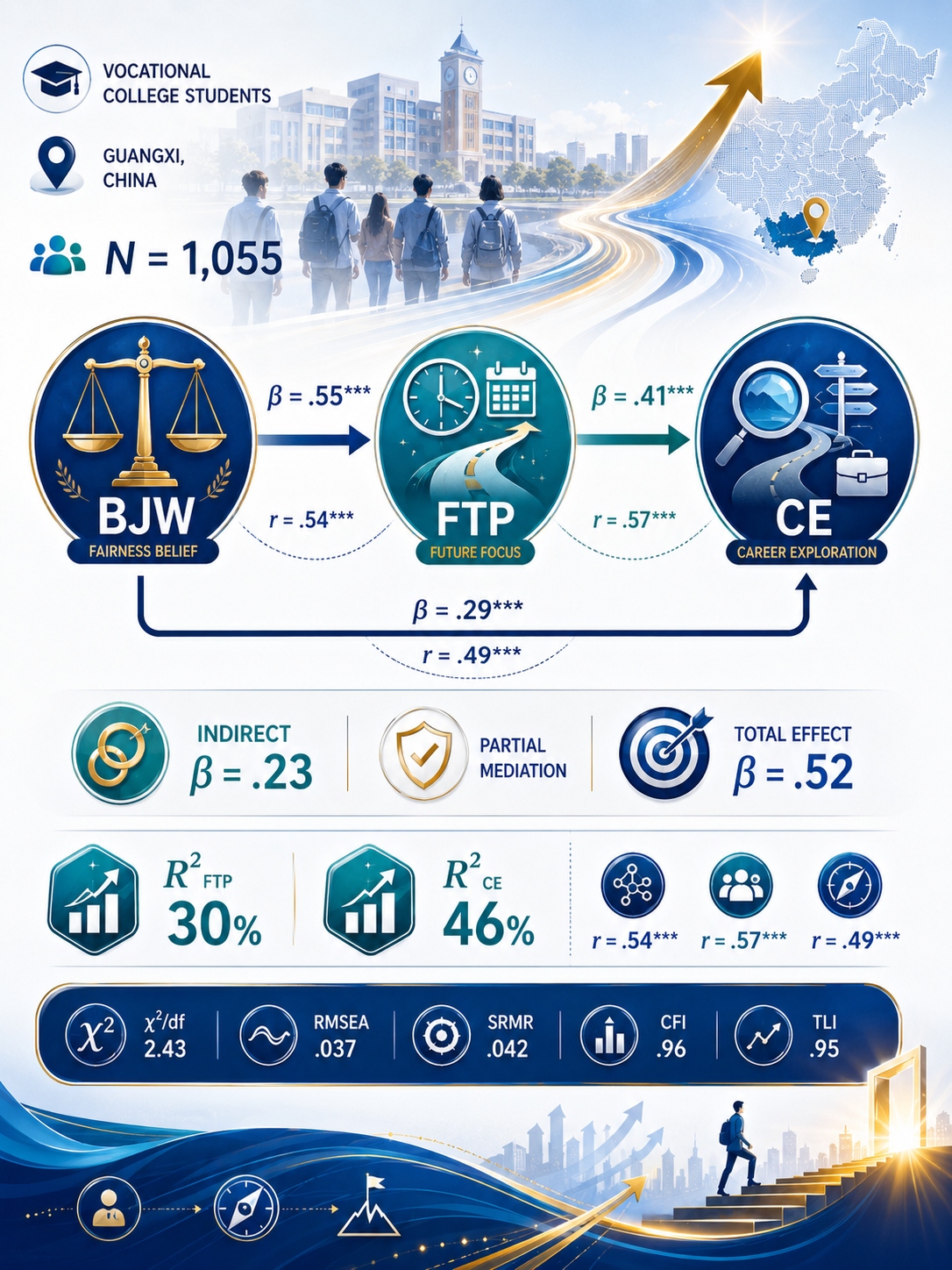
This study examined the relationship between belief in a just world, future time perspective, and career exploration among vocational college students in Guangxi, China. Drawing on Career Construction Theory, belief in a just world was conceptualized as an adaptive readiness factor, future time perspective as a cognitive-regulatory resource, and career exploration as an adapting response. A quantitative cross-sectional survey design was employed. Data were collected from 1,055 students enrolled in nine higher vocational institutions and analyzed using confirmatory factor analysis and structural equation modeling. The measurement model demonstrated satisfactory reliability, convergent validity, and discriminant validity. The structural model showed an acceptable fit to the data, with χ²/df = 2.43, RMSEA = 0.037, SRMR = 0.042, CFI = 0.96, and TLI = 0.95. The results indicated that belief in a just world was positively associated with career exploration and future time perspective. Future time perspective was also positively associated with career exploration and partially mediated the relationship between belief in a just world and career exploration. The model explained 30% of the variance in future time perspective and 46% of the variance in career exploration. These findings suggest that students’ fairness-related beliefs and future-oriented cognition are important psychological correlates of proactive career development behavior. The study extends Career Construction Theory by integrating just-world beliefs and future time perspective into a mediation framework for vocational students’ career exploration. Because the study used a cross-sectional design, the findings should be interpreted as theoretically grounded associations rather than causal evidence.
Downloads
Article Details

This work is licensed under a Creative Commons Attribution-ShareAlike 4.0 International License.
Authors who publish with this journal agree to the following terms:
- Copyright of the published article belongs to the authors and grant the journal right of first publication with the work simultaneously licensed under a Creative Commons Attribution-ShareAlike 4.0 (CC BY SA) International License that allows others to share the work with an acknowledgment of the work's authorship and initial publication in this journal.
- Authors are able to enter into separate, additional contractual arrangements for the non-exclusive distribution of the journal's published version of the work (e.g., post it to an institutional repository or publish it in a book), with an acknowledgment of its initial publication in this journal.
- Authors are permitted and encouraged to post their work online (e.g., in institutional repositories or on their website) prior to and during the submission process, as it can lead to productive exchanges, as well as earlier and greater citation of published work (See the Effect of Open Access).
References
[1] M. Pavlova, J. C. K. Lee, and R. Maclean, “Complexities of school to work transitions,” Educ. Res. Policy Pract., vol. 16, no. 1, pp. 1–7, 2017, https://doi.org/10.1007/s10671-017-9211-5
[2] UNESCO, “Transforming technical and vocational education and training for successful and just transitions: UNESCO strategy 2022-2029,” Transforming technical and vocational education and training for successful and just transitions: UNESCO strategy 2022-2029. UNESCO, Paris, 2022. https://doi.org/10.54675/eudu5854
[3] World Bank, ILO, and UNESCO, “Improve Technical and Vocational Education and Training (TVET) to meet skills and labour mismatch,” World Bank Group, 2023. https://www.ilo.org/resource/news/improve-technical-and-vocational-education-and-training-tvet-meet-skills
[4] S. A. Stumpf, S. M. Colarelli, and K. Hartman, “Development of the Career Exploration Survey (CES),” J. Vocat. Behav., vol. 22, no. 2, pp. 191–226, 1983, https://doi.org/10.1016/0001-8791(83)90028-3
[5] Z. Jiang, A. Newman, H. Le, A. Presbitero, and C. Zheng, “Career exploration: A review and future research agenda,” J. Vocat. Behav., vol. 110, pp. 338–356, 2019, https://doi.org/10.1016/j.jvb.2018.08.008
[6] J. Harford, F. Jiang, R. Wang, and F. Xie, “Analyst career concerns, effort allocation, and firms’ information environment,” Rev. Financ. Stud., vol. 32, no. 6, pp. 2179–2224, 2019, https://doi.org/10.1093/rfs/hhy101
[7] N. A. Khumaira and M. T. Safirin, “Impact of Employee Placement, Motivation, and Career Development on Performance and Productivity at Bank XYZ Using PLS-SEM,” Adv. Sustain. Sci. Eng. Technol., vol. 7, no. 1, 2025, https://doi.org/10.26877/asset.v7i1.662
[8] J. Zikic and D. T. Hall, “Toward a more complex view of career exploration,” Career Dev. Q., vol. 58, no. 2, pp. 181–191, 2009, https://doi.org/10.1002/j.2161-0045.2009.tb00055.x
[9] A. Yulastri, Ganefri, F. Ferdian, Elfizon, Y. A. Fiandra, and G. Farell, “University Students’ Intentions Toward Entrepreneurial Careers in the Hospitality and Tourism Sector: Empirical Insights From the Techno-Savvy Generation in Higher Education,” J. Appl. Eng. Technol. Sci., vol. 6, no. 2, pp. 1121–1134, 2025, https://doi.org/10.37385/jaets.v6i2.6328
[10] M. L. Savickas and E. J. Porfeli, “Career Adapt-Abilities Scale: Construction, reliability, and measurement equivalence across 13 countries,” J. Vocat. Behav., vol. 80, no. 3, pp. 661–673, 2012, https://doi.org/10.1016/j.jvb.2012.01.011
[11] C. W. Rudolph, K. N. Lavigne, and H. Zacher, “Career adaptability: A meta-analysis of relationships with measures of adaptivity, adapting responses, and adaptation results,” J. Vocat. Behav., vol. 98, pp. 17–34, 2017, https://doi.org/10.1016/j.jvb.2016.09.002
[12] E. Wang, S. Li, Y. Jiang, and J. Zhang, “Longitudinal effect of career-related parental support on vocational college students’ proactive career behavior: a moderated mediation model,” Curr. Psychol., vol. 43, no. 13, pp. 11422–11434, 2024, https://doi.org/10.1007/s12144-023-05268-8
[13] M. Fang, R. Pan, R. Ding, Z. Hou, and D. Wang, “Effect of proactive personality on career adaptability of higher vocational college students: the mediating role of college experience,” Front. Psychol., vol. 15, p. 1333677, 2024, https://doi.org/10.3389/fpsyg.2024.1333677
[14] T. Xia, H. Gu, Y. Huang, Q. Zhu, and Y. Cheng, “The Relationship Between Career Social Support and Employability of College Students: A Moderated Mediation Model,” Front. Psychol., vol. 11, p. 28, 2020, https://doi.org/10.3389/fpsyg.2020.00028
[15] M. J. Lerner and D. T. Miller, “Just world research and the attribution process: Looking back and ahead,” Psychol. Bull., vol. 85, no. 5, pp. 1030–1051, 1978, https://doi.org/10.1037/0033-2909.85.5.1030
[16] C. L. Hafer and L. Bègue, “Experimental research on just-world theory: Problems, developments, and future challenges,” Psychol. Bull., vol. 131, no. 1, pp. 128–167, 2005, https://doi.org/10.1037/0033-2909.131.1.128
[17] C. Dalbert, I. M. Lipkus, H. Sallay, and I. Goch, “A just and an unjust world: Structure and validity of different world beliefs,” Pers. Individ. Dif., vol. 30, no. 4, pp. 561–577, 2001, https://doi.org/10.1016/S0191-8869(00)00055-6
[18] J. Bartholomaeus and P. Strelan, “The adaptive, approach-oriented correlates of belief in a just world for the self: A review of the research,” Pers. Individ. Dif., vol. 151, p. 109485, 2019, https://doi.org/10.1016/j.paid.2019.06.028
[19] R. M. Sutton and E. J. Winnard, “Looking ahead through lenses of justice: The relevance of just-world beliefs to intentions and confidence in the future,” Br. J. Soc. Psychol., vol. 46, no. 3, pp. 649–666, 2007, https://doi.org/10.1348/014466606X166220
[20] R. M. Sutton, J. Stoeber, and S. V. Kamble, “Belief in a just world for oneself versus others, social goals, and subjective well-being,” Pers. Individ. Dif., vol. 113, pp. 115–119, 2017, https://doi.org/10.1016/j.paid.2017.03.026
[21] X. Lin, Y. Hu, C. Chen, and Y. Zhu, “The Influence of Social Support on Higher Vocational Students’ Learning Motivation: The Mediating Role of Belief in a Just World and the Moderating Role of Gender,” Psychol. Res. Behav. Manag., vol. 16, pp. 1471–1483, 2023, https://doi.org/10.2147/PRBM.S402643
[22] J. Husman and D. F. Shell, “Beliefs and perceptions about the future: A measurement of future time perspective,” Learn. Individ. Differ., vol. 18, no. 2, pp. 166–175, 2008, https://doi.org/10.1016/j.lindif.2007.08.001
[23] H. M. Baird, T. L. Webb, F. M. Sirois, and J. Gibson-Miller, “Understanding the effects of time perspective: A meta-analysis testing a self-regulatory framework.,” Psychol. Bull., vol. 147, no. 3, pp. 233–267, 2021, https://doi.org/10.1037/bul0000313
[24] S. Hu, M. Hood, P. A. Creed, and X. Shen, “The relationship between career-related future time orientation and employment outcomes: a time-lagged study,” Int. J. Educ. Vocat. Guid., vol. 25, no. 3, pp. 1365–1384, 2025, https://doi.org/10.1007/s10775-024-09673-8
[25] P. Shen, Y. Wu, Y. Liu, and R. Lian, “Linking undergraduates’ future orientation and their employability confidence: The role of vocational identity clarity and internship effectiveness,” Acta Psychol. (Amst)., vol. 248, p. 104360, 2024, https://doi.org/10.1016/j.actpsy.2024.104360
[26] A. Praskova, P. A. Creed, and M. Hood, “Career identity and the complex mediating relationships between career preparatory actions and career progress markers,” J. Vocat. Behav., vol. 87, pp. 145–153, 2015, https://doi.org/10.1016/j.jvb.2015.01.001
[27] M. L. Savickas, “The theory and practice of career construction,” Career Couns., vol. 1, no. 1, pp. 192–202, 2020, https://doi.org/10.4324/9781315693590-26
[28] M. L. Savickas, “Career construction assessment.,” Career Couns., vol. 149, no. 205, pp. 71–88, 2018, https://doi.org/10.1037/0000105-005
[29] M. Savickas, “Career Development and Counseling: Career Construction Theory and Practice,” Career Dev. Couns. Putt. theory Res. to Work, vol. 2, no. 1, pp. 147–183, 2013.
[30] R. E. Wulansari, R. H. Sakti, A. Ambiyar, M. Giatman, Wakhinuddin, and N. Syah, “Expert System for Career Early Determination Based on Howard Gardner’S Multiple Intelligence,” J. Appl. Eng. Technol. Sci., vol. 3, no. 2, pp. 67–76, 2022, https://doi.org/10.37385/jaets.v3i2.568
[31] A. Hirschi, “Career adaptability development in adolescence: Multiple predictors and effect on sense of power and life satisfaction,” J. Vocat. Behav., vol. 74, no. 2, pp. 145–155, 2009, https://doi.org/10.1016/j.jvb.2009.01.002
[32] C. S. Johnston, “A Systematic Review of the Career Adaptability Literature and Future Outlook,” J. Career Assess., vol. 26, no. 1, pp. 3–30, 2018, https://doi.org/10.1177/1069072716679921
[33] N. Hidayati, T. Winarti, and A. M. Hirzan, “Hybrid Filtering for Student Major Recommendation: A Comparative Study,” Adv. Sustain. Sci. Eng. Technol., vol. 7, no. 1, 2025, https://doi.org/10.26877/asset.v7i1.1250
[34] D. L. Blustein, “A context-rich perspective of career exploration across the life roles,” Career Dev. Q., vol. 45, no. 3, pp. 260–274, 1997, https://doi.org/10.1002/j.2161-0045.1997.tb00470.x
[35] H. Flum and D. L. Blustein, “Reinvigorating the Study of Vocational Exploration: A Framework for Research,” J. Vocat. Behav., vol. 56, no. 3, pp. 380–404, 2000, https://doi.org/10.1006/jvbe.2000.1721
[36] E. J. Porfeli, B. Lee, F. W. Vondracek, and I. K. Weigold, “A multi-dimensional measure of vocational identity status,” J. Adolesc., vol. 34, no. 5, pp. 853–871, 2011, https://doi.org/10.1016/j.adolescence.2011.02.001
[37] M. J. Lerner, “The belief in a just world,” in The belief in a just world: A fundamental delusion, Boston, Massachusetts, United State: Springer, 1980, pp. 9–30. https://doi.org/10.1007/978-1-4899-0448-5_2
[38] C. L. Hafer, M. A. Busseri, A. N. Rubel, C. E. Drolet, and J. N. Cherrington, “A Latent Factor Approach to Belief in a Just World and its Association with Well-Being,” Soc. Justice Res., vol. 33, no. 1, pp. 1–17, 2020, https://doi.org/10.1007/s11211-019-00342-8
[39] C. Dalbert, “The world is more just for me than generally: About the personal belief in a just world scale’s validity,” Soc. Justice Res., vol. 12, no. 2, pp. 79–98, 1999, https://doi.org/10.1023/A:1022091609047
[40] K. Laurin, G. M. Fitzsimons, and A. C. Kay, “Social Disadvantage and the Self-Regulatory Function of Justice Beliefs,” J. Pers. Soc. Psychol., vol. 100, no. 1, pp. 149–171, 2011, https://doi.org/10.1037/a0021343
[41] K. A. Keough, P. G. Zimbardo, and J. N. Boyd, “Who’s smoking, drinking, and using drugs? Time perspective as a predictor of substance use,” Basic Appl. Soc. Psych., vol. 21, no. 2, pp. 149–164, 1999, https://doi.org/10.1207/S15324834BA210207
[42] R. H. Hoyle and M. R. Sherrill, “Future orientation in the self-system: Possible selves, self-regulation, and behavior,” J. Pers., vol. 74, no. 6, pp. 1673–1696, 2006, https://doi.org/10.1111/j.1467-6494.2006.00424.x
[43] M. L. Savickas, E. J. Porfeli, T. L. Hilton, and S. Savickas, “The Student Career Construction Inventory,” J. Vocat. Behav., vol. 106, pp. 138–152, 2018, https://doi.org/10.1016/j.jvb.2018.01.009
[44] L. Andre, A. E. M. Van Vianen, T. T. D. Peetsma, and F. J. Oort, “Motivational power of future time perspective: Meta-analyses in education, work, and health,” PLoS One, vol. 13, no. 1, p. e0190492, 2018, https://doi.org/10.1371/journal.pone.0190492
[45] D. Wang and Y. Li, “Career construction theory: tools, interventions, and future trends,” Front. Psychol., vol. 15, p. 1381233, 2024, https://doi.org/10.3389/fpsyg.2024.1381233
[46] S. A. Stumpf and M. C. Lockhart, “Career exploration: Work-role salience, work preferences, beliefs, and behavior,” J. Vocat. Behav., vol. 30, no. 3, pp. 258–269, 1987.
[47] J. Rowold and K. Staufenbiel, “The validity of a German version of the career exploration survey,” Int. J. Educ. Vocat. Guid., vol. 10, no. 1, pp. 21–34, 2010, https://doi.org/10.1007/s10775-009-9169-9
[48] B. Tabachnick and L. Fidell, Using Multivariate Statistics Title: Using multivariate statistics, vol. 5, no. 7th. Boston, Massachusetts, United State: Allyn & Bacon/Pearson Education, 2019.
[49] J. F. Hair, B. J. Babin, R. E. Anderson, and W. C. Black, Multivariate Data Analysis. Belmont, CA: Cengage Learning, 2022.
[50] C. K. Enders, Applied missing data analysis. New York, United States: Guilford Publications, 2022.
[51] A. N. Baraldi and C. K. Enders, “An introduction to modern missing data analyses,” J. Sch. Psychol., vol. 48, no. 1, pp. 5–37, 2010, https://doi.org/10.1016/j.jsp.2009.10.001
[52] R. B. Kline, Principles and practice of structural equation modeling, 4th ed. New York, United States: Guilford publications, 2015.
[53] A. W. Meade and S. B. Craig, “Identifying careless responses in survey data,” Psychol. Methods, vol. 17, no. 3, pp. 437–455, 2012, https://doi.org/10.1037/a0028085
[54] R. B. Kline, Principles and practice of structural equation modeling. Guilford publications, 2023.
[55] J. F. Hair, W. C. Black, B. J. Babin, R. E. Anderson, and R. L. Tatham, Multivariate Data Analysis, 8th ed. Edinburgh Gate, Harlow: Pearson Education Limited, 2019.
[56] L. J. Cronbach, “Coefficient alpha and the internal structure of tests,” Psychometrika, vol. 16, no. 3, pp. 297–334, 1951, https://doi.org/10.1007/BF02310555
[57] J. C. Nunnally and I. H. Bernstein, “The Assessment of Reliability,” in Psychometric Theory, 3rd ed., New York, USA: McGraw-Hill Education, 1994, pp. 248–292.
[58] L. T. Hu and P. M. Bentler, “Cutoff criteria for fit indexes in covariance structure analysis: Conventional criteria versus new alternatives,” Struct. Equ. Model., vol. 6, no. 1, pp. 1–55, 1999, https://doi.org/10.1080/10705519909540118
[59] B. M. Byrne, Structural equation modeling with AMOS: Basic concepts, applications, and programming, 2nd ed. New York: Routledge, 2016.
[60] K. Schermelleh-Engel, H. Moosbrugger, and H. Müller, “Evaluating the fit of structural equation models: Tests of significance and descriptive goodness-of-fit measures,” Methods Psychol. Res. online, vol. 8, no. 2, pp. 23–74, 2003.
[61] C. Fornell and D. F. Larcker, “Evaluating Structural Equation Models with Unobservable Variables and Measurement Error,” J. Mark. Res., vol. 18, no. 1, p. 39, 1981, https://doi.org/10.2307/3151312
[62] J. Henseler, C. M. Ringle, and M. Sarstedt, “A new criterion for assessing discriminant validity in variance-based structural equation modeling,” J. Acad. Mark. Sci., vol. 43, no. 1, pp. 115–135, 2015, https://doi.org/10.1007/s11747-014-0403-8
[63] K. J. Preacher and A. F. Hayes, “Asymptotic and resampling strategies for assessing and comparing indirect effects in multiple mediator models,” Behav. Res. Methods, vol. 40, no. 3, pp. 879–891, 2008, https://doi.org/10.3758/BRM.40.3.879
[64] J. G. Mackinnon, “Bootstrap Hypothesis Testing,” Handb. Comput. Econom., pp. 183–213, 2009, https://doi.org/10.1002/9780470748916.ch6
[65] A. F. Hayes, “Partial, conditional, and moderated moderated mediation: Quantification, inference, and interpretation,” Commun. Monogr., vol. 85, no. 1, pp. 4–40, 2018, https://doi.org/10.1080/03637751.2017.1352100
[66] M. J. Lerner and L. Montada, “An overview: advances in belief in a just world theory and methods,” Responses to Vict. belief a just world, pp. 1–7, 1998.
[67] R. Eisenman, “The Belief in a Just World (Book),” in Journal of Personality Assessment, vol. 46, no. 4, Springer, 1982, pp. 440–441. https://doi.org/10.1207/s15327752jpa4604_19
[68] J. Li, J. Bai, L. Ouyang, and H. Lin, “How belief in a just world shapes academic engagement among Chinese college art majors: A cross-level moderated mediation model,” PLoS One, vol. 20, no. 1 January, p. e0317583, 2025, https://doi.org/10.1371/journal.pone.0317583
[69] X. Yu, G. Ren, S. Huang, and Y. Wang, “Undergraduates’ belief in a just world and subjective well-being: The mediating role of sense of control,” Soc. Behav. Pers., vol. 46, no. 5, pp. 831–840, 2018, https://doi.org/10.2224/sbp.6912
[70] A. Liu, Z. Chen, S. Wang, J. Guo, and L. Lin, “Relationships Between College Students’ Belief in a Just World and Their Learning Satisfaction: The Chain Mediating Effects of Gratitude and Engagement,” Psychol. Res. Behav. Manag., vol. 16, pp. 197–209, 2023, https://doi.org/10.2147/PRBM.S396702
[71] I. J. Park, K. Han, and K. Ryu, “Development and Validation of a Career Future Time Perspective Scale,” J. Career Dev., vol. 48, no. 5, pp. 701–714, 2021, https://doi.org/10.1177/0894845319887810
[72] I. J. Park, D. Yun, P. B. Kim, and S. Hai, “How to fuel hotel employees’ daily innovative work? The interplay of daily affect and career future time perspective,” J. Hosp. Mark. Manag., vol. 30, no. 6, pp. 759–783, 2021, https://doi.org/10.1080/19368623.2021.1888367
[73] H. M. Baird, T. L. Webb, J. Martin, and F. M. Sirois, “The relationship between time perspective and self-regulatory processes, abilities and outcomes: A protocol for a meta-analytical review,” BMJ Open, vol. 7, no. 6, p. e017000, 2017, https://doi.org/10.1136/bmjopen-2017-017000
[74] F. Zhao, P. Li, S. Chen, Y. Hao, and J. Qin, “Career Exploration and Career Decision Self-Efficacy in Northwest Chinese Pre-service Kindergarten Teachers: The Mediating Role of Work Volition and Career Adaptability,” Front. Psychol., vol. 12, p. 729504, 2022, https://doi.org/10.3389/fpsyg.2021.729504
[75] M. L. Savickas, “The theory and practice of career construction,” Career Couns., pp. 192–202, 2020, https://doi.org/10.4324/9781315693590-26
[76] C. W. Rudolph, H. Zacher, and A. Hirschi, “Empirical developments in career construction theory,” Journal of Vocational Behavior, vol. 111. Elsevier, pp. 1–6, 2019. https://doi.org/10.1016/j.jvb.2018.12.003
[77] B. T. Erford and S. A. Crockett, “Practice and research in career counseling and development-2011,” Career Dev. Q., vol. 60, no. 4, pp. 290–332, 2012, https://doi.org/10.1002/j.2161-0045.2012.00024.x
[78] Q. Zeng, Y. He, J. Quan, Y. Yang, J. Li, and P. Chen, “Career maturity and career adaptability among vocational high school students: a moderated mediation model of future time perspective and future work self,” Int. J. Educ. Vocat. Guid., vol. 26, no. 1, pp. 177–196, 2024, https://doi.org/10.1007/s10775-024-09708-0
[79] Z. Yan, B. Duan, Y. Qu, K. Long, G. Li, and S. Xu, “Shaping future workers in China’s secondary vocational schools — a person-centered study on professional identity and career adaptability,” Curr. Psychol., vol. 43, no. 18, pp. 16264–16277, 2024, https://doi.org/10.1007/s12144-023-05576-z
[80] H. Li, S. I. Khattak, and M. A. Shamim, “Quality culture, university-industry collaboration, and perceived employability among vocational students in China: a Yanpei Huang perspective,” Front. Psychol., vol. 15, p. 1439097, 2024, https://doi.org/10.3389/fpsyg.2024.1439097
[81] Q. Gao and M. Mohamad, “A Conceptual Model of Learning Adaptability of Higher Vocational Students in China,” Asia-Pacific Educ. Res., vol. 34, no. 3, pp. 1063–1075, 2025, https://doi.org/10.1007/s40299-024-00921-7
[82] S. E. Maxwell and D. A. Cole, “Bias in cross-sectional analyses of longitudinal mediation,” Psychol. Methods, vol. 12, no. 1, pp. 23–44, 2007, https://doi.org/10.1037/1082-989X.12.1.23
[83] S. E. Maxwell, D. A. Cole, and M. A. Mitchell, “Bias in cross-sectional analyses of longitudinal mediation: Partial and complete mediation under an autoregressive model,” Multivariate Behav. Res., vol. 46, no. 5, pp. 816–841, 2011, https://doi.org/10.1080/00273171.2011.606716
[84] K. D. O’Laughlin, M. J. Martin, and E. Ferrer, “Cross-Sectional Analysis of Longitudinal Mediation Processes,” Multivariate Behav. Res., vol. 53, no. 3, pp. 375–402, 2018, https://doi.org/10.1080/00273171.2018.1454822