
Smart Composter for Experiential Learning in Sustainable Agriculture: System Design and Application for a Small-Scale Farm Setting
Article Sidebar
Main Article Content
Abstract
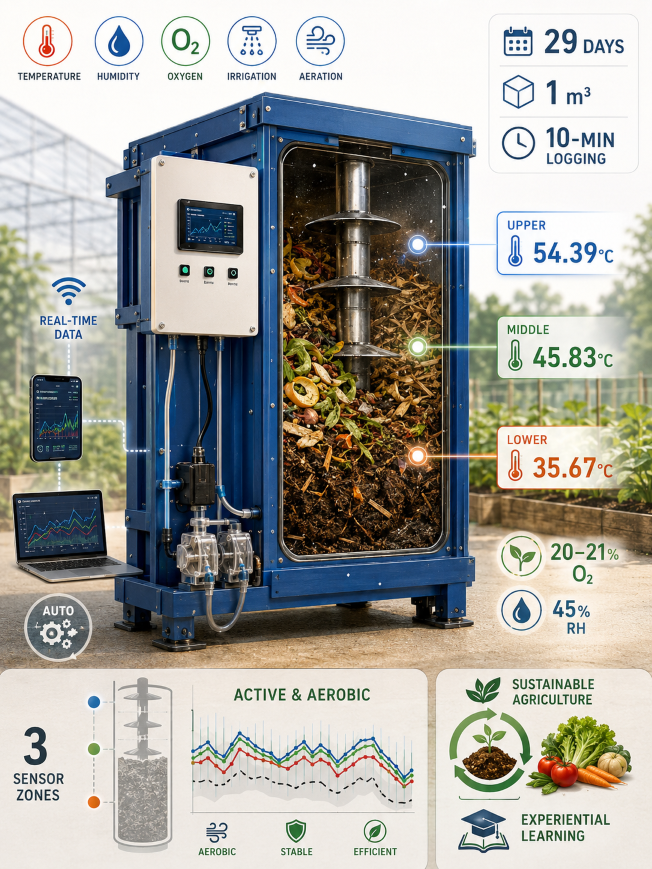
Composting offers a practical pathway for recycling organic waste, yet maintaining favorable process conditions and translating composting into structured experiential learning remain challenging. This study designed and conducted a preliminary field evaluation of an automated, sensor-enabled composting system intended to process vegetative waste from a small-scale farm while supporting sustainability education. The prototype combined an aerated static-pile configuration with forced aeration, humidity-triggered irrigation, three vertically distributed temperature and relative-humidity sensors, oxygen and fill-level monitoring, a touchscreen interface, transparent viewing panels, multiple access points, and remote data logging. A 29-day trial was conducted in an unheated tunnel greenhouse using approximately 1 m³ of vegetative waste and wood chips mixed at a reported 1:1 mass ratio. Sensor data were recorded at 10-minute intervals and analyzed descriptively to examine temporal patterns, vertical variation, system performance, and data completeness. Temperatures showed recurrent diurnal fluctuations and clear vertical stratification, reaching maximum values of 54.39°C, 45.83°C, and 35.67°C in the upper, middle, and lower zones, respectively. Lower-zone measurements were incomplete because of a connection failure, while middle-zone relative humidity remained near sensor saturation, limiting interpretation. The observed temperature increases, absence of malodor, and visible material changes were consistent with ongoing aerobic decomposition, although compost maturity and educational outcomes were not directly assessed. These findings demonstrate the feasibility of integrating monitoring, user interaction, visual access, and real-time data communication in a smart composter. Future work should validate sensor placement, quantify actuator performance, assess compost quality, and evaluate learning outcomes aligned with the United Nations Sustainable Development Goals.
Downloads
Article Details

This work is licensed under a Creative Commons Attribution-ShareAlike 4.0 International License.
Authors who publish with this journal agree to the following terms:
- Copyright of the published article belongs to the authors and grant the journal right of first publication with the work simultaneously licensed under a Creative Commons Attribution-ShareAlike 4.0 (CC BY SA) International License that allows others to share the work with an acknowledgment of the work's authorship and initial publication in this journal.
- Authors are able to enter into separate, additional contractual arrangements for the non-exclusive distribution of the journal's published version of the work (e.g., post it to an institutional repository or publish it in a book), with an acknowledgment of its initial publication in this journal.
- Authors are permitted and encouraged to post their work online (e.g., in institutional repositories or on their website) prior to and during the submission process, as it can lead to productive exchanges, as well as earlier and greater citation of published work (See the Effect of Open Access).
References
[1] A. L. Craveiro, M. T. Santos, and A. Rodrigues, “Implementing Composting and Awareness Campaigns in a Higher Education Institution to Promote Circularity,” Sustain., vol. 17, no. 18, p. 8446, 2025, https://doi.org/10.3390/su17188446
[2] M. Morris, A. McFarland, T. M. Waliczek, and L. Stroup, “A Trans-Boundary Case Study of Water Conserving Agricultural Practices in the South Rio Grande Basin,” Texas J. Agric. Nat. Resour., vol. 29, pp. 23–38, 2016, [Online]. Available: https://txjanr.agintexas.org/index.php/txjanr/article/view/24
[3] L. Hussein, S. A. Ameer, and N. Gogineni, “Advanced Optimization of Compost Utilization from Organic Waste Streams for Enhanced Nutrient Cycling and Soil Fertility Improvement in Smallholder Organic Farms,” in SHS Web of Conferences, 2025, vol. 216, p. 01071. https://doi.org/10.1051/shsconf/202521601071
[4] A. M. Ansari and M. R. Khan, “Role of the Organic Food System in Achieving Sustainable Development Goals: A Review Study,” J. Clim. Chang., vol. 10, no. 4, pp. 9–16, 2024, https://doi.org/10.3233/JCC240028
[5] H. Purwanto, R. Nurhasana, and A. Rohimah, “Assessing the Feasibility of Small-Scale RDF Technology in Urban Solid Waste Management Using Cost-Benefit Analysis,” Adv. Sustain. Sci. Eng. Technol., vol. 7, no. 3, 2025, https://doi.org/10.26877/asset.v7i3.1988
[6] H. W. J. Rittel and M. M. Webber, “Dilemmas in a general theory of planning,” Policy Sci., vol. 4, no. 2, pp. 155–169, 1973, https://doi.org/10.1007/BF01405730
[7] Y. H. Then, J. C. Lai, and Y. L. Then, “Study of forced aeration system for fruit and vegetable waste composting,” in IOP Conference Series: Materials Science and Engineering, 2021, vol. 1195, no. 1, p. 012059. https://doi.org/10.1088/1757-899x/1195/1/012059
[8] I. Mckenzie, S. Diana, S. Jaikishun, and A. Ansari, “Comparative Review of Aerobic and Anaerobic Composting for the Reduction of Organic Waste,” Agric. Rev., vol. 43, no. Of, 2022, https://doi.org/10.18805/ag.r-191
[9] G. Gershuny and L. M. Deborah, The Rodale Book of Composting, Newly Revised and Updated: Simple Methods to Improve Your Soil, Recycle Waste, Grow Healthier Plants, and Create an Earth-Friendly Garden. New York, United States: Rodale Books, 2018.
[10] E. Smidt, K. Meissl, J. Tintner, and E. Binner, “Resource recovery by composting-materials, techniques, quality assessment,” in Composting: Processing, Materials and Approaches, J. C. P. and J. L. Bolin, Ed. New York, United States: Nova Science Publishers inc., 2009, pp. 1–30. [Online]. Available: https://hero.epa.gov/reference/8086466/
[11] C. Oshins, F. Michel, P. Louis, T. L. Richard, and R. Rynk, “The composting Process,” in The Composting Handbook: a how-to and why manual for farm, municipal, institutional and commercial composters, Elsevier, 2021, pp. 51–101. https://doi.org/10.1016/B978-0-323-85602-7.00008-X
[12] P. D. Alexander, “Effect of turning and vessel type on compost temperature and composition in backyard (amateur) composting,” Compost Sci. Util., vol. 15, no. 3, pp. 167–175, 2007, https://doi.org/10.1080/1065657X.2007.10702329
[13] F. Michel et al., “Forced aeration composting, aerated static pile, and similar methods,” in The Composting Handbook: a how-to and why manual for farm, municipal, institutional and commercial composters, Elsevier, 2021, pp. 197–269. https://doi.org/10.1016/B978-0-323-85602-7.00007-8
[14] M. S. Ayilara, O. S. Olanrewaju, O. O. Babalola, and O. Odeyemi, “Waste management through composting: Challenges and potentials,” Sustain., vol. 12, no. 11, p. 4456, 2020, https://doi.org/10.3390/su12114456
[15] X. Zhu-Barker, S. K. Bailey, K. T. Paw U, M. Burger, and W. R. Horwath, “Greenhouse gas emissions from green waste composting windrow,” Waste Manag., vol. 59, pp. 70–79, 2017, https://doi.org/10.1016/j.wasman.2016.10.004
[16] F. Michel et al., “Contained and in-vessel composting methods and methods summary,” in The Composting Handbook: a how-to and why manual for farm, municipal, institutional and commercial composters, Elsevier, 2021, pp. 271–305. https://doi.org/10.1016/B978-0-323-85602-7.00009-1
[17] F. J. Aquino, K. Te, R. Ungab, V. J. Montero, and M. Calamba, “Machine Learning-based Assessment of Automated Composting System for Banana Agricultural Waste,” in IEEE Region 10 Humanitarian Technology Conference, R10-HTC, 2024, pp. 1–6. https://doi.org/10.1109/R10-HTC59322.2024.10778779
[18] A. A. C. Illahi, M. A. Co, J. R. Go, F. J. Magallanes, and J. M. Vong, “Development of an Automated Microcontroller-based In-Vessel Composting System for the Household Setting,” in GCCE 2023 - 2023 IEEE 12th Global Conference on Consumer Electronics, 2023, pp. 323–327. https://doi.org/10.1109/GCCE59613.2023.10315421
[19] M. Elalami, Y. Baskoun, F. Zahra Beraich, M. Arouch, M. Taouzari, and S. D. Qanadli, “Design and Test of the Smart Composter Controlled by Sensors,” in Proceedings of 2019 7th International Renewable and Sustainable Energy Conference, IRSEC 2019, 2019, pp. 1–6. https://doi.org/10.1109/IRSEC48032.2019.9078197
[20] R. Siswoyo Jo, M. Lu, V. Raman, and P. Hanghui Then, “Design and implementation of iot-enabled compost monitoring system,” in ISCAIE 2019 - 2019 IEEE Symposium on Computer Applications and Industrial Electronics, 2019, pp. 23–28. https://doi.org/10.1109/ISCAIE.2019.8743981
[21] R. Bhoir, R. Thakur, P. Tambe, R. Borase, and S. Pawar, “Design and Implementation of Smart Compost System Using IOT,” in 2020 IEEE International Conference for Innovation in Technology, INOCON 2020, 2020, pp. 1–5. https://doi.org/10.1109/INOCON50539.2020.9298219
[22] N. Anggraini, S. F. R. Bachri, and M. T. Rosyadi, “Implementation of LoRaWAN Routing Protocol in Wireless Sensor Network for Smart Compost System with LoRa Communication Module,” in 2023 11th International Conference on Cyber and IT Service Management, CITSM 2023, 2023, pp. 1–5. https://doi.org/10.1109/CITSM60085.2023.10455168
[23] I. B. P. Prayoga, H. H. Nuha, and S. A. Karimah, “Compost Machine Control with Predicted Temperature and Soil Moisture using Regression Tree,” in 2023 3rd International Conference on Intelligent Cybernetics Technology and Applications, ICICyTA 2023, 2023, pp. 443–447. https://doi.org/10.1109/ICICyTA60173.2023.10428775
[24] T. W. Agustina, N. Y. Rustaman, Riandi, and W. Purwianingsih, “The learning of aquaponics practice in university,” in Journal of Physics: Conference Series, 2018, vol. 1013, no. 1, p. 12128. https://doi.org/10.1088/1742-6596/1013/1/012018
[25] D. M. Parr, C. J. Trexler, N. R. Khanna, and B. T. Battisti, “Designing sustainable agriculture education: Academics’ suggestions for an undergraduate curriculum at a land grant university,” Agric. Human Values, vol. 24, no. 4, pp. 523–533, 2007, https://doi.org/10.1007/s10460-007-9084-y
[26] R. Rynk et al., “Why compost?,” in The composting handbook: A how-to and why manual for farm, municipal, institutional and commercial composters, San Diego, CA, USA: Academic Press, 2022, pp. 1–26. https://doi.org/10.1016/B978-0-323-85602-7.00001-7
[27] M. Rasapoor, M. Adl, and B. Pourazizi, “Comparative evaluation of aeration methods for municipal solid waste composting from the perspective of resource management: A practical case study in Tehran, Iran,” J. Environ. Manage., vol. 184, pp. 528–534, 2016, https://doi.org/10.1016/j.jenvman.2016.10.029
[28] D. Lake, A. McFarland, and J. Vogelzang, “Creating resilient interventions to food waste: Aligning and leveraging systems and design thinking,” in Food Waste Management: Solving the Wicked Problem, Springer, 2019, pp. 193–221. https://doi.org/10.1007/978-3-030-20561-4_8
[29] R. J. Williams and K. Grain, “Teaching in a Time of Climate Collapse: From ‘An Education in Hope’ to a Praxis of Critical Hope,” Sustain., vol. 17, no. 12, p. 5459, 2025, https://doi.org/10.3390/su17125459
[30] V. Marchal-Gaillard, “The science behind composting: How household biowaste management practices shape young children’s understanding of organic matter decomposition,” Environ. Educ. Res., vol. 30, no. 1, pp. 37–55, 2024, https://doi.org/10.1080/13504622.2022.2099531
[31] T. Waliczek, A. McFarland, and M. Holmes, “The relationship between a campus composting program and environmental attitudes, environmental locus of control, compost knowledge, and compost attitudes of college students,” Horttechnology, vol. 26, no. 5, pp. 592–598, 2016, https://doi.org/10.21273/HORTTECH03320-16
[32] K. J. Holohan, “Cartography of the Present: The Meaning Crisis and Maps for the Future,” J. Soc. Justice, vol. 11, p. 2023, 2023, [Online]. Available: http://www.transformativestudies.org
[33] A. Snabes, “The Scoop on Composting: A Comprehensive Literature Review on Composting with a Focus on Grand Valley State University,” Honors Project No. 865, 2021. [Online]. Available: https://scholarworks.gvsu.edu/honorsprojects/865/
[34] M. N. Lunag and J. C. Elauria, “Community-based design compost processor: its performance, economic, and environmental impact assessment,” J. Mater. Cycles Waste Manag., vol. 26, no. 6, pp. 3728–3744, 2024, https://doi.org/10.1007/s10163-024-02072-9
[35] Iowa Environmental Mesonet, “IEM computed daily summary of observations,” Iowa State University, 2023. https://www.mesonet.agron.iastate.edu/request/daily.phtml?network=MI_ASOS (accessed May 01, 2026).
[36] L. Fernandes, W. Zhan, N. K. Patni, and P. Y. Jui, “Temperature distribution and variation in passively aerated static compost piles,” Bioresour. Technol., vol. 48, no. 3, pp. 257–263, 1994, https://doi.org/10.1016/0960-8524(94)90155-4
[37] S. Barrington, D. Choinière, M. Trigui, and W. Knight, “Compost convective airflow under passive aeration,” Bioresour. Technol., vol. 86, no. 3, pp. 259–266, 2003, https://doi.org/10.1016/S0960-8524(02)00155-4
[38] A. K. Lau, K. V. Lo, P. H. Liao, and J. C. Yu, “Aeration experiments for swine waste composting,” Bioresour. Technol., vol. 41, no. 2, pp. 145–152, 1992, https://doi.org/10.1016/0960-8524(92)90185-Z
[39] L. Peng et al., “Co-composting of kitchen waste with agriculture and forestry residues and characteristics of compost with different particle size: An industrial scale case study,” Waste Manag., vol. 149, pp. 313–322, 2022, https://doi.org/10.1016/j.wasman.2022.06.029
[40] A. K. Hansen et al., “Biology beyond the Classroom: Experiential Learning through Authentic Research, Design, and Community Engagement,” Integr. Comp. Biol., vol. 61, no. 3, pp. 926–933, 2021, https://doi.org/10.1093/icb/icab155
[41] E. A. Mikhailova, C. J. Post, and D. G. Nelson, “Integrating United Nations Sustainable Development Goals in Soil Science Education,” Soil Syst., vol. 8, no. 1, p. 29, 2024, https://doi.org/10.3390/soilsystems8010029
[42] J. Bouma, L. Montanarella, and G. Evanylo, “The challenge for the soil science community to contribute to the implementation of the UN Sustainable Development Goals,” Soil Use Manag., vol. 35, no. 4, pp. 538–546, 2019, https://doi.org/10.1111/sum.12518
[43] C. C. Johnson, J. B. Walton, and E. E. Peters-Burton, Composting, Grade 5: STEM Road Map for Elementary School, 1st ed. New York, United States: Routledge, 2023. https://doi.org/10.4324/9781003370772
[44] S. W. R. Tsang, E. L. Sharp, and V. Egli, “Children’s knowledge and experience of compost/ing,” J. Geosci. Educ., vol. 74, no. 2, pp. 229–242, 2025, https://doi.org/10.1080/10899995.2025.2537996
[45] A. P. Heriyanti et al., “Exploring Biochar Briquettes from Biomass Waste for Sustainable Energy,” Adv. Sustain. Sci. Eng. Technol., vol. 7, no. 3, 2025, https://doi.org/10.26877/7mhm6t05