
Exploring Teachers’ Perceptions, Experiences and Needs for Augmented Reality-Based Mathematics Learning in Elementary Schools
Article Sidebar
Main Article Content
Abstract
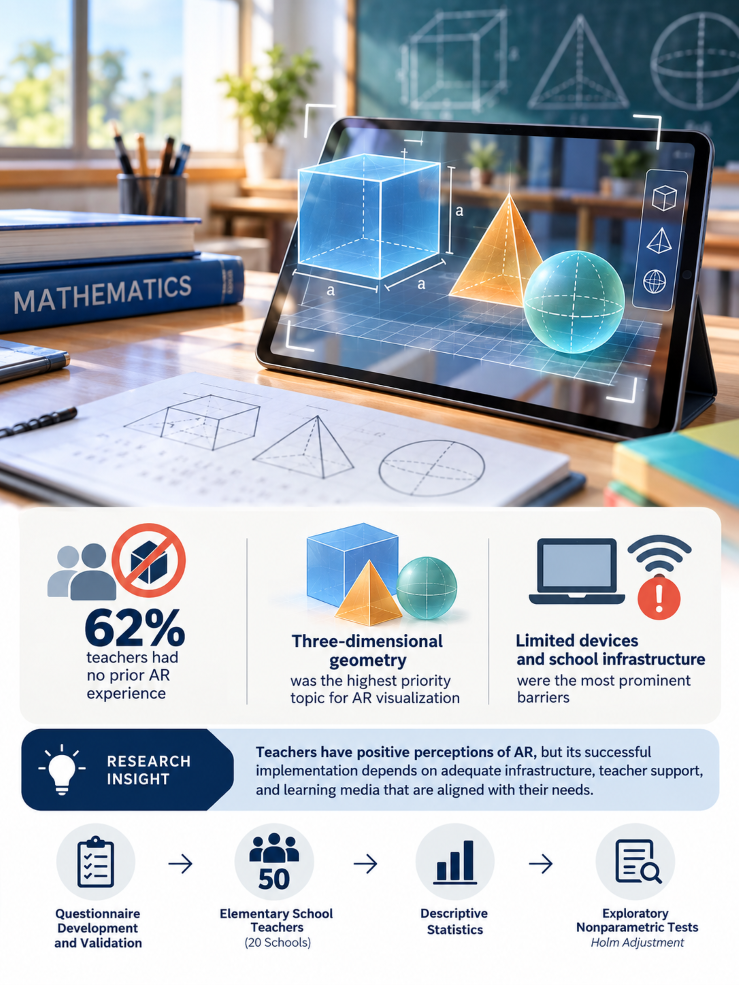
Augmented reality (AR) offers promising representational affordances for elementary mathematics, yet its classroom feasibility depends on teachers’ experience, technological conditions, and implementation support. This study examined teachers’ perceptions of AR, prior digital and AR experience, perceived barriers, mathematics-topic priorities, and requirements for prospective AR-based learning media. A quantitative cross-sectional survey was conducted with 50 elementary-school teachers recruited purposively from 20 public and private schools. Data were collected using a validated questionnaire (S-CVI/Ave = 0.93; Cronbach’s Alpha = 0.79–0.84 for multi-item constructs) and analyzed using descriptive statistics and exploratory nonparametric tests with Holm adjustment. Teachers reported highly favorable perceptions across the four measured constructs (M = 4.59–4.75), although 62% had no prior AR experience and only 8% used AR often or very often. Three-dimensional geometry received the highest perceived need for AR visualization (M = 3.30, SD = 0.91). The most prominent barriers were limited technological devices and school infrastructure (both M = 4.00), while interactive content, ease of use, offline functionality, curriculum alignment, age-appropriate design, institutional support, and training emerged as key implementation requirements. Exploratory associations involving digital-technology use, prior AR experience, and perception scores did not remain statistically significant after Holm correction. These findings position AR adoption as a teacher-informed, needs-driven design problem and provide an empirical basis for prototype development, usability testing, and classroom feasibility evaluation rather than evidence of AR effectiveness or demonstrated implementation readiness.
Downloads
Article Details

This work is licensed under a Creative Commons Attribution-ShareAlike 4.0 International License.
Authors who publish with this journal agree to the following terms:
- Copyright of the published article belongs to the authors and grant the journal right of first publication with the work simultaneously licensed under a Creative Commons Attribution-ShareAlike 4.0 (CC BY SA) International License that allows others to share the work with an acknowledgment of the work's authorship and initial publication in this journal.
- Authors are able to enter into separate, additional contractual arrangements for the non-exclusive distribution of the journal's published version of the work (e.g., post it to an institutional repository or publish it in a book), with an acknowledgment of its initial publication in this journal.
- Authors are permitted and encouraged to post their work online (e.g., in institutional repositories or on their website) prior to and during the submission process, as it can lead to productive exchanges, as well as earlier and greater citation of published work (See the Effect of Open Access).
References
[1] R. T. Azuma, “A survey of augmented reality,” Presence Teleoperators Virtual Environ., vol. 6, no. 4, pp. 355–385, 1997, https://doi.org/10.1162/pres.1997.6.4.355
[2] M. Billinghurst, A. Clark, and G. Lee, “A survey of augmented reality,” Found. Trends Human-Computer Interact., vol. 8, no. 2–3, pp. 73–272, 2014, https://doi.org/10.1561/1100000049
[3] S. A. Nikou, M. Perifanou, and A. A. Economides, “Development and validation of the teachers’ augmented reality competences (TARC) scale,” J. Comput. Educ., vol. 11, no. 4, pp. 1041–1060, 2024, https://doi.org/10.1007/s40692-023-00288-6
[4] J. Zhang, G. Li, Q. Huang, Q. Feng, and H. Luo, “Augmented Reality in K–12 Education: A Systematic Review and Meta-Analysis of the Literature from 2000 to 2020,” Sustain., vol. 14, no. 15, p. 9725, 2022, https://doi.org/10.3390/su14159725
[5] S. Hwang, E. Flavin, and J. E. Lee, “Exploring research trends of technology use in mathematics education: A scoping review using topic modeling,” Educ. Inf. Technol., vol. 28, no. 8, pp. 10753–10780, 2023, https://doi.org/10.1007/s10639-023-11603-0
[6] M. Bulut and R. Borromeo Ferri, “A systematic literature review on augmented reality in mathematics education.,” Eur. J. Sci. Math. Educ., vol. 11, no. 3, pp. 556–572, 2023, https://doi.org/10.30935/scimath/13124
[7] Y. Yang, W. Du, M. Mavrikis, and E. Geraniou, “Spatial Skill Development Through Augmented Reality in Mathematics Education: A Scoping Review,” Digit. Exp. Math. Educ., vol. 12, no. 2, pp. 277–310, 2026, https://doi.org/10.1007/s40751-025-00187-8
[8] W. Tarng, J. K. Huang, and K. L. Ou, “Improving Elementary Students’ Geometric Understanding Through Augmented Reality and Its Performance Evaluation,” Systems, vol. 12, no. 11, p. 493, 2024, https://doi.org/10.3390/systems12110493
[9] M. B. Nadzeri, M. Musa, C. C. Meng, and I. M. Ismail, “The Effects of Augmented Reality Geometry Learning Applications on Spatial Visualization Ability for Lower Primary School Pupils,” Int. J. Interact. Mob. Technol., vol. 18, no. 16, pp. 104–118, 2024, https://doi.org/10.3991/ijim.v18i16.47079
[10] J. Garzón and J. Acevedo, “Meta-analysis of the impact of Augmented Reality on students’ learning gains,” Educ. Res. Rev., vol. 27, pp. 244–260, 2019, https://doi.org/10.1016/j.edurev.2019.04.001
[11] M. C. Howard and M. M. Davis, “A Meta-analysis of augmented reality programs for education and training,” Virtual Real., vol. 27, no. 4, pp. 2871–2894, 2023, https://doi.org/10.1007/s10055-023-00844-6
[12] J. Garzón, Kinshuk, S. Baldiris, J. Gutiérrez, and J. Pavón, “How do pedagogical approaches affect the impact of augmented reality on education? A meta-analysis and research synthesis,” Educ. Res. Rev., vol. 31, p. 100334, 2020, https://doi.org/10.1016/j.edurev.2020.100334
[13] M. Akçayır and G. Akçayır, “Advantages and challenges associated with augmented reality for education: A systematic review of the literature,” Educ. Res. Rev., vol. 20, pp. 1–11, 2017, https://doi.org/10.1016/j.edurev.2016.11.002
[14] I. Radu, “Augmented reality in education: A meta-review and cross-media analysis,” Pers. ubiquitous Comput., vol. 18, no. 6, pp. 1533–1543, 2014, https://doi.org/10.1007/s00779-013-0747-y
[15] M. B. Ibáñez and C. Delgado-Kloos, “Augmented reality for STEM learning: A systematic review,” Comput. Educ., vol. 123, pp. 109–123, 2018, https://doi.org/10.1016/j.compedu.2018.05.002
[16] F. D. Davis, “Perceived usefulness, perceived ease of use, and user acceptance of information technology,” MIS Q. Manag. Inf. Syst., vol. 13, no. 3, pp. 319–339, 1989, https://doi.org/10.2307/249008
[17] P. Mishra and M. J. Koehler, “Technological pedagogical content knowledge: A framework for teacher knowledge,” Teach. Coll. Rec., vol. 108, no. 6, pp. 1017–1054, 2006, https://doi.org/10.1111/j.1467-9620.2006.00684.x
[18] M. Li, C. Vale, H. Tan, and J. Blannin, “A systematic review of TPACK research in primary mathematics education,” Math. Educ. Res. J., vol. 37, no. 2, pp. 281–311, 2025, https://doi.org/10.1007/s13394-024-00491-3
[19] M. Perifanou, A. A. Economides, and S. A. Nikou, “Teachers’ Views on Integrating Augmented Reality in Education: Needs, Opportunities, Challenges and Recommendations,” Futur. Internet, vol. 15, no. 1, p. 20, 2023, https://doi.org/10.3390/fi15010020
[20] S. A. Nikou, M. Perifanou, and A. A. Economides, “Exploring Teachers’ Competences to Integrate Augmented Reality in Education: Results from an International Study,” TechTrends, vol. 68, no. 6, pp. 1208–1221, 2024, https://doi.org/10.1007/s11528-024-01014-4
[21] J. Piedade and E. Batista, “Teachers’ Perceptions of Augmented Reality in Education: Between Pedagogical Potential and Technological Readiness,” Educ. Sci., vol. 15, no. 8, p. 1076, 2025, https://doi.org/10.3390/educsci15081076
[22] M. Freese, A. Teichrew, J. Winkelmann, R. Erb, M. Ullrich, and M. Tremmel, “Measuring teachers’ competencies for a purposeful use of augmented reality experiments in physics lessons,” Front. Educ., vol. 8, p. 1180266, 2023, https://doi.org/10.3389/feduc.2023.1180266
[23] M. A. Maulyda, Sugiman, W. Wuryandani, N. Sulistyani, and A. M. Annizar, “Investigating the role of digital capabilities on the relationship between teacher readiness and teacher skills using augmented reality media in elementary schools: A mediation and moderation analysis,” Soc. Sci. Humanit. Open, vol. 11, p. 101411, 2025, https://doi.org/10.1016/j.ssaho.2025.101411
[24] N. Alalwan, L. Cheng, H. Al-Samarraie, R. Yousef, A. Ibrahim Alzahrani, and S. M. Sarsam, “Challenges and Prospects of Virtual Reality and Augmented Reality Utilization among Primary School Teachers: A Developing Country Perspective,” Stud. Educ. Eval., vol. 66, p. 100876, 2020, https://doi.org/10.1016/j.stueduc.2020.100876
[25] M. Ripsam and C. Nerdel, “Teachers’ attitudes and self-efficacy toward augmented reality in chemistry education,” Front. Educ., vol. 8, p. 1293571, 2023, https://doi.org/10.3389/feduc.2023.1293571
[26] M. Nijhawan, N. Sindhwani, S. Tanwar, and S. Kumar, “Prioritizing barriers influencing educators in adoption of augmented reality in K-5 education,” J. Inf. Syst. Eng. Manag., vol. 10, no. 41s, pp. 355–370, 2025, https://doi.org/10.52783/jisem.v10i41s.7841
[27] S. Bhattacharya, A. Sau, P. Bera, C. Sardar, S. Chaudhuri, and N. Thakur, “Exploring Indian educators’ perceptions, attitudes, and behaviors regarding augmented reality applications in school settings: a comprehensive mixed-methods study,” Front. Educ., vol. 10, p. 1655843, 2025, https://doi.org/10.3389/feduc.2025.1655843
[28] R. J. Maulion and M. Prudente, “Perceptions of K-12 teachers on Mobile Augmented Reality in Biology Education: A Descriptive Action Research,” Int. J. Chem. Educ. Res., pp. 151–164, 2025, https://doi.org/10.20885/ijcer.vol9.iss2.art5
[29] G. Kazakou, G. Koutromanos, and C. Christogiannis, “Examining teachers’ acceptance of augmented reality smart glasses through the immersive technologies acceptance model,” Educ. Inf. Technol., vol. 30, no. 18, pp. 26329–26372, 2025, https://doi.org/10.1007/s10639-025-13687-2
[30] C. B. De Lima, S. Walton, and T. Owen, “A critical outlook at augmented reality and its adoption in education,” Comput. Educ. Open, vol. 3, p. 100103, 2022, https://doi.org/10.1016/j.caeo.2022.100103
[31] S. Cuendet, Q. Bonnard, S. Do-Lenh, and P. Dillenbourg, “Designing augmented reality for the classroom,” Comput. Educ., vol. 68, pp. 557–569, 2013, https://doi.org/10.1016/j.compedu.2013.02.015
[32] H. Tobar-Muñoz, S. Baldiris, and R. Fabregat, “Co-Design of Augmented Reality Games for Learning with Teachers: A Methodological Approach,” Technol. Knowl. Learn., vol. 28, no. 2, pp. 901–923, 2023, https://doi.org/10.1007/s10758-023-09643-z
[33] G. Koutromanos, A. T. Mikropoulos, D. Mavridis, and C. Christogiannis, “The mobile augmented reality acceptance model for teachers and future teachers,” Educ. Inf. Technol., vol. 29, no. 7, pp. 7855–7893, 2024, https://doi.org/10.1007/s10639-023-12116-6
[34] N. I. N. Ahmad and S. N. Junaini, “Augmented Reality for Learning Mathematics: A Systematic Literature Review,” Int. J. Emerg. Technol. Learn., vol. 15, no. 16, pp. 106–122, 2020, https://doi.org/10.3991/ijet.v15i16.14961
[35] L. P. Souza and S. C. S. Jucá, “Insertion of augmented reality in mathematics teaching: A systematic literature review,” Rev. Context. Educ., vol. 39, no. 121, p. e14831, 2024, https://doi.org/10.21527/2179-1309.2024.121.14831
[36] F. A. Hidajat, “Augmented reality applications for mathematical creativity: a systematic review,” J. Comput. Educ., vol. 11, no. 4, pp. 991–1040, 2024, https://doi.org/10.1007/s40692-023-00287-7
[37] M. L. Niess, “Preparing teachers to teach science and mathematics with technology: Developing a technology pedagogical content knowledge,” Teach. Teach. Educ., vol. 21, no. 5, pp. 509–523, 2005, https://doi.org/10.1016/j.tate.2005.03.006
[38] D. A. Schmidt, E. Baran, A. D. Thompson, P. Mishra, M. J. Koehler, and T. S. Shin, “Technological pedagogical content knowledge (TRACK): The development and validation of an assessment instrument for preservice teachers,” J. Res. Technol. Educ., vol. 42, no. 2, pp. 123–149, 2009, https://doi.org/10.1080/15391523.2009.10782544
[39] H. Y. Chang et al., “Ten years of augmented reality in education: A meta-analysis of (quasi-) experimental studies to investigate the impact,” Comput. Educ., vol. 191, p. 104641, 2022, https://doi.org/10.1016/j.compedu.2022.104641
[40] R. Hidayat and Y. Wardat, “A systematic review of Augmented Reality in Science, Technology, Engineering and Mathematics education,” Educ. Inf. Technol., vol. 29, no. 8, pp. 9257–9282, 2024, https://doi.org/10.1007/s10639-023-12157-x
[41] K. R. Bujak, I. Radu, R. Catrambone, B. MacIntyre, R. Zheng, and G. Golubski, “A psychological perspective on augmented reality in the mathematics classroom,” Comput. Educ., vol. 68, pp. 536–544, 2013, https://doi.org/10.1016/j.compedu.2013.02.017
[42] J. Gonnermann-Müller and J. M. Krüger, “Unlocking Augmented Reality Learning Design Based on Evidence From Empirical Cognitive Load Studies—A Systematic Literature Review,” J. Comput. Assist. Learn., vol. 41, no. 1, p. e13095, 2025, https://doi.org/10.1111/jcal.13095
[43] J. Bacca, S. Baldiris, R. Fabregat, S. Graf, and Kinshuk, “Augmented reality trends in education: A systematic review of research and applications,” Educ. Technol. Soc., vol. 17, no. 4, pp. 133–149, 2014.
[44] Z. B. Erşen and Y. Alp, “A Systematic Review of Augmented Reality In Mathematics Education In The Last Decade,” Malaysian Online J. Educ. Technol., vol. 12, no. 1, pp. 15–31, 2024, https://doi.org/10.52380/mojet.2024.12.1.476
[45] E. Demitriadou, K. E. Stavroulia, and A. Lanitis, “Comparative evaluation of virtual and augmented reality for teaching mathematics in primary education,” Educ. Inf. Technol., vol. 25, no. 1, pp. 381–401, 2020, https://doi.org/10.1007/s10639-019-09973-5
[46] C. Walkington et al., “Comparing learning geometry using a tablet to head-mounted display augmented reality: How and when dimensionality matters,” Educ. Inf. Technol., vol. 30, no. 4, pp. 5397–5426, 2025, https://doi.org/10.1007/s10639-024-13008-z
[47] D. Amalia et al., “Development of a Game-Based Learning: Airfield Lighting System Simulator Using Virtual Reality and Augmented Reality,” J. Appl. Eng. Technol. Sci., vol. 5, no. 2, pp. 978–994, 2024, https://doi.org/10.37385/jaets.v5i2.3253
[48] F. Ayu, Ganefri, D. Irfan, A. Huda, and D. Suryani, “Is It Practical Digital Learning Application for Learning 3D Graphic Design Based on Augmented Reality?,” J. Appl. Eng. Technol. Sci., vol. 5, no. 1, pp. 595–607, 2023, https://doi.org/10.37385/jaets.v5i1.1785
[49] H. Na and S. Yun, “The effect of augmented reality on K-12 students’ motivation: a meta-analysis,” Educ. Technol. Res. Dev., vol. 72, no. 6, pp. 2989–3020, 2024, https://doi.org/10.1007/s11423-024-10385-7
[50] V. Venkatesh, M. G. Morris, G. B. Davis, and F. D. Davis, “User acceptance of information technology: Toward a unified view,” MIS Q. Manag. Inf. Syst., vol. 27, no. 3, pp. 425–478, 2003, https://doi.org/10.2307/30036540
[51] R. Scherer, F. Siddiq, and J. Tondeur, “The technology acceptance model (TAM): A meta-analytic structural equation modeling approach to explaining teachers’ adoption of digital technology in education,” Comput. Educ., vol. 128, pp. 13–35, 2019, https://doi.org/10.1016/j.compedu.2018.09.009
[52] J. Voogt, P. Fisser, N. Pareja Roblin, J. Tondeur, and J. van Braak, “Technological pedagogical content knowledge - A review of the literature,” J. Comput. Assist. Learn., vol. 29, no. 2, pp. 109–121, 2013, https://doi.org/10.1111/j.1365-2729.2012.00487.x
[53] S. A. Nikou, “Factors influencing student teachers’ intention to use mobile augmented reality in primary science teaching,” Educ. Inf. Technol., vol. 29, no. 12, pp. 15353–15374, 2024, https://doi.org/10.1007/s10639-024-12481-w
[54] J. M. Rosenberg and M. J. Koehler, “Context and technological pedagogical content knowledge (TPACK): A systematic review,” J. Res. Technol. Educ., vol. 47, no. 3, pp. 186–210, 2015, https://doi.org/10.1080/15391523.2015.1052663
[55] K. F. Hew and T. Brush, “Integrating technology into K-12 teaching and learning: Current knowledge gaps and recommendations for future research,” Educ. Technol. Res. Dev., vol. 55, no. 3, pp. 223–252, 2007, https://doi.org/10.1007/s11423-006-9022-5
[56] F. A. Inan and D. L. Lowther, “Factors affecting technology integration in K-12 classrooms: A path model,” Educ. Technol. Res. Dev., vol. 58, no. 2, pp. 137–154, 2010, https://doi.org/10.1007/s11423-009-9132-y
[57] P. A. Ertmer, “Addressing first- and second-order barriers to change: Strategies for technology integration,” Educ. Technol. Res. Dev., vol. 47, no. 4, pp. 47–61, 1999, https://doi.org/10.1007/BF02299597
[58] S. Baumeister, T. Kocher, P. N. Papapanou, B. Holtfreter, and R. T. Demmer, “Cross‐Sectional Studies: Strengths, Limitations, and Methodological Considerations,” J. Periodontal Res., 2026, https://doi.org/10.1111/jre.70063
[59] T. R. Vetter, “Descriptive Statistics: Reporting the Answers to the 5 Basic Questions of Who, What, Why, When, Where, and a Sixth, so What?,” Anesth. Analg., vol. 125, no. 5, pp. 1797–1802, 2017, https://doi.org/10.1213/ANE.0000000000002471
[60] S. Lydersen, V. Pradhan, P. Senchaudhuri, and P. Laake, “Choice of test for association in small sample unordered r × c tables,” Stat. Med., vol. 26, no. 23, pp. 4328–4343, 2007, https://doi.org/10.1002/sim.2839
[61] P. Schober and T. R. Vetter, “Nonparametric Statistical Methods in Medical Research,” Anesth. Analg., vol. 131, no. 6, pp. 1862–1863, 2020, https://doi.org/10.1213/ANE.0000000000005101
[62] F. F. Peres, “Effect sizes for nonparametric tests,” Biochem. Medica, vol. 36, no. 1, pp. 5–16, 2026, https://doi.org/10.11613/BM.2026.010101
[63] L. A. Palinkas, S. M. Horwitz, C. A. Green, J. P. Wisdom, N. Duan, and K. Hoagwood, “Purposeful Sampling for Qualitative Data Collection and Analysis in Mixed Method Implementation Research,” Adm. Policy Ment. Heal. Ment. Heal. Serv. Res., vol. 42, no. 5, pp. 533–544, 2015, https://doi.org/10.1007/s10488-013-0528-y
[64] C. Andrade, “The Inconvenient Truth About Convenience and Purposive Samples,” Indian J. Psychol. Med., vol. 43, no. 1, pp. 86–88, 2021, https://doi.org/10.1177/0253717620977000
[65] E. von Elm, D. G. Altman, M. Egger, S. J. Pocock, P. C. Gøtzsche, and J. P. Vandenbroucke, “The Strengthening the Reporting of Observational Studies in Epidemiology (STROBE) statement: guidelines for reporting observational studies.,” Lancet, vol. 370, no. 9596, pp. 1453–1457, 2007, https://doi.org/10.1016/S0140-6736(07)61602-X
[66] G. Eysenbach, “Improving the quality of web surveys: The Checklist for Reporting Results of Internet E-Surveys (CHERRIES),” Journal of Medical Internet Research, vol. 6, no. 3. Gunther Eysenbach Centre for Global eHealth Innovation, Toronto, Canada, p. e34, 2004. https://doi.org/10.2196/jmir.6.3.e34
[67] American Association for Public Opinion Research, Standard definitions: Final dispositions of case codes and outcome rates for surveys, 10th ed. Alexandria, VA, USA: AAPOR, 2023. [Online]. Available: https://aapor.org/wp-content/uploads/2024/03/Standards-Definitions-10th-edition.pdf
[68] D. Lakens, “Sample Size Justification,” Collabra Psychol., vol. 8, no. 1, p. 33267, 2022, https://doi.org/10.1525/collabra.33267
[69] G. O. Boateng, T. B. Neilands, E. A. Frongillo, H. R. Melgar-Quiñonez, and S. L. Young, “Best Practices for Developing and Validating Scales for Health, Social, and Behavioral Research: A Primer,” Front. Public Heal., vol. 6, p. 149, 2018, https://doi.org/10.3389/fpubh.2018.00149
[70] D. F. Polit, C. T. Beck, and S. V. Owen, “Focus on research methods: Is the CVI an acceptable indicator of content validity? Appraisal and recommendations,” Res. Nurs. Heal., vol. 30, no. 4, pp. 459–467, 2007, https://doi.org/10.1002/nur.20199
[71] G. A. Johanson and G. P. Brooks, “Initial scale development: Sample size for pilot studies,” Educ. Psychol. Meas., vol. 70, no. 3, pp. 394–400, 2010, https://doi.org/10.1177/0013164409355692
[72] S. E. Harpe, “How to analyze Likert and other rating scale data,” Curr. Pharm. Teach. Learn., vol. 7, no. 6, pp. 836–850, 2015, https://doi.org/10.1016/j.cptl.2015.08.001
[73] G. H. Freeman and J. H. Halton, “Note on an exact treatment of contingency, goodness of fit and other problems of significance.,” Biometrika, vol. 38, no. 1–2, pp. 141–149, 1951, https://doi.org/10.1093/biomet/38.1-2.141
[74] Sture Holm, “A Simple Sequentially Rejective Multiple Test Procedure,” Scand. J. Stat., vol. 6, no. 2, pp. 65–70, 1979, https://doi.org/10.2307/4615733
[75] E. Flavin, S. Hwang, and M. T. Flavin, “Augmented Reality for Mathematics Achievement: A Meta-Analysis of Main and Moderator Effects,” Int. J. Sci. Math. Educ., vol. 23, no. 7, pp. 2305–2330, 2025, https://doi.org/10.1007/s10763-025-10546-x
[76] R. Hidayat, S. Samsudin, X. Wang, and S. N. A. Rahman, “Augmented Reality in Science, Technology, Engineering and Mathematics Education: A Meta-Analysis,” J. Comput. Assist. Learn., vol. 42, no. 1, p. e70164, 2026, https://doi.org/10.1002/jcal.70164
[77] M. Poupard, F. Larrue, H. Sauzéon, and A. Tricot, “A systematic review of immersive technologies for education: Learning performance, cognitive load and intrinsic motivation,” Br. J. Educ. Technol., vol. 56, no. 1, pp. 5–41, 2025, https://doi.org/10.1111/bjet.13503
[78] X. Zhu, K. Peng, S. Yu, and G. Wang, “Can augmented reality technology reduce learners’ cognitive load? A meta-analysis,” Smart Learn. Environ., vol. 13, no. 1, p. 9, 2026, https://doi.org/10.1186/s40561-025-00429-7
[79] G. S. Sidik, T. Antiya, R. F. Zahrah, I. F. Apriani, and M. Salimi, “What Are the Learning Obstacles in Students’ Algebraic Thinking During the Introduction of Plane Geometry Material?,” Salud, Cienc. y Tecnol., vol. 5, p. 1160, 2025, https://doi.org/10.56294/saludcyt20251160
[80] E. Nur’aeni, L. Nur, M. R. W. Muharram, and N. F. Dewi, “Didactical design of cube nets based on Pecle traditional games in primary school,” in Journal of Physics: Conference Series, 2019, vol. 1318, no. 1, p. Art. 12075. https://doi.org/10.1088/1742-6596/1318/1/012075
[81] M. Salimi, L. E. W. Fajari, and I. F. Apriani, “The Digital Empathy Paradox: Beyond ParenteAI’s Technical Efficacy,” Evidence-Based Pract. Child Adolesc. Ment. Heal., vol. 11, no. 2, pp. 329–330, 2026, https://doi.org/10.1080/23794925.2026.2666767