
From Environmental Literacy to Sustainable Lifestyle: A Three-Wave CB-SEM Analysis of Virtual Reality Learning Experience among University Students
Article Sidebar
Main Article Content
Abstract
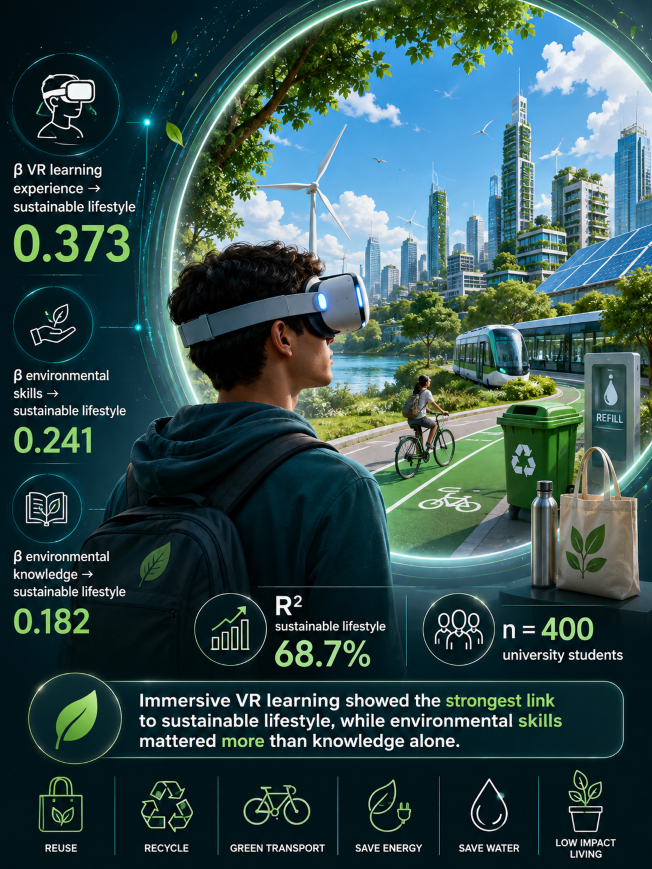
Universities increasingly require pedagogical approaches that connect environmental literacy with sustainable lifestyle practices. This study examined the associations of environmental knowledge and environmental skills with sustainable lifestyle and assessed potential indirect pathways through a virtual reality (VR) learning experience. The final analytical sample comprised 400 university students who completed all three assessments and met the prespecified data-quality criteria. Environmental knowledge and skills were measured before the session, VR learning experience immediately afterward, and sustainable lifestyle through a self-report follow-up two weeks later. Confirmatory factor analysis and covariance-based structural equation modeling were applied. The model demonstrated acceptable fit (CMIN/DF = 2.376, RMSEA = 0.059, SRMR = 0.052, CFI = 0.936, TLI = 0.927). Environmental knowledge was positively associated with sustainable lifestyle (β = 0.182, p < 0.001) and VR learning experience (β = 0.312, p < 0.001). Environmental skills showed larger standardized associations with sustainable lifestyle (β = 0.241, p < 0.001) and VR learning experience (β = 0.451, p < 0.001). VR learning experience had the largest standardized direct association with sustainable lifestyle (β = 0.373, p < 0.001). The model-implied indirect effects were 0.116 for environmental knowledge and 0.168 for environmental skills and were interpreted descriptively. The model explained 51.4% of the variance in VR learning experience and 68.7% of the variance in sustainable lifestyle. These findings suggest that immersive learning experience may provide an intermediate link between environmental literacy and short-term self-reported sustainable practices. Causal and long-term claims require comparison groups, longer follow-up, and objective behavioral indicators.
Downloads
Article Details

This work is licensed under a Creative Commons Attribution-ShareAlike 4.0 International License.
Authors who publish with this journal agree to the following terms:
- Copyright of the published article belongs to the authors and grant the journal right of first publication with the work simultaneously licensed under a Creative Commons Attribution-ShareAlike 4.0 (CC BY SA) International License that allows others to share the work with an acknowledgment of the work's authorship and initial publication in this journal.
- Authors are able to enter into separate, additional contractual arrangements for the non-exclusive distribution of the journal's published version of the work (e.g., post it to an institutional repository or publish it in a book), with an acknowledgment of its initial publication in this journal.
- Authors are permitted and encouraged to post their work online (e.g., in institutional repositories or on their website) prior to and during the submission process, as it can lead to productive exchanges, as well as earlier and greater citation of published work (See the Effect of Open Access).
References
[1] T. Jackson, “Motivating Sustainable Consumption,” A Rev. Evid. Consum. Behav. Behav. Chang. A Rep. to Sustain. Dev. Res. Netw. as part ESRC Sustain. Technol. Program. Cent. Environ. Strateg. Univ. Surrey Guildf., vol. 15, no. January, pp. 1027–1051, 2005, https://doi.org/10.1260/0958305043026573
[2] S. Lorek and D. Fuchs, “Strong sustainable consumption governance–precondition for a degrowth path?,” J. Clean. Prod., vol. 38, pp. 36–43, 2013.
[3] P. C. Stern, “Toward a coherent theory of environmentally significant behavior,” J. Soc. Issues, vol. 56, no. 3, pp. 407–424, 2000, https://doi.org/10.1111/0022-4537.00175
[4] S. Barr, “Sustainable Lifestyles,” Environ. Soc., pp. 177–206, 2020, https://doi.org/10.4324/9781315579986-16
[5] F. G. Kaiser, “A general measure of ecological behavior,” J. Appl. Soc. Psychol., vol. 28, no. 5, pp. 395–422, 1998, https://doi.org/10.1111/j.1559-1816.1998.tb01712.x
[6] F. G. Kaiser and M. Wilson, “Goal-directed conservation behavior: The specific composition of a general performance,” Pers. Individ. Dif., vol. 36, no. 7, pp. 1531–1544, 2004, https://doi.org/10.1016/j.paid.2003.06.003
[7] F. Lange and S. Dewitte, “Measuring pro-environmental behavior: Review and recommendations,” J. Environ. Psychol., vol. 63, pp. 92–100, 2019, https://doi.org/10.1016/j.jenvp.2019.04.009
[8] UNESCO, Shaping the Future We Want UN Decade of Education for Sustainable Development. 2005-2014 Final Report. Paris: UNESCO, 2014. [Online]. Available: http://unesdoc.unesco.org/images/0023/002301/230171e.pdf
[9] K. S. Hollweg, J. R. Taylor, R. W. Bybee, T. J. Marcinkowski, W. C. McBeth, and P. Zoido, “Developing a framework for assessing environmental literacy,” vol. 122. North American Association for Environmental Education, Washington, DC, 2011. [Online]. Available: http://www.naaee.net/framework
[10] C. E. Roth, Environmental Literacy: Its Roots, Evolution and Directions in the 1990s. Columbus: ERIC/CSMEE Publications, 1992. https://eric.ed.gov/?id=ED348235
[11] J. Frick, F. G. Kaiser, and M. Wilson, “Environmental knowledge and conservation behavior: Exploring prevalence and structure in a representative sample,” Pers. Individ. Dif., vol. 37, no. 8, pp. 1597–1613, 2004, https://doi.org/10.1016/j.paid.2004.02.015
[12] D. Olsson, N. Gericke, W. Sass, and J. Boeve-de Pauw, “Self-perceived action competence for sustainability: the theoretical grounding and empirical validation of a novel research instrument,” Environ. Educ. Res., vol. 26, no. 5, pp. 742–760, 2020, https://doi.org/10.1080/13504622.2020.1736991
[13] A. Wiek, L. Withycombe, and C. L. Redman, “Key competencies in sustainability: A reference framework for academic program development,” Sustain. Sci., vol. 6, no. 2, pp. 203–218, 2011, https://doi.org/10.1007/s11625-011-0132-6
[14] K. Brundiers et al., “Key competencies in sustainability in higher education—toward an agreed-upon reference framework,” Sustain. Sci., vol. 16, no. 1, pp. 13–29, 2021, https://doi.org/10.1007/s11625-020-00838-2
[15] A. Kollmuss and J. Agyeman, “Mind the Gap: Why do people act environmentally and what are the barriers to pro-environmental behavior?,” Environ. Educ. Res., vol. 8, no. 3, pp. 239–260, 2002, https://doi.org/10.1080/13504620220145401
[16] L. Steg and C. Vlek, “Encouraging pro-environmental behaviour: An integrative review and research agenda,” J. Environ. Psychol., vol. 29, no. 3, pp. 309–317, 2009, https://doi.org/10.1016/j.jenvp.2008.10.004
[17] S. Bamberg and G. Möser, “Twenty years after Hines, Hungerford, and Tomera: A new meta-analysis of psycho-social determinants of pro-environmental behaviour,” J. Environ. Psychol., vol. 27, no. 1, pp. 14–25, 2007, https://doi.org/10.1016/j.jenvp.2006.12.002
[18] R. Gifford, “The Dragons of Inaction: Psychological Barriers That Limit Climate Change Mitigation and Adaptation,” Am. Psychol., vol. 66, no. 4, pp. 290–302, 2011, https://doi.org/10.1037/a0023566
[19] K. T. Stevenson, M. N. Peterson, H. D. Bondell, A. G. Mertig, and S. E. Moore, “Environmental, Institutional, and Demographic Predictors of Environmental Literacy among Middle School Children,” PLoS One, vol. 8, no. 3, p. e59519, 2013, https://doi.org/10.1371/journal.pone.0059519
[20] B. Verplanken and W. Wood, “Interventions to break and create consumer habits,” J. Public Policy Mark., vol. 25, no. 1, pp. 90–103, 2006, https://doi.org/10.1509/jppm.25.1.90
[21] B. Melovic, S. Rogic, J. C. Smolovic, B. Dudic, and M. Gregus, “The impact of sport sponsorship perceptions and attitudes on purchasing decision of fans as consumers-relevance for promotion of corporate social responsibility and sustainable practices,” Sustain., vol. 11, no. 22, p. 6389, 2019, https://doi.org/10.3390/su11226389
[22] F. Mogensen and K. Schnack, “The action competence approach and the ‘new’ discourses of education for sustainable development, competence and quality criteria,” Environ. Educ. Res., vol. 16, no. 1, pp. 59–74, 2010, https://doi.org/10.1080/13504620903504032
[23] D. Hamilton, J. McKechnie, E. Edgerton, and C. Wilson, “Immersive virtual reality as a pedagogical tool in education: a systematic literature review of quantitative learning outcomes and experimental design,” J. Comput. Educ., vol. 8, no. 1, pp. 1–32, 2021, https://doi.org/10.1007/s40692-020-00169-2
[24] J. Radianti, T. A. Majchrzak, J. Fromm, and I. Wohlgenannt, “A systematic review of immersive virtual reality applications for higher education: Design elements, lessons learned, and research agenda,” Comput. Educ., vol. 147, p. 103778, 2020, https://doi.org/10.1016/j.compedu.2019.103778
[25] T. Schubert, F. Friedmann, and H. Regenbrecht, “The experience of presence: Factor analytic insights,” Presence Teleoperators Virtual Environ., vol. 10, no. 3, pp. 266–281, 2001, https://doi.org/10.1162/105474601300343603
[26] B. G. Witmer and M. J. Singer, “Measuring presence in virtual environments: A presence questionnaire,” Presence, vol. 7, no. 3, pp. 225–240, 1998.
[27] G. Makransky and G. B. Petersen, “Immersive virtual reality and learning,” Learn. Instr., vol. 80, no. 4, p. 101509, 2022, https://doi.org/10.1016/j.learninstruc.2022.101509
[28] J. Parong and R. E. Mayer, “Cognitive and affective processes for learning science in immersive virtual reality,” J. Comput. Assist. Learn., vol. 37, no. 1, pp. 226–241, 2021, https://doi.org/10.1111/jcal.12482
[29] E. S. Sahabuddin and A. Makkasau, “Utilization of virtual reality as a learning tool to increase students’ pro-environmental behavior at universities: A maximum likelihood estimation approach,” Eurasia J. Math. Sci. Technol. Educ., vol. 20, no. 12, p. em2540, 2024, https://doi.org/10.29333/ejmste/15654
[30] S. J. Ahn, J. N. Bailenson, and D. Park, “Short- and long-term effects of embodied experiences in immersive virtual environments on environmental locus of control and behavior,” Comput. Human Behav., vol. 39, pp. 235–245, 2014, https://doi.org/10.1016/j.chb.2014.07.025
[31] D. M. Markowitz, R. Laha, B. P. Perone, R. D. Pea, and J. N. Bailenson, “Immersive Virtual Reality field trips facilitate learning about climate change,” Front. Psychol., vol. 9, no. NOV, p. 2364, 2018, https://doi.org/10.3389/fpsyg.2018.02364
[32] D. Pimentel and S. Kalyanaraman, “The effects of embodying wildlife in virtual reality on conservation behaviors,” Sci. Rep., vol. 12, no. 1, p. 6439, 2022, https://doi.org/10.1038/s41598-022-10268-y
[33] R. B. Stevenson, M. Brody, J. Dillon, and A. E. J. Wals, International handbook of research on environmental education. Routledge New York, 2013. https://doi.org/10.4324/9780203813331
[34] F. D. Pertiwi et al., “A New Approach to Measuring Institutional and Researcher Contributions to the SDGs: Combining Data from Elsevier SciVal and VOSviewer,” Adv. Sustain. Sci. Eng. Technol., vol. 6, no. 4, 2024, https://doi.org/10.26877/asset.v6i4.1076
[35] G. Makransky, T. S. Terkildsen, and R. E. Mayer, “Adding immersive virtual reality to a science lab simulation causes more presence but less learning,” Learn. Instr., vol. 60, pp. 225–236, 2019, https://doi.org/10.1016/j.learninstruc.2017.12.007
[36] R. R. Putra, I. D. Perwitasari, D. M. Rangkuty, V. Tasril, S. Handayani, and A. S. Dewi, “From Virtual To Reality: How Metaverse and VR Technologies Influence Travel Decisions,” J. Appl. Eng. Technol. Sci., vol. 6, no. 2, pp. 862–873, 2025, https://doi.org/10.37385/jaets.v6i2.6314
[37] A. V. Agbedahin, “Sustainable development, Education for Sustainable Development, and the 2030 Agenda for Sustainable Development: Emergence, efficacy, eminence, and future,” Sustain. Dev., vol. 27, no. 4, pp. 669–680, 2019, https://doi.org/10.1002/sd.1931
[38] H. Kopnina, “Education for the future? Critical evaluation of education for sustainable development goals,” J. Environ. Educ., vol. 51, no. 4, pp. 280–291, 2020, https://doi.org/10.1080/00958964.2019.1710444
[39] G. Makransky and G. B. Petersen, “The Cognitive Affective Model of Immersive Learning (CAMIL): a Theoretical Research-Based Model of Learning in Immersive Virtual Reality,” Educ. Psychol. Rev., vol. 33, no. 3, pp. 937–958, 2021, https://doi.org/10.1007/s10648-020-09586-2
[40] C. Arias, J. B. Cadena Lozano, and M. A. Bello Bernal, “The Role of Value in Extending the Lifetime of Products: An Analysis of Perceived Value and Green Consumption Values on Pro-Circular Behaviors of Repair and Reuse,” Sustain., vol. 16, no. 4, p. 1567, 2024, https://doi.org/10.3390/su16041567
[41] B. Borusiak, A. Szymkowiak, E. Horska, N. Raszka, and E. Zelichowska, “Towards building sustainable consumption: A study of second-hand buying intentions,” Sustain., vol. 12, no. 3, p. 875, 2020, https://doi.org/10.3390/su12030875
[42] B. Gatersleben, L. Steg, and C. Vlek, “Measurement and determinants of environmentally significant consumer behavior,” Environ. Behav., vol. 34, no. 3, pp. 335–362, 2002, https://doi.org/10.1177/0013916502034003004
[43] T. Marcinkowski and A. Reid, “Reviews of research on the attitude–behavior relationship and their implications for future environmental education research,” Environmental Education Research, vol. 25, no. 4. Taylor & Francis, pp. 459–471, 2019. https://doi.org/10.1080/13504622.2019.1634237
[44] E. Shove, “Beyond the ABC: Climate change policy and theories of social change,” Environ. Plan. A, vol. 42, no. 6, pp. 1273–1285, 2010, https://doi.org/10.1068/a42282
[45] F. Creutzig, B. Fernandez, H. Haberl, R. Khosla, Y. Mulugetta, and K. C. Seto, “Beyond Technology: Demand-Side Solutions for Climate Change Mitigation,” Annu. Rev. Environ. Resour., vol. 41, no. 1, pp. 173–198, 2016, https://doi.org/10.1146/annurev-environ-110615-085428
[46] L. Steg, “Psychology of Climate Change,” Annu. Rev. Psychol., vol. 74, no. 1, pp. 391–421, 2023, https://doi.org/10.1146/annurev-psych-032720-042905
[47] Q. Miao and C. Nduneseokwu, “Advancing Environmental Leadership: Education, Development, and Training,” Environ. Leadersh. a VUCA Era, pp. 467–538, 2024, https://doi.org/10.1007/978-981-96-0324-4_10
[48] A. Shutaleva, “Ecological Culture and Critical Thinking: Building of a Sustainable Future,” Sustain., vol. 15, no. 18, p. 13492, 2023, https://doi.org/10.3390/su151813492
[49] A. E. Torsdottir, D. Olsson, and A. T. Sinnes, “Developing action competence for sustainability – Do school experiences in influencing society matter?,” Glob. Environ. Chang., vol. 86, p. 102840, 2024, https://doi.org/10.1016/j.gloenvcha.2024.102840
[50] I. Oinonen, T. Seppälä, and R. Paloniemi, “How does action competence explain young people’s sustainability action?,” Environ. Educ. Res., vol. 30, no. 4, pp. 499–518, 2024, https://doi.org/10.1080/13504622.2023.2241675
[51] J. B. de Pauw, N. Gericke, D. Olsson, and T. Berglund, “The effectiveness of education for sustainable development,” Sustain., vol. 7, no. 11, pp. 15693–15717, 2015, https://doi.org/10.3390/su71115693
[52] J. Parong and R. E. Mayer, “Learning science in immersive virtual reality,” J. Educ. Psychol., vol. 110, no. 6, pp. 785–797, 2018, https://doi.org/10.1037/edu0000241
[53] P. M. Podsakoff, S. B. MacKenzie, J. Y. Lee, and N. P. Podsakoff, “Common Method Biases in Behavioral Research: A Critical Review of the Literature and Recommended Remedies,” J. Appl. Psychol., vol. 88, no. 5, pp. 879–903, 2003, https://doi.org/10.1037/0021-9010.88.5.879
[54] S. Campbell et al., “Purposive sampling: complex or simple? Research case examples,” J. Res. Nurs., vol. 25, no. 8, pp. 652–661, 2020, https://doi.org/10.1177/1744987120927206
[55] E. Chang, H. T. Kim, and B. Yoo, “Virtual Reality Sickness: A Review of Causes and Measurements,” Int. J. Hum. Comput. Interact., vol. 36, no. 17, pp. 1658–1682, 2020, https://doi.org/10.1080/10447318.2020.1778351
[56] A. W. Meade and S. B. Craig, “Identifying careless responses in survey data,” Psychol. Methods, vol. 17, no. 3, pp. 437–455, 2012, https://doi.org/10.1037/a0028085
[57] J. Daniel, Sampling Essentials: Practical Guidelines for Making Sampling Choices. Sage publications, 2014. https://doi.org/10.4135/9781452272047
[58] S. Campbell, M. Greenwood, S. Prior, T. Shearer, K. Walkem, S. Young, D. Bywaters, and K. Walker, “Purposive sampling: Complex or simple? Research case examples,” J. Res. Nurs., vol. 25, no. 8, pp. 652–661, 2020, https://doi.org/10.1177/1744987120927206
[59] E. J. Wolf, K. M. Harrington, S. L. Clark, and M. W. Miller, “Sample Size Requirements for Structural Equation Models: An Evaluation of Power, Bias, and Solution Propriety,” Educ. Psychol. Meas., vol. 73, no. 6, pp. 913–934, 2013, https://doi.org/10.1177/0013164413495237
[60] J. F. Hair, W. C. Black, B. J. Babin, and R. E. Anderson, “Multivariate data analysis,” 2019.
[61] B. M. Byrne, Structural equation modeling with Mplus: Basic concepts, applications, and programming. routledge, 2013. https://doi.org/10.4324/9780203807644
[62] L. T. Hu and P. M. Bentler, “Cutoff criteria for fit indexes in covariance structure analysis: Conventional criteria versus new alternatives,” Struct. Equ. Model., vol. 6, no. 1, pp. 1–55, 1999, https://doi.org/10.1080/10705519909540118
[63] R. B. Kline, Principles and practice of structural equation modeling. Guilford publications, 2023.
[64] R. E. Schumacker and R. G. Lomax, A Beginner’s Guide to Structural Equation Modeling. Oxfordshire, United Kingdom: psychology press, 2004. https://doi.org/10.4324/9781410610904
[65] R. Hoyle and A. T. Panter, “Writing about structural equation models,” Struct. Equ. Model. Concepts, issues, Appl., pp. 158–176, 1995.
[66] S. A. Mulaik, L. R. James, J. Van Alstine, N. Bennett, S. Lind, and C. D. Stilwell, “Evaluation of Goodness-of-Fit Indices for Structural Equation Models,” Psychol. Bull., vol. 105, no. 3, pp. 430–445, 1989, https://doi.org/10.1037/0033-2909.105.3.430
[67] C. Fornell and D. F. Larcker, “Evaluating Structural Equation Models with Unobservable Variables and Measurement Error,” J. Mark. Res., vol. 18, no. 1, p. 39, 1981, https://doi.org/10.2307/3151312
[68] J. van de Wetering, P. Leijten, J. Spitzer, and S. Thomaes, “Does environmental education benefit environmental outcomes in children and adolescents? A meta-analysis,” J. Environ. Psychol., vol. 81, p. 101782, 2022, https://doi.org/10.1016/j.jenvp.2022.101782
[69] M. Mago, M. Yadav, S. Sharma, and H. Kaur, “Environmental knowledge influencing pro-environmental behavior among university students: a serial mediation and MGA approach,” Int. J. Sustain. High. Educ., vol. 26, no. 5, pp. 1072–1095, 2025, https://doi.org/10.1108/IJSHE-02-2024-0110
[70] R. Portus et al., “Exploring environmental value action gap and education research: a semi-systematic literature review,” Environ. Educ. Res., vol. 30, no. 6, pp. 833–863, 2024, https://doi.org/10.1080/13504622.2024.2314060
[71] C. Neves, T. Oliveira, and F. Santini, “Understanding the determinants of sustainable consumption behavior: Insights from a meta and weight analysis,” J. Environ. Manage., vol. 393, p. 126932, 2025, https://doi.org/10.1016/j.jenvman.2025.126932
[72] F. E. Ikuemonisan, Y. O. Kayode, O. O. Popogbe, and O. V. Ikuomenisan, “The role of environmental knowledge, subjective norms, perceived behavioral control, and institutional support in social media advocacy for geoscience-informed sustainability practices,” Discov. Sustain., vol. 6, no. 1, 2025, https://doi.org/10.1007/s43621-025-01911-5
[73] A. Dioba, V. Kroker, S. Dewitte, and F. Lange, “Barriers to Pro-Environmental Behavior Change: A Review of Qualitative Research,” Sustain., vol. 16, no. 20, p. 8776, 2024, https://doi.org/10.3390/su16208776
[74] X. Yao, Y. Liu, and G. Qi, “Enhancing sustainable consumer practices: the role of environmental knowledge in adopting BORS services,” Asia Pacific J. Mark. Logist., vol. 37, no. 7, pp. 1937–1954, 2025, https://doi.org/10.1108/APJML-05-2024-0649
[75] A. K. Trinh, M. D. Tran, and S. Adomako, “Environmental Knowledge and Sustainable Consumption Behavior: Evidence From Vietnam,” Sustain. Dev., vol. 33, no. S1, pp. 577–593, 2025, https://doi.org/10.1002/sd.70013
[76] A.-B. Ciocîrlan, H. Baird, and R. Rowe, “A systematic review and meta-analysis of the relationships between pro-environmental behaviours,” J. Environ. Psychol., vol. 108, Art. no. 102807, 2025. https://doi.org/10.1016/j.jenvp.2025.102807
[77] W. Świątkowski, F. L. Surret, J. Henry, C. Buchs, E. P. Visintin, and F. Butera, “Interventions promoting pro-environmental behaviors in children: A meta-analysis and a research agenda,” J. Environ. Psychol., vol. 96, p. 102295, 2024, https://doi.org/10.1016/j.jenvp.2024.102295
[78] B. B. Jensen and K. Schnack, “The action competence approach in environmental education,” Environ. Educ. Res., vol. 3, no. 2, pp. 163–178, 1997, https://doi.org/10.1080/1350462970030205
[79] A. Redman, A. Wiek, and M. Barth, “Current practice of assessing students’ sustainability competencies: a review of tools,” Sustain. Sci., vol. 16, no. 1, pp. 117–135, 2021, https://doi.org/10.1007/s11625-020-00855-1
[80] P. Sá, M. Lourenço, and V. Carlos, “Sustainability Competencies in Higher Education Research: An Analysis of Doctoral Theses in Portugal,” Eur. J. Investig. Heal. Psychol. Educ., vol. 12, no. 4, pp. 387–399, 2022, https://doi.org/10.3390/ejihpe12040028
[81] O. Álvarez-García and J. Sureda-Negre, “Greenwashing and education: An evidence-based approach,” J. Environ. Educ., vol. 54, no. 4, pp. 265–277, 2023. https://doi.org/10.1080/00958964.2023.2238190
[82] D. Irfan et al., “Exploring the Effectiveness of VR-Based Educational Games in Improving Student Engagement and Comprehension in Computer Architecture,” J. Appl. Eng. Technol. Sci., vol. 6, no. 2, pp. 1312–1323, 2025, https://doi.org/10.37385/jaets.v6i2.7070
[83] G. B. Petersen, G. Petkakis, and G. Makransky, “A study of how immersion and interactivity drive VR learning,” Comput. Educ., vol. 179, p. 104429, 2022, https://doi.org/10.1016/j.compedu.2021.104429
[84] V. Aksel Stenberdt and G. Makransky, “Mastery experiences in immersive virtual reality promote pro-environmental waste-sorting behavior,” Comput. Educ., vol. 198, p. 104760, 2023, https://doi.org/10.1016/j.compedu.2023.104760
[85] H. Sungur, Z. M. C. van Berlo, H. Hegyiová, and T. Hartmann, “Designing effective VR experiences for pro-environmental outcomes: Enhancing self-efficacy through mastering solutions,” Comput. Hum. Behav. Reports, vol. 19, p. 100783, 2025, https://doi.org/10.1016/j.chbr.2025.100783
[86] C. Kormos and R. Gifford, “The validity of self-report measures of proenvironmental behavior: A meta-analytic review,” J. Environ. Psychol., vol. 40, pp. 359–371, 2014, https://doi.org/10.1016/j.jenvp.2014.09.003
[87] K. Koller, P. K. Pankowska, and C. Brick, “Identifying bias in pro-environmental behavior,” Curr. Res. Ecol. Soc. Psychol., vol. 4, Art. no. 100087, 2023. https://doi.org/10.1016/j.cresp.2022.100087
[88] S. Vesely and C. A. Klöckner, “Social Desirability in Environmental Psychology Research: Three Meta-Analyses,” Front. Psychol., vol. 11, p. 1395, 2020, https://doi.org/10.3389/fpsyg.2020.01395
[89] O. Y. Zhu, D. Greene, and S. Dolnicar, “Should the risk of social desirability bias in survey studies be assessed at the level of each pro-environmental behaviour?,” Tour. Manag., vol. 104, p. 104933, 2024, https://doi.org/10.1016/j.tourman.2024.104933
[90] I. Miguel-Alonso, D. Checa, H. Guillen-Sanz, and A. Bustillo, “Evaluation of the novelty effect in immersive Virtual Reality learning experiences,” Virtual Real., vol. 28, no. 1, p. 27, 2024, https://doi.org/10.1007/s10055-023-00926-5
[91] D. A. Kolb, Experiential Learning: Experience as The Source of Learning and Development, no. 1984. FT press, 1984. https://doi.org/10.1016/B978-0-7506-7223-8.50017-4
[92] C. Hurrell, A. Chai, H. Green, and G. Bradley, “Virtual reality facilitates pro-environmental behavioural intentions,” Environ. Educ. Res., vol. 30, no. 10, pp. 1856–1883, 2024, https://doi.org/10.1080/13504622.2024.2342942
[93] M. Hajj-Hassan, R. Chaker, and A. M. Cederqvist, “Environmental Education: A Systematic Review on the Use of Digital Tools for Fostering Sustainability Awareness,” Sustain. , vol. 16, no. 9, p. 3733, 2024, https://doi.org/10.3390/su16093733
[94] I. Ajzen, “The theory of planned behavior,” Handb. Theor. Soc. Psychol. Vol. 1, vol. 50, no. 2, pp. 438–459, 2012, https://doi.org/10.4135/9781446249215.n22
[95] R. E. Dunlap, K. D. Van Liere, A. G. Mertig, and R. E. Jones, “Measuring endorsement of the new ecological paradigm: A revised NEP scale,” J. Soc. Issues, vol. 56, no. 3, pp. 425–442, 2000, https://doi.org/10.1111/0022-4537.00176
[96] H. Tian and X. Liu, “Pro-Environmental Behavior Research: Theoretical Progress and Future Directions,” Int. J. Environ. Res. Public Health, vol. 19, no. 11, p. 6721, 2022, https://doi.org/10.3390/ijerph19116721
[97] T. Phiri and L. Chakauya, “the Influence of a Soccer Event Sponsorship on Consumer Attitudes, Perceptions and Sponsorship Awareness,” Gsj, vol. 11, no. 6, 2023, [Online]. Available: www.globalscientificjournal.com
[98] M. T. Borges-Tiago, A. Almeida, F. G. B. Tiago, and S. M. M. Avelar, “Bridging the innovative Attitude–Behavior Gap: A dual-level analysis,” J. Innov. Knowl., vol. 9, no. 4, p. 100561, 2024, https://doi.org/10.1016/j.jik.2024.100561
[99] D. T. K. Ng, J. K. L. Leung, S. K. W. Chu, and M. S. Qiao, “Conceptualizing AI literacy: An exploratory review,” Comput. Educ. Artif. Intell., vol. 2, p. 100041, 2021, https://doi.org/10.1016/j.caeai.2021.100041
[100] R. A. Fabio, A. Croce, and C. Calabrese, “Bridging the Green Attitude–Behavior Gap,” J. Sustain. Res., vol. 7, no. 3, 2025, https://doi.org/10.20900/jsr20250059
[101] V. Hristova, K. Haralampiev, I. Vlaev, and S. Karabeliova, “Predicting Pro-Environmental Behavior: The Leading Influence of Environmental Attitudes,” Behav. Sci. (Basel)., vol. 15, no. 3, p. 291, 2025, https://doi.org/10.3390/bs15030291
[102] T. E. Becker, G. Atinc, J. A. Breaugh, K. D. Carlson, J. R. Edwards, and P. E. Spector, “Statistical control in correlational studies: 10 essential recommendations for organizational researchers,” J. Organ. Behav., vol. 37, no. 2, pp. 157–167, 2016, https://doi.org/10.1002/job.2053
[103] J. B. Bernerth and H. Aguinis, “A Critical Review and Best-Practice Recommendations for Control Variable Usage,” Pers. Psychol., vol. 69, no. 1, pp. 229–283, 2016, https://doi.org/10.1111/peps.12103
[104] D. Llanos-Ruiz, V. Abella-García, and V. Ausín-Villaverde, “Virtual Reality in Higher Education: A Systematic Review Aligned with the Sustainable Development Goals,” Societies, vol. 15, no. 9, p. 251, 2025, https://doi.org/10.3390/soc15090251
[105] A. L. Novaes, “Enhancing sustainability education in higher education through simulation-based learning: integrating sustainable development goals,” Int. J. Sustain. High. Educ., vol. 27, no. 5, pp. 1124–1141, 2026, https://doi.org/10.1108/IJSHE-08-2024-0571
[106] D. Irfan, D. Hariyanto, H. Prabowo, Zulhendra, Edidas, and A. Herayono, “Linking Gamification Technology, Motivation, and Flow To Student Engagement and Problem-Solving in Education,” J. Appl. Eng. Technol. Sci., vol. 7, no. 2, pp. 943–959, 2026, https://doi.org/10.37385/a75mdr10