
Psychological Resilience under Adversity in University Students: A Scoping Review of Emotion Regulation, Social Support and Adaptive Coping
Article Sidebar
Main Article Content
Abstract
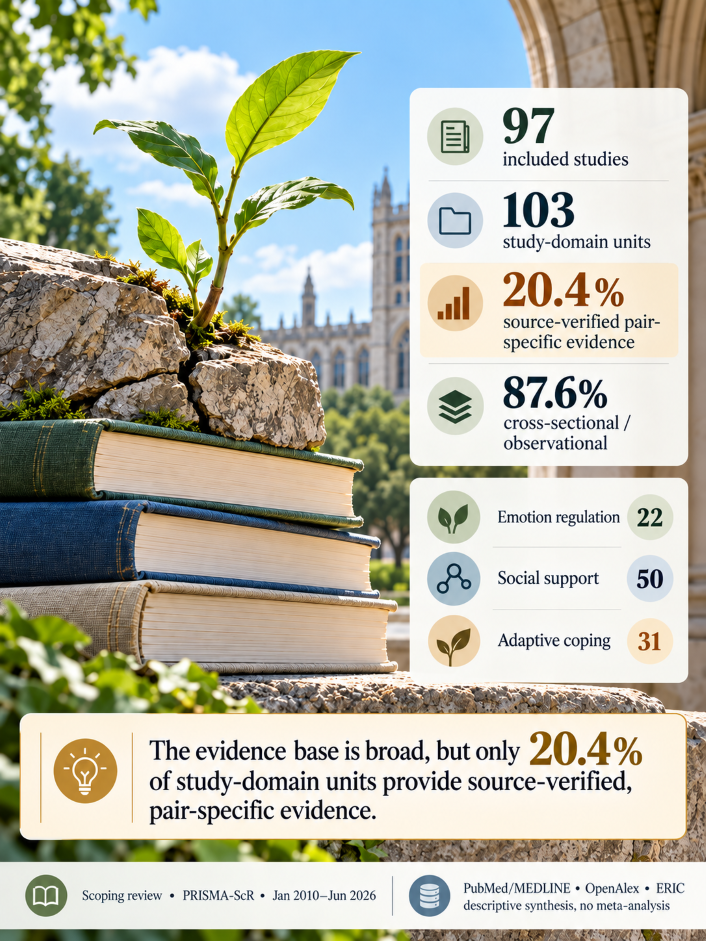
Psychological resilience among university students has been examined across diverse adversities, but the evidence directly linking resilience with emotion regulation, social support, and adaptive coping remains unclear. This scoping review mapped adversity-specific evidence and distinguished co-measurement from verified focal findings. Peer-reviewed English-language journal articles published from January 2010 through June 2026 were identified through PubMed/MEDLINE, OpenAlex, and ERIC. Eligible studies involved tertiary students, an identifiable adversity or sustained adaptation demand, a resilience construct, and at least one focal domain. Study design, context, measures, and evidence state were charted and synthesized descriptively without meta-analysis. Ninety-seven studies met the criteria, yielding 103 study–domain units: 22 emotion-regulation, 50 social-support, and 31 positive/adaptive-coping units. Cross-sectional or observational designs accounted for 85 studies (87.6%). Pandemic/lockdown and academic/clinical demands were the primary adversity in 41 (42.3%) and 28 (28.9%) studies, respectively. Only 21 units (20.4%) contained a source-verified direct focal result; 26 involved an analyzed pair without a recoverable pair-specific estimate or source location, 43 co-measured the constructs without a reported focal analysis, and 13 had unavailable results or sources. Verified findings varied by strategy, support measure, coping definition, and resilience operationalization, limiting cross-study comparison and causal interpretation. Twenty-six of 137 sought reports remained unretrieved. The breadth of construct coverage therefore exceeded the availability of interpretable direct evidence. Prospective studies with specified adversity and adaptation criteria, repeated outcome assessment, and transparent pair-specific reporting are needed to examine these relationships over time.
Downloads
Article Details

This work is licensed under a Creative Commons Attribution-ShareAlike 4.0 International License.
Authors who publish with this journal agree to the following terms:
- Copyright of the published article belongs to the authors and grant the journal right of first publication with the work simultaneously licensed under a Creative Commons Attribution-ShareAlike 4.0 (CC BY SA) International License that allows others to share the work with an acknowledgment of the work's authorship and initial publication in this journal.
- Authors are able to enter into separate, additional contractual arrangements for the non-exclusive distribution of the journal's published version of the work (e.g., post it to an institutional repository or publish it in a book), with an acknowledgment of its initial publication in this journal.
- Authors are permitted and encouraged to post their work online (e.g., in institutional repositories or on their website) prior to and during the submission process, as it can lead to productive exchanges, as well as earlier and greater citation of published work (See the Effect of Open Access).
References
[1] J. J. Arnett, “Emerging adulthood: A theory of development from the late teens through the twenties,” Am. Psychol., vol. 55, no. 5, pp. 469–480, 2000, https://doi.org/10.1037/0003-066X.55.5.469
[2] R. Beiter et al., “The prevalence and correlates of depression, anxiety, and stress in a sample of college students,” J. Affect. Disord., vol. 173, pp. 90–96, 2015, https://doi.org/10.1016/j.jad.2014.10.054
[3] B. Andrews and J. M. Wilding, “The relation of depression and anxiety to life-stress and achievement in students,” Br. J. Psychol., vol. 95, no. 4, pp. 509–521, 2004, https://doi.org/10.1348/0007126042369802
[4] M. Credé and S. Niehorster, “Adjustment to College as Measured by the Student Adaptation to College Questionnaire: A Quantitative Review of its Structure and Relationships with Correlates and Consequences,” Educ. Psychol. Rev., vol. 24, no. 1, pp. 133–165, 2012, https://doi.org/10.1007/s10648-011-9184-5
[5] R. P. Auerbach et al., “WHO world mental health surveys international college student project: Prevalence and distribution of mental disorders,” J. Abnorm. Psychol., vol. 127, no. 7, pp. 623–638, 2018, https://doi.org/10.1037/abn0000362
[6] R. Bruffaerts et al., “Mental health problems in college freshmen: Prevalence and academic functioning,” J. Affect. Disord., vol. 225, pp. 97–103, 2018, https://doi.org/10.1016/j.jad.2017.07.044
[7] R. J. Teixeira, T. Brandão, and A. R. Dores, “Academic stress, coping, emotion regulation, affect and psychosomatic symptoms in higher education,” Curr. Psychol., vol. 41, no. 11, pp. 7618–7627, 2022, https://doi.org/10.1007/s12144-020-01304-z
[8] A. S. Masten, “Ordinary magic: Resilience processes in development,” Am. Psychol., vol. 56, no. 3, pp. 227–238, 2001, https://doi.org/10.1037/0003-066X.56.3.227
[9] G. A. Bonanno, “Loss, Trauma, and Human Resilience: Have We Underestimated the Human Capacity to Thrive after Extremely Aversive Events?,” Am. Psychol., vol. 59, no. 1, pp. 20–28, 2004, https://doi.org/10.1037/0003-066X.59.1.20
[10] M. Ungar, “The social ecology of resilience: Addressing contextual and cultural ambiguity of a nascent construct,” Am. J. Orthopsychiatry, vol. 81, no. 1, pp. 1–17, 2011, https://doi.org/10.1111/j.1939-0025.2010.01067.x
[11] A. S. Masten, C. M. Lucke, K. M. Nelson, and I. C. Stallworthy, “Resilience in Development and Psychopathology: Multisystem Perspectives,” Annu. Rev. Clin. Psychol., vol. 17, pp. 521–549, 2021, https://doi.org/10.1146/annurev-clinpsy-081219-120307
[12] C. A. Denckla et al., “Psychological resilience: an update on definitions, a critical appraisal, and research recommendations,” Eur. J. Psychotraumatol., vol. 11, no. 1, p. 1822064, 2020, https://doi.org/10.1080/20008198.2020.1822064
[13] S. M. Southwick, G. A. Bonanno, A. S. Masten, C. Panter-Brick, and R. Yehuda, “Resilience definitions, theory, and challenges: Interdisciplinary perspectives,” Eur. J. Psychotraumatol., vol. 5, no. 1, p. 25338, 2014, https://doi.org/10.3402/ejpt.v5.25338
[14] K. M. Connor and J. R. T. Davidson, “Development of a new Resilience scale: The Connor-Davidson Resilience scale (CD-RISC),” Depress. Anxiety, vol. 18, no. 2, pp. 76–82, 2003, https://doi.org/10.1002/da.10113
[15] B. W. Smith, J. Dalen, K. Wiggins, E. Tooley, P. Christopher, and J. Bernard, “The brief resilience scale: Assessing the ability to bounce back,” Int. J. Behav. Med., vol. 15, no. 3, pp. 194–200, 2008, https://doi.org/10.1080/10705500802222972
[16] S. Cassidy, “The Academic Resilience Scale (ARS-30): A new multidimensional construct measure,” Front. Psychol., vol. 7, no. NOV, p. 1787, 2016, https://doi.org/10.3389/fpsyg.2016.01787
[17] M. Ahluwalia, K. J. Shillington, and J. D. Irwin, “The relationship between resilience and mental health of undergraduate students: A scoping review,” J. Am. Coll. Heal., vol. 73, no. 3, pp. 1266–1279, 2025, https://doi.org/10.1080/07448481.2023.2252925
[18] J. J. Gross, “The emerging field of emotion regulation: An integrative review,” Rev. Gen. Psychol., vol. 2, no. 3, pp. 271–299, 1998, https://doi.org/10.1037/1089-2680.2.3.271
[19] J. J. Gross, “Emotion Regulation: Current Status and Future Prospects,” Psychol. Inq., vol. 26, no. 1, pp. 1–26, 2015, https://doi.org/10.1080/1047840X.2014.940781
[20] A. Aldao, S. Nolen-Hoeksema, and S. Schweizer, “Emotion-regulation strategies across psychopathology: A meta-analytic review,” Clin. Psychol. Rev., vol. 30, no. 2, pp. 217–237, 2010, https://doi.org/10.1016/j.cpr.2009.11.004
[21] K. L. Gratz and L. Roemer, “Multidimensional Assessment of Emotion Regulation and Dysregulation: Development, Factor Structure, and Initial Validation of the Difficulties in Emotion Regulation Scale,” J. Psychopathol. Behav. Assess., vol. 26, no. 1, pp. 41–54, 2004, https://doi.org/10.1023/B:JOBA.0000007455.08539.94
[22] M. Kritikou and T. Giovazolias, “Emotion regulation, academic buoyancy, and academic adjustment of university students within a self-determination theory framework: A systematic review,” Front. Psychol., vol. 13, p. 1057697, 2022, https://doi.org/10.3389/fpsyg.2022.1057697
[23] S. Cohen and T. A. Wills, “Stress, Social Support, and the Buffering Hypothesis,” Psychol. Bull., vol. 98, no. 2, pp. 310–357, 1985, https://doi.org/10.1037/0033-2909.98.2.310
[24] P. A. Thoits, “Mechanisms linking social ties and support to physical and mental health,” J. Health Soc. Behav., vol. 52, no. 2, pp. 145–161, 2011, https://doi.org/10.1177/0022146510395592
[25] G. D. Zimet, N. W. Dahlem, S. G. Zimet, and G. K. Farley, “The Multidimensional Scale of Perceived Social Support,” J. Pers. Assess., vol. 52, no. 1, pp. 30–41, 1988, https://doi.org/10.1207/s15327752jpa5201_2
[26] L. Ruihua, N. C. Hassan, Z. Qiuxia, O. Sha, and D. Jingyi, “A systematic review on the impact of social support on college students’ wellbeing and mental health,” PLoS One, vol. 20, no. 7 July, p. e0325212, 2025, https://doi.org/10.1371/journal.pone.0325212
[27] R. S. Lazarus and S. Folkman, Stress, appraisal, and coping. New York: Springer Publishing Company, 1984.
[28] E. A. Skinner, K. Edge, J. Altman, and H. Sherwood, “Searching for the Structure of Coping: A Review and Critique of Category Systems for Classifying Ways of Coping,” Psychol. Bull., vol. 129, no. 2, pp. 216–269, 2003, https://doi.org/10.1037/0033-2909.129.2.216
[29] C. S. Carver, “You want to measure coping but your protocol’s too long: Consider the brief COPE,” Int. J. Behav. Med., vol. 4, no. 1, pp. 92–100, 1997, https://doi.org/10.1207/s15327558ijbm0401_6
[30] C. Trudel-Fitzgerald et al., “Coping and Emotion Regulation: A Conceptual and Measurement Scoping Review,” Can. Psychol., vol. 65, no. 3, pp. 149–162, 2023, https://doi.org/10.1037/cap0000377
[31] B. E. Compas et al., “Coping, emotion regulation, and psychopathology in childhood and adolescence: A meta-analysis and narrative review,” Psychol. Bull., vol. 143, no. 9, pp. 939–991, 2017, https://doi.org/10.1037/bul0000110
[32] E. Vicary, D. Kapadia, P. Bee, M. Bennion, and H. Brooks, “The impact of social support on university students living with mental illness: a systematic review and narrative synthesis,” J. Ment. Heal., vol. 34, no. 4, pp. 463–475, 2025, https://doi.org/10.1080/09638237.2024.2408237
[33] L. Campbell-Sills and M. B. Stein, “Psychometric analysis and refinement of the Connor-Davidson Resilience Scale (CD-RISC): Validation of a 10-item measure of resilience,” J. Trauma. Stress, vol. 20, no. 6, pp. 1019–1028, 2007, https://doi.org/10.1002/jts.20271
[34] G. M. Wagnild and H. M. Young, “Development and psychometric evaluation of the Resilience Scale.,” J. Nurs. Meas., vol. 1, no. 2, pp. 165–178, 1993.
[35] J. J. Gross, “The Extended Process Model of Emotion Regulation: Elaborations, Applications, and Future Directions,” Psychol. Inq., vol. 26, no. 1, pp. 130–137, 2015, https://doi.org/10.1080/1047840X.2015.989751
[36] J. J. Gross and O. P. John, “Individual Differences in Two Emotion Regulation Processes: Implications for Affect, Relationships, and Well-Being,” J. Pers. Soc. Psychol., vol. 85, no. 2, pp. 348–362, 2003, https://doi.org/10.1037/0022-3514.85.2.348
[37] R. Brites, T. Brandão, J. Hipólito, A. Ros, and O. Nunes, “Emotion regulation, resilience, and mental health: A mediation study with university students in the pandemic context,” Psychol. Sch., vol. 61, no. 1, pp. 304–328, 2024, https://doi.org/10.1002/pits.23055
[38] R. Renati, N. S. Bonfiglio, and D. Rollo, “Italian University Students’ Resilience during the COVID-19 Lockdown—A Structural Equation Model about the Relationship between Resilience, Emotion Regulation and Well-Being,” Eur. J. Investig. Heal. Psychol. Educ., vol. 13, no. 2, pp. 259–270, 2023, https://doi.org/10.3390/ejihpe13020020
[39] B. Ye, S. Zhao, Y. Zeng, C. Chen, and Y. Zhang, “Perceived parental support and college students’ depressive symptoms during the COVID-19 pandemic: The mediating roles of emotion regulation strategies and resilience,” Curr. Psychol., vol. 42, no. 23, pp. 20275–20286, 2023, https://doi.org/10.1007/s12144-022-03049-3
[40] K. A. Rufino, S. J. Babb, and R. M. Johnson, “Moderating effects of emotion regulation difficulties and resilience on students’ mental health and well-being during the COVID-19 pandemic,” J. Adult Contin. Educ., vol. 28, no. 2, pp. 397–413, 2022, https://doi.org/10.1177/14779714221099609
[41] B. Tanacioğlu Aydin and D. Pekşen Süslü, “The mediating role of difficulties in emotion regulation in the relationship between childhood trauma and resilience among university students,” Turkish Psychol. Couns. Guid. J., vol. 13, no. 70, pp. 315–329, 2023, https://doi.org/10.17066/tpdrd.1265528.4
[42] Y. Tan, J. Ding, and G. Wang, “Emotion regulation and psychological resilience sequentially mediate the association between training-related perceived stress and aggressive behavior among sport-major undergraduates,” Front. Psychol., vol. 17, 2026, https://doi.org/10.3389/fpsyg.2026.1778128
[43] H. A. Razak, C. MacLeod, D. Rudaizky, and L. Notebaert, “The Role of Emotion Regulation in Distinct Measures of Emotional Resilience,” Cognit. Ther. Res., vol. 49, no. 4, pp. 748–768, 2025, https://doi.org/10.1007/s10608-025-10581-6
[44] B. Lakey and S. Cohen, “Social Support Theory and Measurement,” in Social Support Measurement and Intervention, S. Cohen, L. G. Underwood, and B. H. Gottlieb, Eds. Oxford University Press, 2015, pp. 29–52. https://doi.org/10.1093/med:psych/9780195126709.003.0002
[45] I. G. Sarason, H. M. Levine, R. B. Basham, and B. R. Sarason, “Assessing social support: The Social Support Questionnaire,” J. Pers. Soc. Psychol., vol. 44, no. 1, pp. 127–139, 1983, https://doi.org/10.1037/0022-3514.44.1.127
[46] J. Wang and R. Zhang, “The effect of employment stress on employment anxiety among physical education students: the mediating role of social support and psychological resilience,” Front. Psychol., vol. 16, 2025, https://doi.org/10.3389/fpsyg.2025.1533218
[47] M. Parlak, D. Michelson, and M. J. Easterbrook, “The mediating role of social support and resilience in the relationship between social identity and mental health among international students.,” BJPsych Open, vol. 11, no. 4, 2025, https://doi.org/10.1192/bjo.2025.72
[48] Y. Liu and Z. Cao, “The impact of social support and stress on academic burnout among medical students in online learning: The mediating role of resilience,” Front. Public Heal., vol. 10, 2022, https://doi.org/10.3389/fpubh.2022.938132
[49] T. R. F. Gianjacomo, R. Rodrigues, C. M. Guidoni, and E. Girotto, “Analysis of the Mediating Role of Resilience in the Relationship Between Social Support and Burnout in University Students,” Educ. em Rev., vol. 41, 2025, https://doi.org/10.1590/0102-469852443-t
[50] J. T. Samoy et al., “Hope and Social Support as Predictors of Academic Resilience among College Students,” Univers. J. Educ. Res., vol. 13, no. 2, pp. 33–42, 2025, https://doi.org/10.13189/ujer.2025.130201
[51] S. Saad and S. Ali, “Academic resilience in medical students: exploring students’ perception of social support provided by peers and teachers to help at-risk students for the successful academic journey,” BMC Med. Educ., vol. 25, no. 1, 2025, https://doi.org/10.1186/s12909-025-06858-9
[52] J. Han et al., “Longitudinal trajectories of perceived stress during college transition: the protective roles of psychological resilience and social support,” BMC Psychol., vol. 14, no. 1, 2026, https://doi.org/10.1186/s40359-026-04265-3
[53] X. Yu, M. A. Talib, and D. Wei, “Understanding academic resilience over time through psychological resources and social support in the Yangtze River Delta region of China,” Front. Psychol., vol. 17, pp. 1–20, 2026, https://doi.org/10.3389/fpsyg.2026.1793326
[54] E. Anderson, B. Jackson, J. Archibald, D. Roy, and D. Traylor, “Navigating stress and resilience: coping strategies among Black male osteopathic medical students,” Educ. Heal., vol. 38, no. 3, pp. 199–209, 2025, https://doi.org/10.62694/efh.2025.320
[55] T. Pehlivan Sarıbudak, “The effect of stress management course on resilience and coping styles of nursing students: A quasi-experimental study.,” Turkiye Klin. J. Nurs. Sci., vol. 16, no. 2, pp. 544–552, 2024, https://doi.org/10.5336/nurses.2023-99541
[56] A. El-Awaisi, S. Ismail, R. Sulaiman, T. Kane, M. S. El Hajj, and M. Shraim, “A Qualitative Exploration of Health Profession Students’ Experiences of Resilience and Burnout Using the Coping Reservoir Model during the COVID-19 Pandemic,” Teach. Learn. Med., vol. 36, no. 3, pp. 256–268, 2024, https://doi.org/10.1080/10401334.2023.2209073
[57] H. Arksey and L. O’Malley, “Scoping studies: Towards a methodological framework,” Int. J. Soc. Res. Methodol. Theory Pract., vol. 8, no. 1, pp. 19–32, 2005, https://doi.org/10.1080/1364557032000119616
[58] H. Khalil et al., “Advancing the methodology of mapping reviews: A scoping review,” Res. Synth. Methods, vol. 15, no. 3, pp. 384–397, 2024, https://doi.org/10.1002/jrsm.1694
[59] D. Levac, H. Colquhoun, and K. K. O’Brien, “Scoping studies: Advancing the methodology,” Implement. Sci., vol. 5, no. 1, p. 69, 2010, https://doi.org/10.1186/1748-5908-5-69
[60] Z. Munn, M. D. J. Peters, C. Stern, C. Tufanaru, A. McArthur, and E. Aromataris, “Systematic review or scoping review? Guidance for authors when choosing between a systematic or scoping review approach,” BMC Med. Res. Methodol., vol. 18, no. 1, p. 143, 2018, https://doi.org/10.1186/s12874-018-0611-x
[61] M. D. J. Peters et al., “Updated methodological guidance for the conduct of scoping reviews,” JBI Evid. Synth., vol. 18, no. 10, pp. 2119–2126, 2020, https://doi.org/10.11124/JBIES-20-00167
[62] D. Pollock et al., “Recommendations for the extraction, analysis, and presentation of results in scoping reviews,” JBI Evid. Synth., vol. 21, no. 3, pp. 520–532, 2022, https://doi.org/10.11124/JBIES-22-00123
[63] M. L. Rethlefsen et al., “PRISMA-S: an extension to the PRISMA Statement for Reporting Literature Searches in Systematic Reviews,” Syst. Rev., vol. 10, no. 1, p. 39, 2021, https://doi.org/10.1186/s13643-020-01542-z
[64] M. J. Page et al., “The PRISMA 2020 statement: An updated guideline for reporting systematic reviews,” Bmj, vol. 372, p. n71, 2021, https://doi.org/10.1136/bmj.n71
[65] A. C. Tricco et al., “PRISMA extension for scoping reviews (PRISMA-ScR): Checklist and explanation,” Ann. Intern. Med., vol. 169, no. 7, pp. 467–473, 2018, https://doi.org/10.7326/M18-0850
[66] J. McGowan, M. Sampson, D. M. Salzwedel, E. Cogo, V. Foerster, and C. Lefebvre, “PRESS Peer Review of Electronic Search Strategies: 2015 Guideline Statement,” J. Clin. Epidemiol., vol. 75, pp. 40–46, 2016, https://doi.org/10.1016/j.jclinepi.2016.01.021
[67] M. D. J. Peters et al., “Best practice guidance and reporting items for the development of scoping review protocols,” JBI Evid. Synth., vol. 20, no. 4, pp. 953–968, 2022, https://doi.org/10.11124/JBIES-21-00242
[68] M. Campbell et al., “Synthesis without meta-analysis (SWiM) in systematic reviews: reporting guideline,” bmj, vol. 368, p. l6890, 2020, https://doi.org/10.1136/bmj.l6890
[69] J. E. McKenzie and S. E. Brennan, “Synthesizing and presenting findings using other methods,” Cochrane Handb. Syst. Rev. Interv., pp. 321–347, 2019, https://doi.org/10.1002/9781119536604.ch12
[70] S. E. Maxwell, D. A. Cole, and M. A. Mitchell, “Bias in cross-sectional analyses of longitudinal mediation: Partial and complete mediation under an autoregressive model,” Multivariate Behav. Res., vol. 46, no. 5, pp. 816–841, 2011, https://doi.org/10.1080/00273171.2011.606716
[71] J. Thomas and A. Harden, “Methods for the thematic synthesis of qualitative research in systematic reviews,” BMC Med. Res. Methodol., vol. 8, no. 1, p. 45, 2008.
[72] C. Guérin-Marion, J. F. Bureau, M. F. Lafontaine, and P. Gaudreau, “Low self-perceived resilience mediates the link between limited access to emotion regulation strategies and non-suicidal self-injury,” Cogent Psychol., vol. 10, no. 1, 2023, https://doi.org/10.1080/23311908.2023.2276862
[73] X. Ma, X. Wang, and Z. Gao, “Associations Between Parental Psychological Control and COVID-19 Pandemic-Related Negative Emotions: The Role of Resilience and Emotion Regulation,” Emerg. Adulthood, vol. 11, no. 5, pp. 1292–1305, 2023, https://doi.org/10.1177/21676968231186022
[74] D. J. Simons, Y. Shoda, and D. S. Lindsay, “Constraints on Generality (COG): A Proposed Addition to All Empirical Papers,” Perspect. Psychol. Sci., vol. 12, no. 6, pp. 1123–1128, 2017, https://doi.org/10.1177/1745691617708630
[75] Firmawati, Nur Sa’adah, Ikhwani, and R. Rahmadani, “Emotion Regulation and Resilience as Predictors of Learning Motivation among Post-Flood University Students,” J. Educ. Heal. Community Psychol., vol. 15, no. 2, pp. 1141–1152, 2026, https://doi.org/10.12928/jehcp.vi.31997
[76] G. A. Bonanno and C. L. Burton, “Regulatory Flexibility: An Individual Differences Perspective on Coping and Emotion Regulation,” Perspect. Psychol. Sci., vol. 8, no. 6, pp. 591–612, 2013, https://doi.org/10.1177/1745691613504116
[77] D. McNeish and M. G. Wolf, “Thinking twice about sum scores,” Behav. Res. Methods, vol. 52, no. 6, pp. 2287–2305, 2020, https://doi.org/10.3758/s13428-020-01398-0
[78] P. M. Podsakoff, S. B. MacKenzie, J. Y. Lee, and N. P. Podsakoff, “Common Method Biases in Behavioral Research: A Critical Review of the Literature and Recommended Remedies,” J. Appl. Psychol., vol. 88, no. 5, pp. 879–903, 2003, https://doi.org/10.1037/0021-9010.88.5.879
[79] J. M. Rohrer, “Thinking Clearly About Correlations and Causation: Graphical Causal Models for Observational Data,” Adv. Methods Pract. Psychol. Sci., vol. 1, no. 1, pp. 27–42, 2018, https://doi.org/10.1177/2515245917745629
[80] G. A. Bonanno, “The resilience paradox,” Eur. J. Psychotraumatol., vol. 12, no. 1, p. 1942642, 2021, https://doi.org/10.1080/20008198.2021.1942642
[81] T. Feng, G. Zhang, and B. Wang, “Sex differences in the network structure linking school bullying self- efficacy, resilience and coping strategies among Chinese university students,” Discov. Ment. Heal., vol. 6, 2026, https://doi.org/10.1007/s44192-026-00480-x
[82] M. Temiz, S. S. Yurdusever, S. Baytar, and N. Bakır, “Career stress, resilience, coping, and life satisfaction among nursing students: a cross-sectional study,” BMC Nurs., vol. 25, no. 1, 2026, https://doi.org/10.1186/s12912-026-04477-3
[83] J. Ni, X. Liao, J. Liu, and Q. Jiang, “Stressful life events and non-suicidal self-injury among college students: chain mediating effect analysis of resilience and emotion dysregulation,” BMC Public Health, vol. 26, no. 1, 2026, https://doi.org/10.1186/s12889-025-25799-y
[84] F. Toper, R. Yanardağ, M. Koca, and V. Baydar, “Post-Traumatic Growth in University Students After Earthquakes: The Effect of Perceived Social Support and Psychological Resilience,” Behav. Sci. (Basel)., vol. 15, no. 9, 2025, https://doi.org/10.3390/bs15091178
[85] B. Salameh, J. Abdallah, M. Z. Malak, A. Shehadeh, and B. Hammad, “Alarm fatigue and its association with perceived stress, resilience, and coping behaviors among Palestinian nursing students during clinical internship in critical care units: a cross-sectional study,” BMC Psychol., vol. 13, no. 1, 2025, https://doi.org/10.1186/s40359-025-02809-7
[86] P. Huai et al., “The relationship between interpersonal emotional regulation and psychological resilience in nursing undergraduates: a cross-sectional study and network analysis,” Front. Psychol., vol. 16, 2025, https://doi.org/10.3389/fpsyg.2025.1546042
[87] B. Zhu, X. M. Gao, M. Zhou, and H. H. Wang, “The mediating roles of cognitive emotion regulation and resilience in the association between life events and sleep quality among medical students,” Front. Psychiatry, vol. 16, 2025, https://doi.org/10.3389/fpsyt.2025.1466138
[88] W. Yuan, J. Ning, M. Huo, and Y. Feng, “The relationship between social support and psychological crisis vulnerability among family impoverished undergraduates: The intermediary role of psychological resilience.,” Front. Public Heal., vol. 13, 2025, https://doi.org/10.3389/fpubh.2025.1501513
[89] N. Zhou and Z. Chen, “The chain mediation effects of psychological resilience and active coping style between discrimination perceptions and subjective well being among college students with disability,” Sci. Rep., vol. 14, no. 1, 2024, https://doi.org/10.1038/s41598-024-81702-6
[90] X. Li et al., “The relationship between academic procrastination and anxiety symptoms among medical students during the COVID-19 pandemic: exploring the moderated mediation effects of resilience and social support,” BMC Psychiatry, vol. 24, no. 1, 2024, https://doi.org/10.1186/s12888-024-06202-3
[91] M. Cassaretto, A. Espinosa, and C. Chau, “Effects of resilience, social support, and academic self-efficacy, on mental health among Peruvian university students during the pandemic: the mediating role of digital inclusion,” Front. Psychol., vol. 15, 2024, https://doi.org/10.3389/fpsyg.2024.1282281
[92] Š. Selak, N. Crnkovič, A. Šorgo, B. Gabrovec, K. Cesar, and M. Žmavc, “Resilience and social support as protective factors against suicidal ideation among tertiary students during COVID-19: a cross-sectional study,” BMC Public Health, vol. 24, no. 1, 2024, https://doi.org/10.1186/s12889-024-19470-1
[93] M. Yang, K. Guo, W. Liu, X. Fang, and T. Liu, “Coping Tendency as a Mediator in the Relationship Between Psychological Resilience and Health Problems Among College Students,” Psychol. Res. Behav. Manag., vol. 17, pp. 2619–2630, 2024, https://doi.org/10.2147/PRBM.S466150
[94] F. Xie, X. Wu, C. Deng, X. Li, and Z. Yi, “How social support and resilience impact mental health: The moderating role of time in isolation during the COVID-19 pandemic,” Heliyon, vol. 10, no. 11, 2024, https://doi.org/10.1016/j.heliyon.2024.e31783
[95] L. J. van der Merwe et al., “Medical registrars at the University of the Free State: Burnout, resilience and coping strategies,” South African Fam. Pract., vol. 65, no. 1, 2023, https://doi.org/10.4102/SAFP.V65I1.5788
[96] M. Hirai, L. L. Vernon, and E. N. Hernandez, “Psychological impacts of the COVID-19 pandemic in a Hispanic sample: Testing the buffering role of resilience and perceived social support,” Curr. Psychol., vol. 43, no. 6, pp. 4974–4986, 2024, https://doi.org/10.1007/s12144-023-04664-4
[97] F. Zeng, W. C. M. John, X. Sun, and Y. Wang, “COVID-19-associated impact and post-traumatic stress symptoms 39 days after pandemic in a sample of home-quarantined Chinese college students: the mediating effecting of past stressful events, psychological resilience, and social support,” BMC Psychiatry, vol. 23, no. 1, 2023, https://doi.org/10.1186/s12888-023-04906-6
[98] D. Zhang et al., “Mediating effect of resilience and fear of COVID-19 on the relationship between social support and post-traumatic stress disorder among campus-quarantined nursing students: a cross-sectional study,” BMC Nurs., vol. 22, no. 1, 2023, https://doi.org/10.1186/s12912-023-01319-4
[99] K. Kim, J. Lee, and J. Yoon, “Effects of Emotional Regulation, Resilience, and Distress Disclosure on Post-Traumatic Growth in Nursing Students,” Int. J. Environ. Res. Public Health, vol. 20, no. 4, 2023, https://doi.org/10.3390/ijerph20042782
[100] J. Xu and X. Yang, “The influence of resilience on stress reaction of college students during COVID-19: the mediating role of coping style and positive adaptive response,” Curr. Psychol., vol. 43, no. 13, pp. 12120–12131, 2024, https://doi.org/10.1007/s12144-022-04214-4
[101] T. B. He, C. C. Tu, and X. Bai, “Impact of social support on college students’ anxiety due to COVID-19 isolation: Mediating roles of perceived risk and resilience in the postpandemic period,” Front. Psychol., vol. 13, 2022, https://doi.org/10.3389/fpsyg.2022.948214
[102] H. Huang et al., “The mediating effects of coping style and resilience on the relationship between parenting style and academic procrastination among Chinese undergraduate nursing students: a cross-sectional study,” BMC Nurs., vol. 21, no. 1, 2022, https://doi.org/10.1186/s12912-022-01140-5
[103] Z. Gong, Y. Lv, X. Jiao, J. Liu, Y. Sun, and Q. Qu, “The relationship between COVID-19-related restrictions and fear of missing out, problematic smartphone use, and mental health in college students: The moderated moderation effect of resilience and social support,” Front. Public Heal., vol. 10, 2022, https://doi.org/10.3389/fpubh.2022.986498
[104] S. I. Haider, F. Ahmed, H. Pasha, H. Pasha, N. Farheen, and M. T. Zahid, “Life satisfaction, resilience and coping mechanisms among medical students during COVID-19,” PLoS One, vol. 17, no. 10 October, 2022, https://doi.org/10.1371/journal.pone.0275319
[105] J. Esparza-Reig, M. Martí-Vilar, F. González-Sala, C. Merino-Soto, and F. Toledano-Toledano, “Social Support and Resilience as Predictors of Prosocial Behaviors before and during COVID-19,” Healthc., vol. 10, no. 9, 2022, https://doi.org/10.3390/healthcare10091669
[106] X. Zhang, X. Liu, Y. Mi, W. Wang, and H. Xu, “Resilience and Depressive Symptoms Mediated Pathways from Social Support to Suicidal Ideation Among Undergraduates During the COVID-19 Campus Lockdown in China,” Psychol. Res. Behav. Manag., vol. 15, pp. 2291–2301, 2022, https://doi.org/10.2147/PRBM.S377158
[107] H. Cao, R. Zhang, L. Li, and L. Yang, “Coping Style and Resilience Mediate the Effect of Childhood Maltreatment on Mental Health Symptomology,” Children, vol. 9, no. 8, 2022, https://doi.org/10.3390/children9081118
[108] C. N. Pineda et al., “Resilience, social support, loneliness and quality of life during COVID-19 pandemic: A structural equation model.,” Nurse Educ. Pract., vol. 64, 2022, https://doi.org/10.1016/j.nepr.2022.103419
[109] Y. Shu, W. Lin, J. Yang, P. Huang, B. Li, and X. Zhang, “How social support predicts anxiety among university students during COVID-19 control phase: Mediating roles of self-esteem and resilience,” Anal. Soc. Issues Public Policy, vol. 22, no. 2, pp. 490–505, 2022, https://doi.org/10.1111/asap.12314
[110] S. Xue et al., “Resilience and Prosocial Behavior Among Chinese University Students During COVID-19 Mitigation: Testing Mediation and Moderation Models of Social Support,” Psychol. Res. Behav. Manag., vol. 15, pp. 1531–1543, 2022, https://doi.org/10.2147/PRBM.S364356
[111] B. A. R. Hassan et al., “Exploring the level of lockdown fatigue and effect of personal resilience and coping behaviours on university students during the covid-19 pandemic: a cross-sectional analysis from Iraq,” Curr. Psychol., vol. 42, no. 17, pp. 14851–14859, 2023, https://doi.org/10.1007/s12144-022-02779-8
[112] A. S. Ramadianto, I. Kusumadewi, F. Agiananda, and N. W. Raharjanti, “Symptoms of depression and anxiety in Indonesian medical students: association with coping strategy and resilience,” BMC Psychiatry, vol. 22, no. 1, 2022, https://doi.org/10.1186/s12888-022-03745-1
[113] S. Warshawski, “Academic self-efficacy, resilience and social support among first-year Israeli nursing students learning in online environments during COVID-19 pandemic,” Nurse Educ. Today, vol. 110, 2022, https://doi.org/10.1016/j.nedt.2022.105267
[114] A. Öztürk and N. Kundakçı, “Loneliness, Perceived Social Support, and Psychological Resilience as Predictors of Internet Addiction: A Cross-Sectional Study with a Sample of Turkish Undergraduates,” Psychiatry Clin. Psychopharmacol., vol. 31, no. 4, pp. 449–456, 2021, https://doi.org/10.5152/pcp.2021.21115
[115] L. Zhao, K. Sznajder, D. Cheng, S. Wang, C. Cui, and X. Yang, “Coping styles for mediating the effect of resilience on depression among medical students in web-based classes during the covid-19 pandemic: Cross-sectional questionnaire study,” J. Med. Internet Res., vol. 23, no. 6, 2021, https://doi.org/10.2196/25259
[116] X. Zhang, P. fei Huang, B. qin Li, W. jian Xu, W. Li, and B. Zhou, “The influence of interpersonal relationships on school adaptation among Chinese university students during COVID-19 control period: Multiple mediating roles of social support and resilience,” J. Affect. Disord., vol. 285, pp. 97–104, 2021, https://doi.org/10.1016/j.jad.2021.02.040
[117] D. J. Fullerton, L. M. Zhang, and S. Kleitman, “An integrative process model of resilience in an academic context: Resilience resources, coping strategies, and positive adaptation,” PLoS One, vol. 16, no. 2 February, 2021, https://doi.org/10.1371/journal.pone.0246000
[118] L. J. van der Merwe, A. Botha, and G. Joubert, “Resilience and coping strategies of undergraduate medical students at the university of the free state,” South African J. Psychiatry, vol. 26, pp. 1–8, 2020, https://doi.org/10.4102/sajpsychiatry.v26i0.1471
[119] Y. Wu, W. Yu, X. Wu, H. Wan, Y. Wang, and G. Lu, “Psychological resilience and positive coping styles among Chinese undergraduate students: A cross-sectional study,” BMC Psychol., vol. 8, no. 1, 2020, https://doi.org/10.1186/s40359-020-00444-y
[120] Z. Ye et al., “Resilience, Social Support, and Coping as Mediators between COVID-19-related Stressful Experiences and Acute Stress Disorder among College Students in China,” Appl. Psychol. Heal. Well-Being, vol. 12, no. 4, pp. 1074–1094, 2020, https://doi.org/10.1111/aphw.12211
[121] M. Lin, D. Wolke, S. Schneider, and J. Margraf, “Bullying History and Mental Health In University Students: The Mediator Roles of Social Support, Personal Resilience, and Self-Efficacy,” Front. Psychiatry, vol. 10, 2020, https://doi.org/10.3389/fpsyt.2019.00960
[122] B. Rahimi, M. Baetz, R. Bowen, and L. Balbuena, “Resilience, stress, and coping among Canadian medical students,” Can. Med. Educ. J., vol. 5, no. 1, pp. e5–e12, 2014, https://doi.org/10.36834/cmej.36689
[123] C. Thomas and S. Zolkoski, “Preventing Stress Among Undergraduate Learners: The Importance of Emotional Intelligence, Resilience, and Emotion Regulation,” Front. Educ., vol. 5, 2020, https://doi.org/10.3389/feduc.2020.00094
[124] A. Ozsaban, N. Turan, and H. Kaya, “Resilience in Nursing Students: The Effect of Academic Stress and Social Support,” Clin. Exp. Heal. Sci., vol. 9, no. 1, pp. 69–76, 2019, https://doi.org/10.33808/marusbed.546903
[125] S. Hamaideh et al., “Relationships and Predictors of Resilience, Social Support, and Perceived Stress among Undergraduate Nursing Students,” Open Nurs. J., vol. 18, no. 1, 2024, https://doi.org/10.2174/0118744346238230240103055340
[126] V. C. Valladolid, “The Role of Coping Strategies in the Resilience and Well-Being of College Students during COVID-19 Pandemic,” Philipp. Soc. Sci. J., vol. 4, no. 2, pp. 30–42, 2021, https://doi.org/10.52006/main.v4i2.342
[127] S. Gonçalves, A. I. Vieira, B. C. Machado, and C. Bessa, “Non-suicidal self-injury in Portuguese college students: relationship with emotion regulation, resilience and self-compassion,” Curr. Psychol., vol. 43, no. 9, pp. 7877–7886, 2024, https://doi.org/10.1007/s12144-023-04985-4
[128] J. Y. Song et al., “The latent category of resilience and its relationship with the mental health and coping styles of medical students,” Front. Educ., vol. 8, 2023, https://doi.org/10.3389/feduc.2023.1114352
[129] K. Bidadi Veerabhadraiah et al., “Nursing students’ perceptions of resilience, social support, and coping strategies during the COVID-19 pandemic: a multi-center study,” Int. J. Community Med. Public Heal., vol. 10, no. 12, pp. 4699–4705, 2023, https://doi.org/10.18203/2394-6040.ijcmph20233766
[130] N. Dezhkam, M. R. Zarbakhsh Bahri, and A. Khaneh Keshi, “Association of addiction tendency with distress tolerance, self-differentiation, and emotion regulation difficulties mediated by resilience in university students,” J. Shahrekord Univ. Med. Sci., vol. 25, no. 2, pp. 76–82, 2023, https://doi.org/10.34172/jsums.2023.760
[131] T. Saleem and A. Zia, “Effects of Social Support on Academic Resilience of Undergraduate Students,” UMT Educ. Rev., vol. 7, no. 1, pp. 91–116, 2024, https://doi.org/10.32350/uer.71.06
[132] H. C. Meléndez, M. S. T. de Rios, J. C. L. Guillermo, L. R. Zumaeta, and C. A. G. Abarca, “Resilience and stress coping strategies of university students in times of pandemic,” J. Pharm. Negat. Results, vol. 13, no. 4, pp. 679–685, 2022, https://doi.org/10.47750/pnr.2022.13.04.091
[133] A. De Lorenzo, T. García, D. Areces, and E. Rabaglietti, “How Do Creativity and Social Support Affect the Resilience of Mediterranean University Students? A Cross-National Study in the Post-Pandemic Period,” Adolescents, vol. 4, no. 2, pp. 311–323, 2024, https://doi.org/10.3390/adolescents4020022
[134] Y. Jiang, N. Mohd Yusof, M. N. Fariduddin, F. Aliana Mohd Radzi, Q. Zhu, and Y. Xiao, “Nurturing Resilience: Exploring Protective Factors in Coping with Adversity among College Students with Left-Behind Experiences in Central China,” Int. J. Acad. Res. Progress. Educ. Dev., vol. 12, no. 4, pp. 1680–1694, 2023, https://doi.org/10.6007/ijarped/v12-i4/19938
[135] C. R. Ikpeama and U. O. Okoye, “Perceived Importance of Social Support on Undergraduates’ Academic Resilience in a Nigerian University: Where do Social Workers come in?,” J. Soc. Work Dev. Soc., vol. 6, no. 1, pp. 74–90, 2024, https://doi.org/10.4314/jswds.v6i1.4
[136] M. Jalali, M. Rahimi, S. Mousavi, and S. Badri Bageh Jan, “The Role of Resilience, Emotional Regulation And Perceived Stress Among Depressed Students,” Iran. Evol. Educ. Psychol. J., vol. 2, no. 3, pp. 160–171, 2020, https://doi.org/10.29252/ieepj.2.3.160
[137] P. Akçay, “The Effect of Social Support Perception and Resilience Levels of Prospective Teachers on Academic Burnout during the Pandemic Period,” Educ. Policy Anal. Strateg. Res., vol. 16, no. 4, pp. 234–254, 2021, https://doi.org/10.29329/epasr.2021.383.13
[138] S. Byra and M. Boczkowska, “Resilience, Coping Strategies, and Stress Related to Online Diploma Exam in University Students in Poland,” Przegląd Badań Eduk., vol. 36, no. 1, pp. 177–197, 2022, https://doi.org/10.12775/pbe.2022.008
[139] J. Ndone, “Building Resilience Among College Students: A Cross-Cultural Investigation on the Importance of Quality Crisis Communication and Social Support,” Int. J. Mass Commun., vol. 2, pp. 20–32, 2024, https://doi.org/10.6000/2818-3401.2024.02.03
[140] Pinki, Gobind, and Sarita., “Correlational study of depression, social support and resilience among university students in Haryana during COVID-19.,” Int. J. Indian Psychol., vol. 10, no. 4, pp. 181–186, 2022, https://doi.org/10.25215/1004.020
[141] J. Ning, S. Yin, and X. Zhang, “The Impact of COVID-19 Risk Perception on College Students’ Positive Psychological Capital: the Role of Psychological Resilience and Social Support,” J. Psychol. Res., vol. 6, no. 2, pp. 14–27, 2024, https://doi.org/10.30564/jpr.v6i2.6315
[142] C. Fu, “Coping Under Pressure: A Qualitative Analysis of Resilience Development among Chinese University Students in Family-School Contexts,” Int. J. Sociol. Anthropol. Sci. Rev., vol. 5, no. 5, pp. 825–848, 2025, https://doi.org/10.60027/ijsasr.2025.6964
[143] K. L. Sturgess and B. T. Conner, “Examining the Effect of Trauma on Emotion Regulation: The Role of Resilience,” Advers. Resil. Sci., vol. 7, no. 2, 2026, https://doi.org/10.1007/s42844-026-00211-9
[144] L. Y. Qi, S. Roslan, and Z. Zaremohzzabieh, “Perceived Social Support and Psychological Well-Being of International Students: The Mediating Effects of Resiliency and Spirituality,” Asian J. Univ. Educ., vol. 17, no. 3, pp. 220–234, 2021, https://doi.org/10.24191/ajue.v17i3.14502
[145] F. Hu, N. R. N. Yaacob, and F. Zhang, “Perceived Stress and Academic Burnout among Chinese Higher Vocational Students: The Mediating Roles of Social Support and Psychological Resilience,” J. Int. Students, vol. 16, no. 3, pp. 109–128, 2026, https://doi.org/10.32674/1rhza525
[146] H. Aqsa, “Resilience and Social Support as Pathways to Academic Achievement and Adjustment among International Students at a Pakistani University,” J. Int. Students, vol. 16, no. 3, pp. 173–190, 2026, https://doi.org/10.32674/gvxrc696
[147] S. Güleç, “The role of intrinsic spirituality, emotion dysregulation, and resilience on post-traumatic stress disorder symptoms in university students who survived earthquake,” Acta Psychol. (Amst)., vol. 253, 2025, https://doi.org/10.1016/j.actpsy.2025.104755
[148] D. J. E. Berdida, V. Lopez, and R. A. N. Grande, “Nursing students’ perceived stress, social support, self-efficacy, resilience, mindfulness and psychological well-being: A structural equation model,” Int. J. Ment. Health Nurs., vol. 32, no. 5, pp. 1390–1404, 2023, https://doi.org/10.1111/inm.13179
[149] L. J. Labrague, J. A. A. De los Santos, and C. C. Falguera, “Social and emotional loneliness among college students during the COVID-19 pandemic: The predictive role of coping behaviors, social support, and personal resilience,” Perspect. Psychiatr. Care, vol. 57, no. 4, pp. 1578–1584, 2021, https://doi.org/10.1111/ppc.12721
[150] N. P. G. Boumans and E. Dorant, “A cross-sectional study on experiences of young adult carers compared to young adult noncarers: parentification, coping and resilience,” Scand. J. Caring Sci., vol. 32, no. 4, pp. 1409–1417, 2018, https://doi.org/10.1111/scs.12586
[151] J. Ensz and C. Mohiyeddini, “Resilience and Burnout among Medical Students: The Role of Difficulties with Emotion Regulation as A Mediator,” OBM Integr. Complement. Med., vol. 08, no. 03, pp. 1–21, 2023, https://doi.org/10.21926/obm.icm.2303038
[152] J. M. Lee, “Polyvictimization and suicidal ideations/behaviors among college students: Examining protective factors of resilience and social support,” Glob. Heal. Econ. Sustain., vol. 3, no. 3, p. 124, 2024, https://doi.org/10.36922/ghes.3737
[153] S. M. J. Silaen, “Advancing Academic Resilience through Emotion Regulation in Digital Learning Environments,” J. La Edusci, vol. 6, no. 3, pp. 422–437, 2025, https://doi.org/10.37899/journallaedusci.v6i3.2437
[154] M. Chen et al., “Mediating role of psychological resilience between social support and negative emotions in nursing interns in the post-COVID-19 era: A cross-sectional survey,” Psychol. Sch., vol. 60, no. 8, pp. 2617–2629, 2023, https://doi.org/10.1002/pits.22874
[155] N. Lacharwar, N. Mahadule, S. Maishkar, M. Mandaokar, R. Ankar, and P. Wagh, “Assess the Psychological Resilience on Academic Stress and Social Support among Nursing Students,” J. Pharm. Res. Int., vol. 33, no. 60B, pp. 379–383, 2021, https://doi.org/10.9734/jpri/2021/v33i60b34631
[156] Saima Masoom Ali, “The University Students’ Concerns about Terrorism, Resilience, and Coping Strategies,” Ann. Psychophysiol., vol. 9, no. 2, pp. 95–105, 2026, https://doi.org/10.29052/2412-3188.v9.i2.2022.95-105