
Mapping Pre-Service Teachers’ Digital Competence Research, 2014-2026: A Bibliometric Analysis of Conceptual Structure and Thematic Evolution
Article Sidebar
Main Article Content
Abstract
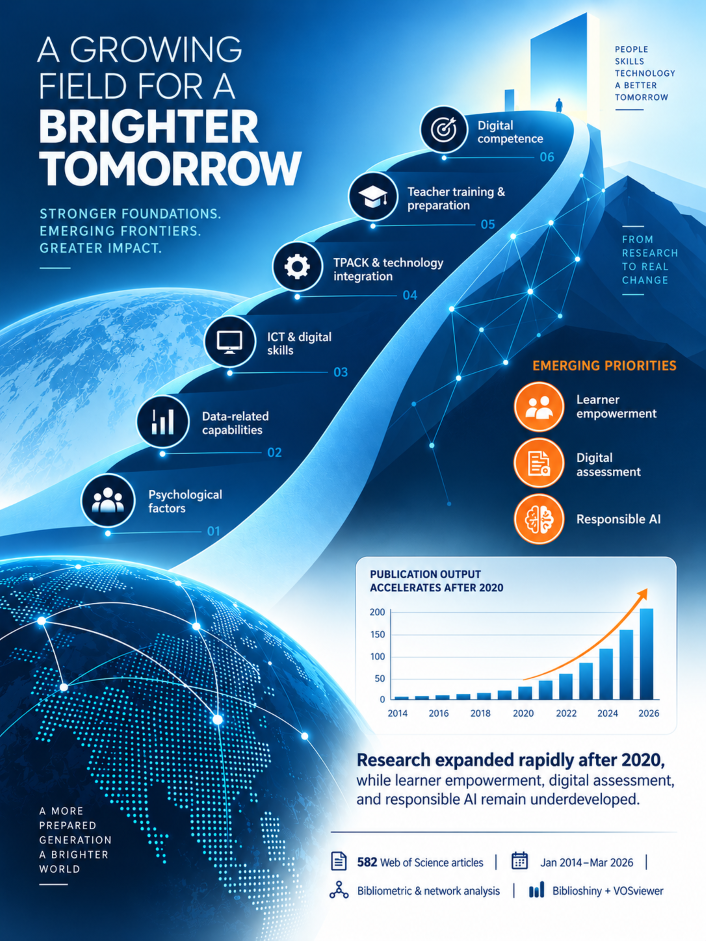
Pre-service teachers’ digital competence has become central to teacher education, yet the field’s conceptual organization, international structure, and temporal development remain insufficiently integrated. This study maps the development of this research domain and identifies its publication patterns, collaboration networks, conceptual clusters, and emerging themes. A corpus of 582 English-language research and review articles published between January 2014 and 19 March 2026 was selected from the Web of Science Core Collection after screening 1,016 records. Bibliometrix/Biblioshiny and VOSviewer were used to analyze annual output, source- and country-level indicators, international co-authorship, author-keyword co-occurrence, overlay visualization, and thematic evolution. Publication output increased from 34 articles in 2020 to 120 in 2025, although productivity, citation visibility, and network connectivity produced different rankings. The United States contributed the most publications, whereas Indonesia recorded the highest international collaboration rate among the ten most productive countries. The keyword network comprised six clusters spanning professional preparation, technological pedagogical knowledge, ICT and digital skills, motivational and self-regulatory factors, data-related capabilities, and teacher training. Digital competence was the most frequent and connected keyword, followed by TPACK and pedagogical content knowledge. Temporal analyses showed persistent attention to digital competence, digital literacy, ICT, and TPACK, alongside the recent visibility of artificial intelligence, AI literacy, critical thinking, engagement, and pedagogical beliefs. These findings indicate cumulative thematic broadening rather than conceptual replacement. Future research should strengthen learner empowerment, performance-based assessment, responsible AI judgment, and longitudinal evidence linking competence development to instructional practice and learner outcomes.
Downloads
Article Details

This work is licensed under a Creative Commons Attribution-ShareAlike 4.0 International License.
Authors who publish with this journal agree to the following terms:
- Copyright of the published article belongs to the authors and grant the journal right of first publication with the work simultaneously licensed under a Creative Commons Attribution-ShareAlike 4.0 (CC BY SA) International License that allows others to share the work with an acknowledgment of the work's authorship and initial publication in this journal.
- Authors are able to enter into separate, additional contractual arrangements for the non-exclusive distribution of the journal's published version of the work (e.g., post it to an institutional repository or publish it in a book), with an acknowledgment of its initial publication in this journal.
- Authors are permitted and encouraged to post their work online (e.g., in institutional repositories or on their website) prior to and during the submission process, as it can lead to productive exchanges, as well as earlier and greater citation of published work (See the Effect of Open Access).
References
[1] F. Caena and C. Redecker, “Aligning teacher competence frameworks to 21st century challenges: The case for the European Digital Competence Framework for Educators (Digcompedu),” Eur. J. Educ., vol. 54, no. 3, pp. 356–369, 2019, https://doi.org/10.1111/ejed.12345
[2] F. Miao and M. Cukurova, AI competency framework for teachers. Paris: UNESCO, 2024. https://doi.org/10.54675/ZJTE2084
[3] G. Falloon, “From digital literacy to digital competence: The teacher digital competency (TDC) framework,” Educ. Technol. Res. Dev., vol. 68, pp. 2449–2472, 2020, https://doi.org/10.1007/s11423-020-09767-4
[4] J. K. Andreasen, C. E. Tømte, I. Bergan, and V. B. Kovac, “Professional digital competence in initial teacher education: An examination of differences in two cohorts of pre-service teachers,” Nord. J. Digit. Lit., vol. 17, no. 1, pp. 61–74, 2022, https://doi.org/10.18261/njdl.17.1.5
[5] O. McGarr and A. McDonagh, “Exploring the digital competence of pre-service teachers on entry onto an initial teacher education programme in Ireland,” Irish Educ. Stud., vol. 40, no. 1, pp. 115–128, 2021, https://doi.org/10.1080/03323315.2020.1800501
[6] L. Starkey, “A review of research exploring teacher preparation for the digital age,” Cambridge J. Educ., vol. 50, no. 1, pp. 37–56, 2020, https://doi.org/10.1080/0305764X.2019.1625867
[7] L. Starkey and A. Yates, “Do digital competence frameworks align with preparing beginning teachers for digitally infused contexts? An evaluation from a New Zealand perspective,” Eur. J. Teach. Educ., vol. 45, no. 4, pp. 476–492, 2022, https://doi.org/10.1080/02619768.2021.1975109
[8] G. B. Gudmundsdottir, H. Hernández Gassó, J. C. Colomer Rubio, and O. E. Hatlevik, “Student teachers’ responsible use of ICT: Examining two samples in Spain and Norway,” Comput. Educ., vol. 152, p. 103877, 2020, https://doi.org/10.1016/j.compedu.2020.103877
[9] P. Mishra and M. J. Koehler, “Technological pedagogical content knowledge: A framework for teacher knowledge,” Teach. Coll. Rec., vol. 108, no. 6, pp. 1017–1054, 2006, https://doi.org/10.1111/j.1467-9620.2006.00684.x
[10] F. Pettersson, “On the issues of digital competence in educational contexts – a review of literature,” Educ. Inf. Technol., vol. 23, no. 3, pp. 1005–1021, 2018, https://doi.org/10.1007/s10639-017-9649-3
[11] D. A. Mahmood and G. Horvath, “Analysis of alert message propagation on the highway in VANET assuming Markovian vehicle arrival process,” Int. J. Commun. Syst., vol. 33, no. 14, 2020, https://doi.org/10.1002/dac.4501
[12] C. Redecker, European framework for the digital competence of educators: DigCompEdu, EUR 28775. Luxembourg: Publications Office of the European Union, 2017. https://doi.org/10.2760/159770
[13] E. J. Instefjord and E. Munthe, “Educating digitally competent teachers: A study of integration of professional digital competence in teacher education,” Teach. Teach. Educ., vol. 67, pp. 37–45, 2017, https://doi.org/10.1016/j.tate.2017.05.016
[14] J. Tondeur, J. van Braak, G. Sang, J. Voogt, P. Fisser, and A. Ottenbreit-Leftwich, “Preparing pre-service teachers to integrate technology in education: A synthesis of qualitative evidence,” Comput. Educ., vol. 59, no. 1, pp. 134–144, 2012, https://doi.org/10.1016/j.compedu.2011.10.009
[15] R. Voithofer and M. J. Nelson, “Teacher educator technology integration preparation practices around TPACK in the United States,” J. Teach. Educ., vol. 72, no. 3, pp. 314–328, 2021, https://doi.org/10.1177/0022487120949842
[16] D. Uerz, M. Volman, and M. Kral, “Teacher educators’ competences in fostering student teachers’ proficiency in teaching and learning with technology: An overview of relevant research literature,” Teach. Teach. Educ., vol. 70, pp. 12–23, 2018, https://doi.org/10.1016/j.tate.2017.11.005
[17] S. Getenet, C. Haeusler, P. Redmond, R. Cantle, and V. Crouch, “First-year Preservice Teachers’ Understanding of Digital Technologies and Their Digital Literacy, Efficacy, Attitude, and Online Learning Engagement: Implication for Course Design,” Technol. Knowl. Learn., vol. 29, no. 3, pp. 1359–1383, 2024, https://doi.org/10.1007/s10758-023-09724-z
[18] N. Janssen and A. W. Lazonder, “Supporting pre-service teachers in designing technology-infused lesson plans,” J. Comput. Assist. Learn., vol. 32, no. 5, pp. 456–467, 2016, https://doi.org/10.1111/jcal.12146
[19] M. Nelson and R. Voithofer, “Coursework, field experiences, and the technology beliefs and practices of preservice teachers,” Comput. Educ., vol. 186, p. 104547, 2022, https://doi.org/10.1016/j.compedu.2022.104547
[20] J. Tondeur, O. Trevisan, S. K. Howard, and J. van Braak, “Preparing preservice teachers to teach with digital technologies: An update of effective SQD-strategies,” Comput. Educ., vol. 232, p. 105262, 2025, https://doi.org/10.1016/j.compedu.2025.105262
[21] C. Tømte, A. B. Enochsson, U. Buskqvist, and A. Kårstein, “Educating online student teachers to master professional digital competence: The TPACK-framework goes online,” Comput. Educ., vol. 84, pp. 26–35, 2015, https://doi.org/10.1016/j.compedu.2015.01.005
[22] İ. Reisoğlu and A. Çebi, “How can the digital competences of pre-service teachers be developed? Examining a case study through the lens of DigComp and DigCompEdu,” Comput. Educ., vol. 156, p. 103940, 2020, https://doi.org/10.1016/j.compedu.2020.103940
[23] L. Momdjian, M. Manegre, and M. Gutiérrez-Colón, “A study of preservice teachers’ digital competence development: Exploring the role of direct instruction, integrated practice, and modeling,” Eval. Program Plann., vol. 109, p. 102538, 2025, https://doi.org/10.1016/j.evalprogplan.2025.102538
[24] A. R. Luís and C. Rodrigues, “Toward the effective integration of DigCompEdu: A pilot study in ELT teacher education,” Ubiquitous Learn. An Int. J., vol. 18, no. 1, pp. 49–66, 2025, https://doi.org/10.18848/1835-9795/CGP/v18i01/49-66
[25] K. Young, Z. Doğança Küçük, T. Delahunty, M. Dempsey, and N. Maglaperidze, “Evaluating the impact of a digital competency-based placement model on STEM pre-service teachers’ digital competence and teaching experiences,” Teach. Teach. Educ., vol. 175, p. 105466, 2026, https://doi.org/10.1016/j.tate.2026.105466
[26] B. Alnasib, “Digital Competencies: Are Pre-Service Teachers Qualified for Digital Education?,” Int. J. Educ. Math. Sci. Technol., vol. 11, no. 1, pp. 96–114, 2023, https://doi.org/10.46328/ijemst.2842
[27] J. M. García-Vandewalle García, M. García-Carmona, J. M. Trujillo Torres, and P. J. Moya Fernández, “Analysis of digital competence of educators (DigCompEdu) in teacher trainees: The context of Melilla, Spain,” Technol. Knowl. Learn., vol. 28, pp. 585–612, 2023, https://doi.org/10.1007/s10758-021-09546-x
[28] C. G. Karacan and T. Can, “Assessing teacher digital competences in pre-service language teachers: Adaptation and validation of the DigCompEdu scale,” J. Res. Technol. Educ., vol. 58, no. 5, pp. 1114–1133, 2026, https://doi.org/10.1080/15391523.2025.2504354
[29] L. Momdjian, M. Manegre, and M. Gutiérrez-Colón, “Assessing and bridging the digital competence gap: A comparative study of Lebanese student teachers and in-service teachers using the DigCompEdu framework,” Discov. Educ., vol. 3, p. 198, 2024, https://doi.org/10.1007/s44217-024-00308-2
[30] J. Quast, C. Rubach, and R. Porsch, “Professional digital competence beliefs of student teachers, pre-service teachers and teachers: Validating an instrument based on the DigCompEdu framework,” Eur. J. Teach. Educ., vol. 48, no. 4, pp. 698–721, 2025, https://doi.org/10.1080/02619768.2023.2251663
[31] S. H. Yoon, “Gender and digital competence: Analysis of pre-service teachers’ educational needs and its implications,” Int. J. Educ. Res., vol. 114, p. 101989, 2022, https://doi.org/10.1016/j.ijer.2022.101989
[32] L. Choi and S. Chung, “Preparing Technologically Competent EFL Teachers: A TPACK-based Approach,” SAGE Open, vol. 15, no. 3, pp. 1–12, 2025, https://doi.org/10.1177/21582440251367827
[33] E. Szeto and A. Y. N. Cheng, “Pedagogies across subjects: What are preservice teachers’ TPACK patterns of integrating technology in practice?,” J. Educ. Comput. Res., vol. 55, no. 3, pp. 346–373, 2017, https://doi.org/10.1177/0735633116667370
[34] A. Lachner et al., “Fostering pre-service teachers’ technological pedagogical content knowledge (TPACK): A quasi-experimental field study,” Comput. Educ., vol. 174, p. 104304, 2021, https://doi.org/10.1016/j.compedu.2021.104304
[35] A. Diamah et al., “Evaluating the effectiveness of technological pedagogical content knowledge-based training program in enhancing pre-service teachers’ perceptions of technological pedagogical content knowledge,” Front. Educ., vol. 7, p. 897447, 2022, https://doi.org/10.3389/feduc.2022.897447
[36] H. O. Kapici and H. Akcay, “Improving student teachers’ TPACK self-efficacy through lesson planning practice in the virtual platform,” Educ. Stud., vol. 49, no. 1, pp. 76–98, 2023, https://doi.org/10.1080/03055698.2020.1835610
[37] A. Çebi, T. Özdemir, I. Reisoglu, and C. Çolak, “From digital competences to technology integration: Re-formation of pre-service teachers’ knowledge and understanding,” Int. J. Educ. Res., vol. 113, p. 101965, 2022, https://doi.org/10.1016/j.ijer.2022.101965
[38] H. Kim, J. Song, and S. Ha, “TPACK expression patterns in preservice teachers’ design of innovative physics teaching and learning materials,” J. Comput. Assist. Learn., vol. 40, no. 4, pp. 1552–1566, 2024, https://doi.org/10.1111/jcal.12965
[39] L. Meroño, A. Calderón, and J. L. Arias-Estero, “Digital pedagogy and cooperative learning: Effect on the technological pedagogical content knowledge and academic performance of pre-service teachers,” Rev. Psicodidact., vol. 26, no. 1, pp. 53–61, 2021, https://doi.org/10.1016/j.psicod.2020.10.002
[40] B. Lim, V. Lake, A. Beisly, and R. Ross-Lightfoot, “Preservice Teachers’ TPACK Growth After Technology Integration Courses in Early Childhood Education,” Early Educ. Dev., vol. 35, no. 1, pp. 114–131, 2024, https://doi.org/10.1080/10409289.2023.2224219
[41] S. Howard, J. Tondeur, J. Ma, and J. Yang, “What to teach? Strategies for developing digital competency in preservice teacher training,” Comput. Educ., vol. 165, p. 104149, 2021, https://doi.org/10.1016/j.compedu.2021.104149
[42] J. Milton, T. H. Giæver, L. Mifsud, and H. Hernández Gassó, “Awareness and knowledge of cyberethics: A study of preservice teachers in Malta, Norway, and Spain,” Nord. J. Comp. Int. Educ., vol. 5, no. 4, pp. 18–37, 2021, https://doi.org/10.7577/njcie.4257
[43] A. Neira, K. Fuentes-Riffo, A. Vine, F. García, and G. Naranjo, “Development and validation of a self-perception instrument for critical media literacy in Chilean pre-service teachers,” Front. Educ., vol. 9, p. 1476500, 2024, https://doi.org/10.3389/feduc.2024.1476500
[44] A. Pérez Garcias and V. I. Marín, “Ethics issues of digital contents for pre-service primary teachers: A gamification experience for self-assessment with Socrative,” IAFOR J. Educ., vol. 4, no. 2, pp. 80–96, 2016, https://doi.org/10.22492/ije.4.2.05
[45] T. S. Cherner and K. Curry, “Preparing pre-service teachers to teach media literacy: A response to ‘fake news,’” J. Media Lit. Educ., vol. 11, no. 1, pp. 1–31, 2019, https://doi.org/10.23860/JMLE-2019-11-1-1
[46] K. Miller-Bains, J. Cohen, and V. C. Wong, “Developing data literacy: Investigating the effects of a pre-service data use intervention,” Teach. Teach. Educ., vol. 109, p. 103569, 2022, https://doi.org/10.1016/j.tate.2021.103569
[47] J. Castellví, M.-C. Díez-Bedmar, and A. Santisteban, “Pre-service teachers’ critical digital literacy skills and attitudes to address social problems,” Soc. Sci., vol. 9, no. 8, p. 134, 2020, https://doi.org/10.3390/socsci9080134
[48] D. T. K. Ng, J. K. L. Leung, S. K. W. Chu, and M. S. Qiao, “Conceptualizing AI literacy: An exploratory review,” Comput. Educ. Artif. Intell., vol. 2, p. 100041, 2021, https://doi.org/10.1016/j.caeai.2021.100041
[49] J. Laru, I. Celik, I. Jokela, and K. Mäkitalo, “The antecedents of pre-service teachers’ AI literacy: Perceptions about own AI-driven applications, attitude towards AI and knowledge in machine learning,” Eur. J. Teach. Educ., vol. 48, no. 5, pp. 964–986, 2025, https://doi.org/10.1080/02619768.2025.2535623
[50] B. L. Moorhouse, Y. Wan, C. Wu, L. Kohnke, T. Y. Ho, and T. Kwong, “Developing language teachers’ professional generative AI competence: An intervention study in an initial language teacher education course,” System, vol. 125, p. 103399, 2024, https://doi.org/10.1016/j.system.2024.103399
[51] O. Almatrafi, A. Johri, and H. Lee, “A systematic review of AI literacy conceptualization, constructs, and implementation and assessment efforts (2019–2023),” Comput. Educ. Open, vol. 6, p. 100173, 2024, https://doi.org/10.1016/j.caeo.2024.100173
[52] S. Heine, M. Krepf, and J. König, “Digital resources as an aspect of teacher professional digital competence: One term, different definitions – a systematic review,” Educ. Inf. Technol., vol. 28, pp. 3711–3738, 2023, https://doi.org/10.1007/s10639-022-11321-z
[53] A. Shokeen and B. Kaur, “Factors influencing digital competence of pre-service teachers: A systematic review of literature,” Indian J. Educ. Technol., vol. 4, no. I, pp. 218–229, 2022, [Online]. Available: https://journals.ncert.gov.in/IJET/article/view/542
[54] M. Zeng, Z. Abdullah, and K. S. L. Cheah, “Pre-service teachers’ digital competence: A systematic review of factors, frameworks, and global patterns,” Int. J. Learn. Teach. Educ. Res., vol. 24, no. 8, pp. 218–247, 2025, https://doi.org/10.26803/ijlter.24.8.10
[55] L. Zhang, C. Yang, and Y. Zheng, “Digital competence for sustainable education of pre-service teachers: A systematic literature review (2014–2024),” Front. Psychol., vol. 16, p. 1710983, 2026, https://doi.org/10.3389/fpsyg.2025.1710983
[56] D. Marín-Suelves, S. López-Gómez, M. M. Castro-Rodríguez, and J. Rodríguez-Rodríguez, “Digital competence in schools: A bibliometric study,” IEEE Rev. Iberoam. Tecnol. del Aprendiz., vol. 15, no. 4, pp. 381–388, 2020, https://doi.org/10.1109/RITA.2020.3033207
[57] H. Ma and L. Ismail, “Bibliometric analysis and systematic review of digital competence in education,” Humanit. Soc. Sci. Commun., vol. 12, p. 185, 2025, https://doi.org/10.1057/s41599-025-04401-1
[58] A. B. Thuy, H. V Dung, N. T. Lan-Ngoc, P. T. Hong-Hanh, N. T. Viet-Nga, and T. T. Phuong Thao, “The evolution of digital competence in pre-service teachers: A global perspective from 2009–2024,” Int. J. Eval. Res. Educ., vol. 15, no. 1, pp. 66–81, 2026, https://doi.org/10.11591/ijere.v15i1.33434
[59] N. Donthu, S. Kumar, D. Mukherjee, N. Pandey, and W. M. Lim, “How to conduct a bibliometric analysis: An overview and guidelines,” J. Bus. Res., vol. 133, pp. 285–296, 2021, https://doi.org/10.1016/j.jbusres.2021.04.070
[60] M. Aria and C. Cuccurullo, “bibliometrix: An R-tool for comprehensive science mapping analysis,” J. Informetr., vol. 11, no. 4, pp. 959–975, 2017, https://doi.org/10.1016/j.joi.2017.08.007
[61] N. J. van Eck and L. Waltman, “Software survey: VOSviewer, a computer program for bibliometric mapping,” Scientometrics, vol. 84, no. 2, pp. 523–538, 2010, https://doi.org/10.1007/s11192-009-0146-3
[62] L. Waltman, “A review of the literature on citation impact indicators,” J. Informetr., vol. 10, no. 2, pp. 365–391, 2016. https://doi.org/10.1016/j.joi.2016.02.007
[63] M. J. Cobo, F. Chiclana, A. Collop, J. De Ona, and E. Herrera-Viedma, “A bibliometric analysis of the intelligent transportation systems research based on science mapping,” IEEE Trans. Intell. Transp. Syst., vol. 15, no. 2, pp. 901–908, 2014, https://doi.org/10.1109/TITS.2013.2284756
[64] M. J. Cobo, A. G. López-Herrera, E. Herrera-Viedma, and F. Herrera, “An approach for detecting, quantifying, and visualizing the evolution of a research field: A practical application to the Fuzzy Sets Theory field,” J. Informetr., vol. 5, no. 1, pp. 146–166, 2011, https://doi.org/10.1016/j.joi.2010.10.002
[65] M. Callon, J. P. Courtial, and F. Laville, “Co-word analysis as a tool for describing the network of interactions between basic and technological research: The case of polymer chemsitry,” Scientometrics, vol. 22, no. 1, pp. 155–205, 1991, https://doi.org/10.1007/BF02019280
[66] Z. Zhang, Y. Maeda, T. Newby, Z. Cheng, and Q. Xu, “The effect of preservice teachers’ ICT integration self-efficacy beliefs on their ICT competencies: The mediating role of online self-regulated learning strategies,” Comput. Educ., vol. 193, p. 104673, 2023, https://doi.org/10.1016/j.compedu.2022.104673
[67] A. Pérez Garcias, A. Darder Mesquida, B. de-Benito Crosetti, and F. Negre-Bennasar, “La competencia digital y la agencia digital docente en la formación inicial del profesorado TT - Digital competence and digital teaching agency in preservice teacher training,” Bordón. Rev. Pedagog., vol. 76, no. 2, pp. 27–44, 2024, https://doi.org/10.13042/Bordon.2024.100546
[68] M. Johannesen, L. Øgrim, and O. E. Hatlevik, “Teachers’ Professional Digital Competence - The Neglected Management of Technology-rich Classrooms?,” Nord. J. Digit. Lit., vol. 19, no. 2, pp. 64–81, 2024, https://doi.org/10.18261/njdl.19.2.2
[69] Y. Y. Hsu and C. H. Lin, “Evaluating the effectiveness of a preservice teacher technology training module incorporating SQD strategies,” Int. J. Educ. Technol. High. Educ., vol. 17, no. 1, p. 31, 2020, https://doi.org/10.1186/s41239-020-00205-2
[70] Ł. Tomczyk, “Digital competence among pre-service teachers: A global perspective on curriculum change as viewed by experts from 33 countries,” Eval. Program Plann., vol. 105, p. 102449, 2024, https://doi.org/10.1016/j.evalprogplan.2024.102449
[71] M. Schmid, E. Brianza, and D. Petko, “Self-reported technological pedagogical content knowledge (TPACK) of pre-service teachers in relation to digital technology use in lesson plans,” Comput. Human Behav., vol. 115, p. 106586, 2021, https://doi.org/10.1016/j.chb.2020.106586
[72] J. Tondeur, R. Scherer, F. Siddiq, and E. Baran, “Enhancing pre-service teachers’ technological pedagogical content knowledge (TPACK): a mixed-method study: J. Tondeur et al.,” Educ. Technol. Res. Dev., vol. 68, no. 1, pp. 319–343, 2020, https://doi.org/10.1007/s11423-019-09692-1
[73] S. Heine, M. Krepf, D. J. Jäger-Biela, K. Gerhard, R. Stollenwerk, and J. König, “Preservice teachers’ professional knowledge for ICT integration in the classroom: Analysing its structure and its link to teacher education,” Educ. Inf. Technol., vol. 29, pp. 11043–11075, 2024, https://doi.org/10.1007/s10639-023-12212-7
[74] A.-K. Hirsch and C. Rubach, “Exploring the interplay between teaching strategies and digital competencies beliefs among pre-service teachers: A longitudinal study,” Educ. Sci., vol. 14, no. 12, p. 1342, 2024, https://doi.org/10.3390/educsci14121342
[75] E. Ross, N. McMaster, and M. Clarkin, “Teacher preparation for integrating technology in primary education: using action plans with pre-service teachers to enhance their self-efficacy in technology pedagogy,” Educ. Inf. Technol., vol. 31, no. 3, pp. 891–922, 2026, https://doi.org/10.1007/s10639-025-13822-z
[76] O. Merjovaara et al., “Early childhood pre-service teachers’ attitudes towards digital technologies and their relation to digital competence,” Educ. Inf. Technol., vol. 29, no. 12, pp. 14647–14662, 2024, https://doi.org/10.1007/s10639-023-12237-y
[77] P. A. Ertmer, “Addressing first- and second-order barriers to change: Strategies for technology integration,” Educ. Technol. Res. Dev., vol. 47, no. 4, pp. 47–61, 1999, https://doi.org/10.1007/BF02299597
[78] T. A. Cullen and B. A. Greene, “Preservice teachers’ beliefs, attitudes, and motivation about technology integration,” J. Educ. Comput. Res., vol. 45, no. 1, pp. 29–47, 2011, https://doi.org/10.2190/EC.45.1.b
[79] E. M. Meyers, I. Erickson, and R. V. Small, “Digital literacy and informal learning environments: An introduction,” Learn. Media Technol., vol. 38, no. 4, pp. 355–367, 2013, https://doi.org/10.1080/17439884.2013.783597
[80] F. Sandoval-Ríos, C. Cabezas-Orellana, and J. A. López-Núñez, “Validation of a Spanish-Language Scale on Data-Driven Decision-Making in Pre-Service Teachers,” Educ. Sci., vol. 15, no. 7, p. 789, 2025, https://doi.org/10.3390/educsci15070789
[81] S. Wurster, S. Bez, and S. Merk, “Does learning how to use data mean being motivated to use it? Effects of a data use intervention on data literacy and motivational beliefs of pre-service teachers,” Learn. Instr., vol. 88, p. 101806, 2023, https://doi.org/10.1016/j.learninstruc.2023.101806
[82] F. de L. González-Mujico, “Measuring student and educator digital competence beyond self-assessment: Developing and validating two rubric-based frameworks,” Educ. Inf. Technol., vol. 29, no. 11, pp. 13299–13324, 2024, https://doi.org/10.1007/s10639-023-12363-7
[83] H. Seifert and A. Lindmeier, “Developing a Performance-Based Assessment to Measure Pre-Service Secondary Teachers’ Digital Competence to Use Digital Mathematics Tools,” J. fur Math., vol. 45, no. 2, p. 25, 2024, https://doi.org/10.1007/s13138-024-00251-7
[84] V. I. Marín, J. P. Carpenter, and G. Tur, “Pre-service teachers’ perceptions of social media data privacy policies,” Br. J. Educ. Technol., vol. 52, no. 2, pp. 519–535, 2021, https://doi.org/10.1111/bjet.13035
[85] S. von Gillern, M. Korona, W. Wright, H. Gould, and B. Haskey-Valerius, “Media literacy, digital citizenship and their relationship: Perspectives of preservice teachers,” Teach. Teach. Educ., vol. 138, p. 104404, 2024, https://doi.org/10.1016/j.tate.2023.104404
[86] L. Huynh, T. H. Le, B. Dang, B. T. An, C. T. Vu, and A. Nguyen, “Mindset matters: Fostering teachers’ responsible AI use through professional development,” J. New Approaches Educ. Res., vol. 14, no. 1, p. 23, 2025, https://doi.org/10.1007/s44322-025-00043-y