
Mathematical Critical Thinking in Trigonometry Under E-Module-Supported Project-Based Learning: An Explanatory Sequential Study Across Self-Reported Modality Preferences
Article Sidebar
Main Article Content
Abstract
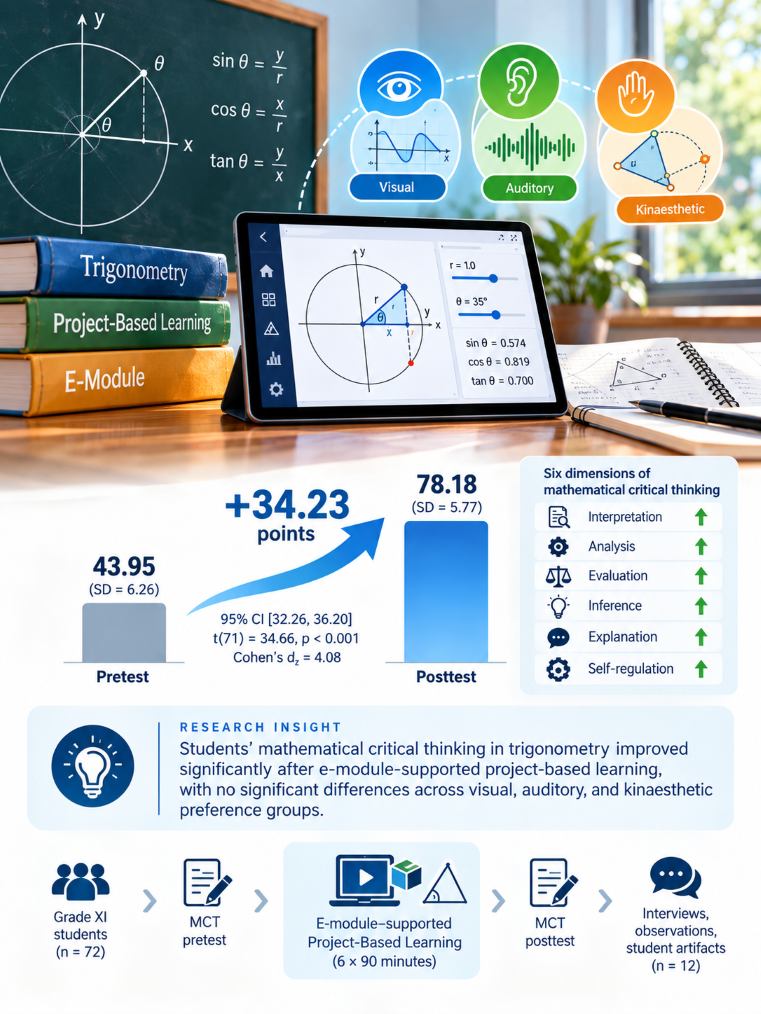
Mathematical critical thinking (MCT) involves interpreting information, analyzing relationships, evaluating procedures, inferring conclusions, explaining reasoning, and regulating problem solving. This study examined pretest-posttest changes in MCT during e-module-supported Project-Based Learning (PjBL) in trigonometry and explored variation across self-reported Visual, Auditory, and Kinaesthetic (VAK) preferences. A quantitatively driven explanatory sequential mixed-methods design was used with Grade XI students at a public senior high school in Cirebon Regency, West Java, Indonesia. From 180 students screened, 72 were included in the quantitative sample (n = 24 per VAK group). Students completed an MCT pretest and posttest around six 90-minute PjBL sessions. Qualitative follow-up used interviews with 12 purposively selected students, classroom observations, and student artifacts. Mean MCT scores increased from 43.95 (SD = 6.26) to 78.18 (SD = 5.77); the mean within-student change was 34.23 points, 95% CI [32.26, 36.20], t(71) = 34.66, p < 0.001, Cohen's dz = 4.08. All six MCT dimension indicators showed statistically significant pretest-posttest changes after false-discovery-rate adjustment. No statistically significant differences were detected among VAK groups for posttest MCT or normalized gain, and ANCOVA controlling for pretest performance yielded the same inferential conclusion. Qualitative analysis identified overlapping patterns of visualization, verbalization, digital manipulation, trial-and-check reasoning, peer discussion, and reflection. The integrated findings document marked within-student change alongside heterogeneous reasoning processes, but the single-group design precludes causal attribution of the observed changes to PjBL or the e-module.
Downloads
Article Details

This work is licensed under a Creative Commons Attribution-ShareAlike 4.0 International License.
Authors who publish with this journal agree to the following terms:
- Copyright of the published article belongs to the authors and grant the journal right of first publication with the work simultaneously licensed under a Creative Commons Attribution-ShareAlike 4.0 (CC BY SA) International License that allows others to share the work with an acknowledgment of the work's authorship and initial publication in this journal.
- Authors are able to enter into separate, additional contractual arrangements for the non-exclusive distribution of the journal's published version of the work (e.g., post it to an institutional repository or publish it in a book), with an acknowledgment of its initial publication in this journal.
- Authors are permitted and encouraged to post their work online (e.g., in institutional repositories or on their website) prior to and during the submission process, as it can lead to productive exchanges, as well as earlier and greater citation of published work (See the Effect of Open Access).
References
[1] P. C. Abrami, R. M. Bernard, E. Borokhovski, D. I. Waddington, C. A. Wade, and T. Persson, “Strategies for Teaching Students to Think Critically: A Meta-Analysis,” Rev. Educ. Res., vol. 85, no. 2, pp. 275–314, 2015, https://doi.org/10.3102/0034654314551063
[2] C. Monteleone, J. Miller, and E. Warren, “Conceptualising critical mathematical thinking in young students,” Math. Educ. Res. J., vol. 35, no. 2, pp. 339–359, 2023, https://doi.org/10.1007/s13394-023-00445-1
[3] Q. Wang and A. H. Abdullah, “Enhancing Students’ Critical Thinking Through Mathematics in Higher Education: A Systemic Review,” SAGE Open, vol. 14, no. 3, 2024, https://doi.org/10.1177/21582440241275651
[4] OECD, “PISA 2022 Results (Volume I): The State of Learning and Equity in Education,” OECD Publishing, Paris, 2023. https://doi.org/10.1787/53f23881-en.
[5] A. Putri, T. Nusantara, Purwanto, and A. R. As’ari, “The contribution of critical thinking skills in rich mathematical problem completion: Insights from pre-service mathematics teachers,” Eurasia J. Math. Sci. Technol. Educ., vol. 21, no. 2, p. em2581, 2025, https://doi.org/10.29333/ejmste/15931
[6] K. L. Yang, C. H. Chen, and W. R. Wu, “Exploring critical and reflective thinking in mathematical literacy through variable- and person-centered approaches,” Think. Ski. Creat., vol. 60, p. 102127, 2026, https://doi.org/10.1016/j.tsc.2026.102127
[7] D. Kamber and D. Takaci, “On problematic aspects in learning trigonometry,” Int. J. Math. Educ. Sci. Technol., vol. 49, no. 2, pp. 161–175, 2018, https://doi.org/10.1080/0020739X.2017.1357846
[8] B. H. Ngu and H. P. Phan, “Differential instructional effectiveness: overcoming the challenge of learning to solve trigonometry problems that involved algebraic transformation skills,” Eur. J. Psychol. Educ., vol. 38, no. 4, pp. 1505–1525, 2023, https://doi.org/10.1007/s10212-022-00670-5
[9] A. T. Ferede, M. A. Ayele, A. A. Mihrka, and A. A. Arara, “The impact of contextualized teaching and learning approach on students’ conceptual understanding of trigonometry,” Teach. Math. its Appl., vol. 45, no. 2, pp. 161–180, 2026, https://doi.org/10.1093/teamat/hraf008
[10] D. Kokotsaki, V. Menzies, and A. Wiggins, “Project-based learning: A review of the literature,” Improv. Sch., vol. 19, no. 3, pp. 267–277, 2016. https://doi.org/10.1177/1365480216659733
[11] C. H. Chen and Y. C. Yang, “Revisiting the effects of project-based learning on students’ academic achievement: A meta-analysis investigating moderators,” Educ. Res. Rev., vol. 26, pp. 71–81, 2019, https://doi.org/10.1016/j.edurev.2018.11.001
[12] S. Farshad and C. Fortin, “An umbrella review of meta-analyses on project-based learning: Effects on academic achievement, higher-order thinking, and 21st-century skills,” Educ. Res. Rev., vol. 52, p. 100809, 2026, https://doi.org/10.1016/j.edurev.2026.100809
[13] J. Young, “Technology-enhanced mathematics instruction: A second-order meta-analysis of 30 years of research,” Educ. Res. Rev., vol. 22, pp. 19–33, 2017, https://doi.org/10.1016/j.edurev.2017.07.001
[14] C. R. Rakes, R. N. Ronau, S. B. Bush, S. O. Driskell, M. L. Niess, and D. K. Pugalee, “Mathematics achievement and orientation: A systematic review and meta-analysis of education technology,” Educ. Res. Rev., vol. 31, p. 100337, 2020, https://doi.org/10.1016/j.edurev.2020.100337
[15] O. Birgin and K. Uzun Yazıcı, “The effect of GeoGebra software–supported mathematics instruction on eighth-grade students’ conceptual understanding and retention,” J. Comput. Assist. Learn., vol. 37, no. 4, pp. 925–939, 2021, https://doi.org/10.1111/jcal.12532
[16] A. M. K. Mannan, M. R. Bajuri, S. S. Abdul Rahim, and N. A. Abdullah, “How do digital tools support metacognition in mathematics learning? A systematic review of research on GeoGebra and problem-solving,” Educ. Res. Rev., vol. 52, p. 100827, 2026, https://doi.org/10.1016/j.edurev.2026.100827
[17] A. Skulmowski and K. M. Xu, “Understanding Cognitive Load in Digital and Online Learning: a New Perspective on Extraneous Cognitive Load,” Educ. Psychol. Rev., vol. 34, no. 1, pp. 171–196, 2022, https://doi.org/10.1007/s10648-021-09624-7
[18] H. Pashler, M. McDaniel, D. Rohrer, and R. Bjork, “Learning styles concepts and evidence,” Psychol. Sci. Public Interes. Suppl., vol. 9, no. 3, pp. 105–119, 2008, https://doi.org/10.1111/j.1539-6053.2009.01038.x
[19] K. Aslaksen and H. Lorås, “The modality-specific learning style hypothesis: A mini-review,” Front. Psychol., vol. 9, no. Aug, p. 1538, 2018, https://doi.org/10.3389/fpsyg.2018.01538
[20] T. Fallace, “The Long Origins of the Visual, Auditory, and Kinesthetic Learning Style Typology, 1921–2001,” Hist. Psychol., vol. 26, no. 4, pp. 334–354, 2023, https://doi.org/10.1037/hop0000240
[21] M. D. Fetters, L. A. Curry, and J. W. Creswell, “Achieving integration in mixed methods designs - Principles and practices,” Health Serv. Res., vol. 48, no. 6 PART2, pp. 2134–2156, 2013, https://doi.org/10.1111/1475-6773.12117
[22] P. A. Facione, “Critical Thinking: A Statement of Expert Consensus for Purposes of Educational Assessment and Instruction. Research Findings and Recommendations,” American Philosophical Association, Newark, DE, 1990. [Online]. Available: https://eric.ed.gov/?id=ED315423
[23] A. H. Schoenfeld, “Learning to think mathematically: Problem solving, metacognition, and sense-making in mathematics,” in Handbook for Research on Mathematics Teaching and Learning, D. A. Grouws, Ed. New York, NY: Macmillan, 1992, pp. 334–370.
[24] J. Lithner, “A research framework for creative and imitative reasoning,” Educ. Stud. Math., vol. 67, pp. 255–276, 2008, https://doi.org/10.1007/s10649-007-9104-2
[25] S. Dolapcioglu and A. Doğanay, “Development of critical thinking in mathematics classes via authentic learning: an action research,” Int. J. Math. Educ. Sci. Technol., vol. 53, no. 6, pp. 1363–1386, 2022, https://doi.org/10.1080/0020739X.2020.1819573
[26] N. Monrat, M. Phaksunchai, and R. Chonchaiya, “Developing Students’ Mathematical Critical Thinking Skills Using Open-Ended Questions and Activities Based on Student Learning Preferences,” Educ. Res. Int., vol. 2022, p. 3300363, 2022, https://doi.org/10.1155/2022/3300363
[27] P. C. Blumenfeld, E. Soloway, R. W. Marx, J. S. Krajcik, M. Guzdial, and A. Palincsar, “Motivating project-based learning: Sustaining the doing, supporting the learning,” Educ. Psychol., vol. 26, no. 3–4, pp. 369–398, 1991, https://doi.org/10.1080/00461520.1991.9653139
[28] R. E. Mayer, Multimedia Learning, 3rd ed. Cambridge, UK: Cambridge University Press, 2020. https://doi.org/10.1017/9781316941355
[29] R. E. Mayer, “Cognitive Theory of Multimedia Learning,” in The Cambridge Handbook of Multimedia Learning, 3rd ed., R. E. Mayer and L. Fiorella, Eds. Cambridge University Press, 2021, pp. 57–72. https://doi.org/10.1017/9781108894333.008
[30] L. Fiorella and R. E. Mayer, “Principles for reducing extraneous processing in multimedia learning: Coherence, signaling, redundancy, spatial contiguity, and temporal contiguity principles,” in The Cambridge Handbook of Multimedia Learning, 3rd ed., R. E. Mayer and L. Fiorella, Eds. Cambridge, UK: Cambridge University Press, 2021, pp. 185–198. https://doi.org/10.1017/9781108894333.019
[31] R. C. Clark, “Multimedia learning in e-courses,” in The Cambridge Handbook of Multimedia Learning, 3rd ed., R. E. Mayer and L. Fiorella, Eds. Cambridge, UK: Cambridge University Press, 2021, pp. 537–551. https://doi.org/10.1017/9781108894333.054
[32] R. Moreno and R. E. Mayer, “Interactive multimodal learning environments,” Educ. Psychol. Rev., vol. 19, pp. 309–326, 2007, https://doi.org/10.1007/s10648-007-9047-2
[33] F. M. Van der Kleij, R. C. W. Feskens, and T. J. H. M. Eggen, “Effects of Feedback in a Computer-Based Learning Environment on Students’ Learning Outcomes: A Meta-Analysis,” Rev. Educ. Res., vol. 85, no. 4, pp. 475–511, 2015, https://doi.org/10.3102/0034654314564881
[34] R. Azevedo, “Using hypermedia as a metacognitive tool for enhancing student learning? The role of self-regulated learning,” Educ. Psychol., vol. 40, no. 4, pp. 199–209, 2005, https://doi.org/10.1207/s15326985ep4004_2
[35] R. Azevedo and J. G. Cromley, “Does training on self-regulated learning facilitate students’ learning with hypermedia?,” J. Educ. Psychol., vol. 96, no. 3, pp. 523–535, 2004, https://doi.org/10.1037/0022-0663.96.3.523
[36] F. Reinhold, T. Leuders, K. Loibl, M. Nückles, M. Beege, and J. M. Boelmann, “Learning Mechanisms Explaining Learning With Digital Tools in Educational Settings: a Cognitive Process Framework,” Educ. Psychol. Rev., vol. 36, no. 1, p. 14, 2024, https://doi.org/10.1007/s10648-024-09845-6
[37] L. Brummer, H. de Boer, J. M. Mouw, and J. W. Strijbos, “A meta-analysis of the effects of context, content, and task factors of digitally delivered instructional feedback on learning performance,” Learn. Environ. Res., vol. 27, no. 3, pp. 453–476, 2024, https://doi.org/10.1007/s10984-024-09501-4
[38] R. E. Mayer, “The Past, Present, and Future of the Cognitive Theory of Multimedia Learning,” Educ. Psychol. Rev., vol. 36, no. 1, p. 8, 2024, https://doi.org/10.1007/s10648-023-09842-1
[39] B. A. Rogowsky, B. M. Calhoun, and P. Tallal, “Matching learning style to instructional method: Effects on comprehension,” J. Educ. Psychol., vol. 107, no. 1, pp. 64–78, 2015, https://doi.org/10.1037/a0037478
[40] J. W. Creswell and V. L. Plano Clark, Designing and Conducting Mixed Methods Research, 3rd ed. Thousand Oaks, CA: SAGE Publications, 2018.
[41] N. V. Ivankova, J. W. Creswell, and S. L. Stick, “Using Mixed-Methods Sequential Explanatory Design: From Theory to Practice,” Field methods, vol. 18, no. 1, pp. 3–20, 2006, https://doi.org/10.1177/1525822X05282260
[42] W. R. Shadish, T. D. Cook, and D. T. Campbell, Experimental and Quasi-Experimental Designs for Generalized Causal Inference. Boston, MA: Houghton Mifflin, 2002.
[43] L. A. Palinkas, S. M. Horwitz, C. A. Green, J. P. Wisdom, N. Duan, and K. Hoagwood, “Purposeful Sampling for Qualitative Data Collection and Analysis in Mixed Method Implementation Research,” Adm. Policy Ment. Heal. Ment. Heal. Serv. Res., vol. 42, no. 5, pp. 533–544, 2015, https://doi.org/10.1007/s10488-013-0528-y
[44] R. M. Branch, Instructional Design: The ADDIE Approach. New York, NY: Springer, 2009. https://doi.org/10.1007/978-0-387-09506-6
[45] W. L. Leite, M. Svinicki, and Y. Shi, “Attempted validation of the scores of the VARK: Learning Styles Inventory with multitrait–multimethod confirmatory factor analysis models,” Educ. Psychol. Meas., vol. 70, no. 2, pp. 323–339, 2010, https://doi.org/10.1177/0013164409344507
[46] K. Warner, M. Hamza, A. Oliver-Smith, F. Renaud, and A. Julca, “Climate change, environmental degradation and migration,” Nat. Hazards, vol. 55, no. 3, pp. 689–715, 2010, https://doi.org/10.1007/s11069-009-9419-7
[47] D. F. Polit and C. T. Beck, “The content validity index: Are you sure you know what’s being reported? Critique and recommendations,” Res. Nurs. Heal., vol. 29, no. 5, pp. 489–497, 2006, https://doi.org/10.1002/nur.20147
[48] M. Tavakol and R. Dennick, “Making sense of Cronbach’s alpha,” Int. J. Med. Educ., vol. 2, pp. 53–55, 2011, https://doi.org/10.5116/ijme.4dfb.8dfd
[49] S. Sireci and M. Faulkner-Bond, “Validity evidence based on test content,” Psicothema, vol. 1, no. 26, pp. 100–107, 2014, https://doi.org/10.7334/psicothema2013.256
[50] S. Messick, “Validity of psychological assessment: Validation of inferences from persons’ responses and performances as scientific inquiry into score meaning,” Am. Psychol., vol. 50, no. 9, pp. 741–749, 1995, https://doi.org/10.1037/0003-066X.50.9.741
[51] P. A. Facione, “Critical Thinking : A Statement of Expert Consensus for Purposes of Educational Assessment and Instruction Executive Summary “ The Delphi Report,” Calif. Acad. Press, vol. 423, no. c, pp. 1–19, 1990, [Online]. Available: http://www.insightassessment.com/pdf_files/DEXadobe.PDF
[52] A. Jönsson and G. Svingby, “The use of scoring rubrics: Reliability, validity and educational consequences,” Educ. Res. Rev., vol. 2, no. 2, pp. 130–144, 2007, https://doi.org/10.1016/j.edurev.2007.05.002
[53] P. E. Shrout and J. L. Fleiss, “Intraclass correlations: Uses in assessing rater reliability,” Psychol. Bull., vol. 86, no. 2, pp. 420–428, 1979, https://doi.org/10.1037/0033-2909.86.2.420
[54] K. A. Hallgren, “Computing Inter-Rater Reliability for Observational Data: An Overview and Tutorial,” Tutor. Quant. Methods Psychol., vol. 8, no. 1, pp. 23–34, 2012, https://doi.org/10.20982/tqmp.08.1.p023
[55] K. O. McGraw and S. P. Wong, “Forming Inferences about Some Intraclass Correlation Coefficients,” Psychol. Methods, vol. 1, no. 1, pp. 30–46, 1996, https://doi.org/10.1037/1082-989X.1.1.30
[56] T. K. Koo and M. Y. Li, “A Guideline of Selecting and Reporting Intraclass Correlation Coefficients for Reliability Research,” J. Chiropr. Med., vol. 15, no. 2, pp. 155–163, 2016, https://doi.org/10.1016/j.jcm.2016.02.012
[57] J. P. G. Kasakewitch, H. G. B. Coelho, and B. B. Lima, “Mixed methods research,” Transl. Cardiol., vol. 12, no. 3, pp. 469–473, 2025, https://doi.org/10.1016/B978-0-323-91790-2.00070-8
[58] V. L. Plano Clark, “Mixed methods research,” J. Posit. Psychol., vol. 12, no. 3, pp. 305–306, 2017, https://doi.org/10.1080/17439760.2016.1262619
[59] D. Lakens, “Calculating and reporting effect sizes to facilitate cumulative science: A practical primer for t-tests and ANOVAs,” Front. Psychol., vol. 4, no. NOV, p. 62627, 2013, https://doi.org/10.3389/fpsyg.2013.00863
[60] Y. Benjamini and Y. Hochberg, “Controlling the False Discovery Rate: A Practical and Powerful Approach to Multiple Testing,” J. R. Stat. Soc. Ser. B Stat. Methodol., vol. 57, no. 1, pp. 289–300, 1995, https://doi.org/10.1111/j.2517-6161.1995.tb02031.x
[61] Syaiful, N. Huda, A. Mukminin, and Kamid, “Using a metacognitive learning approach to enhance students’ critical thinking skills through mathematics education,” SN Soc. Sci., vol. 2, no. 4, p. 31, 2022, https://doi.org/10.1007/s43545-022-00325-8
[62] C. E. Hmelo-Silver, “Problem-based learning: What and how do students learn?,” Educ. Psychol. Rev., vol. 16, no. 3, pp. 235–266, 2004, https://doi.org/10.1023/B:EDPR.0000034022.16470.f3
[63] T. Tafakur, H. Retnawati, and A. A. M. Shukri, “Effectiveness of project-based learning for enhancing students critical thinking skills: A meta-analysis,” JINoP (Jurnal Inov. Pembelajaran), vol. 9, no. 2, pp. 191–209, 2023, https://doi.org/10.22219/jinop.v9i2.22142
[64] S. M. M. Loyens, J. E. van Meerten, L. Schaap, and L. Wijnia, “Situating higher-order, critical, and critical-analytic thinking in problem- and project-based learning environments: A systematic review,” Educ. Psychol. Rev., vol. 35, p. 39, 2023, https://doi.org/10.1007/s10648-023-09757-x
[65] P. Guo, N. Saab, L. S. Post, and W. Admiraal, “A review of project-based learning in higher education: Student outcomes and measures,” Int. J. Educ. Res., vol. 102, p. 101586, 2020, https://doi.org/10.1016/j.ijer.2020.101586
[66] E. Rexigel, J. Kuhn, S. Becker, and S. Malone, “The more the better? A systematic review and meta-analysis of the benefits of more than two external representations in STEM education,” Educ. Psychol. Rev., vol. 36, p. 124, 2024, https://doi.org/10.1007/s10648-024-09958-y
[67] Z. Ji, K. Guo, and S. Song, “Effects of dynamic mathematical software on students’ performance: A three-level meta-analysis,” J. Educ. Comput. Res., vol. 62, no. 4, pp. 815–840, 2024, https://doi.org/10.1177/07356331241226594
[68] Y. B. Zhang, P. Wang, W. Jia, A. Zhang, and G. Chen, “Dynamic visualization by GeoGebra for mathematics learning: A meta-analysis of 20 years of research,” J. Res. Technol. Educ., vol. 57, no. 2, pp. 437–458, 2025, https://doi.org/10.1080/15391523.2023.2250886
[69] J. Shao, Y. Chen, X. Wei, X. Li, and Y. Li, “Effects of regulated learning scaffolding on regulation strategies and academic performance: A meta-analysis,” Front. Psychol., vol. 14, p. 1110086, 2023, https://doi.org/10.3389/fpsyg.2023.1110086
[70] V. Clinton-Lisell and C. Litzinger, “Is it really a neuromyth? A meta-analysis of the learning styles matching hypothesis,” Front. Psychol., vol. 15, p. 1428732, 2024, https://doi.org/10.3389/fpsyg.2024.1428732
[71] L. Melzner and C. Kappes, “Testing the meshing hypothesis in prospective teachers: Are there effects of matching learning style and presentation mode on learning performance and on metacognitive aspects of learning?,” Instr. Sci., vol. 53, pp. 365–389, 2025, https://doi.org/10.1007/s11251-024-09689-1
[72] M. Peters and S. Fàbregues, “Missed opportunities in mixed methods EdTech research? Visual joint display development as an analytical strategy for achieving integration in mixed methods studies,” Educ. Technol. Res. Dev., vol. 72, pp. 2477–2497, 2024, https://doi.org/10.1007/s11423-023-10234-z
[73] D. Juandi, S. Suparman, A. D. Putri, J. A. Dahlan, and D. Dasari, “The utilization of computer-assisted mathematics education integrated into project-based learning to optimize Indonesian students’ mathematics achievement: A systematic review and meta-analysis,” Int. Electron. J. Math. Educ., vol. 20, no. 4, p. em0853, 2025, https://doi.org/10.29333/iejme/16899