
Multi-Criteria Performance Assessment of Rigid Pavement Concrete with High-Absorption Local Fine Aggregate Using Superplasticizer and Water-Reducing Admixture
Article Sidebar
Main Article Content
Abstract
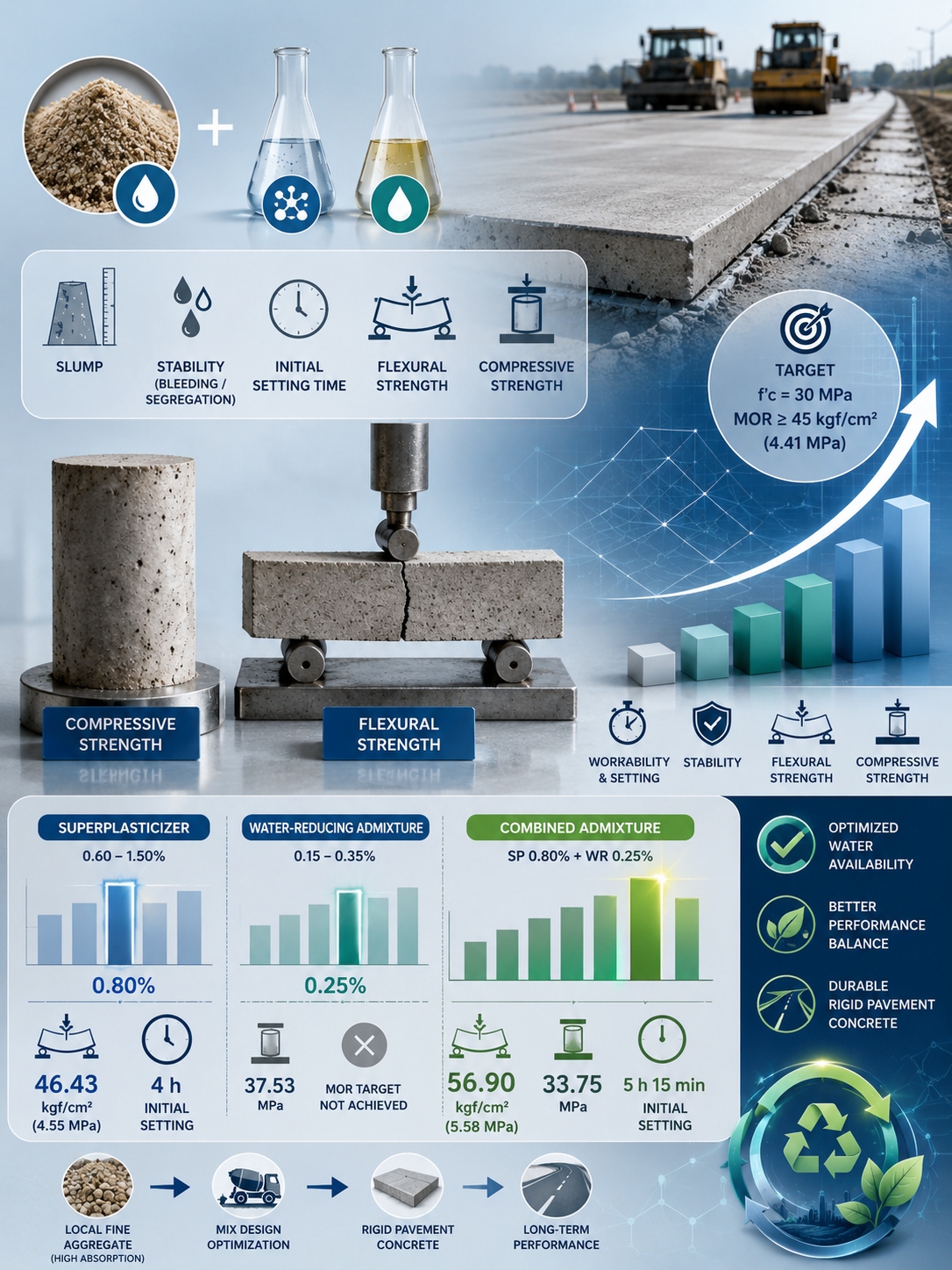
Rigid pavement concrete incorporating high-absorption local fine aggregate requires careful control of effective water availability, as aggregate moisture conditions may influence workability, setting behavior, and flexural performance. This study assessed the effects of superplasticizer and water-reducing admixture dosages on pavement concrete designed for a target compressive strength of 30 MPa and a target modulus of rupture of 45 kgf/cm² (4.41 MPa). A laboratory-based performance screening was conducted using a control mixture, superplasticizer mixtures at 0.60–1.50% by cement mass, water-reducing admixture mixtures at 0.15–0.35%, and one combined admixture mixture. Fresh properties were evaluated using slump, visual stability, bleeding and segregation observations, and initial setting time, whereas hardened performance was assessed through 7- and 28-day compressive and flexural strength tests. The control mixture achieved 31.71 MPa compressive strength at 28 days but failed the flexural strength requirement, reaching only 39.70 kgf/cm² (3.89 MPa). The 0.80% superplasticizer mixture achieved balanced performance, with 33.93 MPa compressive strength, 46.43 kgf/cm² (4.55 MPa) modulus of rupture, and an initial setting time of 4 hours. The 0.25% water-reducing admixture produced the highest compressive strength, 37.53 MPa, but did not meet the flexural criterion. The combined admixture mixture showed the best overall laboratory performance, achieving 33.75 MPa compressive strength, 56.90 kgf/cm² (5.58 MPa) modulus of rupture, and an initial setting time of 5 h 15 min. These findings indicate that pavement concrete mixture selection should integrate flexural strength, setting behavior, workability, and fresh-state stability rather than rely solely on compressive strength.
Downloads
Article Details

This work is licensed under a Creative Commons Attribution-ShareAlike 4.0 International License.
Authors who publish with this journal agree to the following terms:
- Copyright of the published article belongs to the authors and grant the journal right of first publication with the work simultaneously licensed under a Creative Commons Attribution-ShareAlike 4.0 (CC BY SA) International License that allows others to share the work with an acknowledgment of the work's authorship and initial publication in this journal.
- Authors are able to enter into separate, additional contractual arrangements for the non-exclusive distribution of the journal's published version of the work (e.g., post it to an institutional repository or publish it in a book), with an acknowledgment of its initial publication in this journal.
- Authors are permitted and encouraged to post their work online (e.g., in institutional repositories or on their website) prior to and during the submission process, as it can lead to productive exchanges, as well as earlier and greater citation of published work (See the Effect of Open Access).
References
[1] S. S. Pradhan, A. C. Pal, M. Panda, and P. Sarkar, “Predicting Mechanical Strength of Concrete Pavement: A Case Study with IoT-Based Monitoring Systems,” Int. J. Pavement Res. Technol., pp. 1–13, 2025, https://doi.org/10.1007/s42947-025-00616-2
[2] R. Campos, M. M. M. Larrain, M. Zaman, and V. Pozadas, “Relationships between compressive and flexural strengths of concrete based on fresh field properties,” Int. J. Pavement Res. Technol., vol. 14, no. 2, pp. 161–167, 2021, https://doi.org/10.1007/s42947-020-1074-0
[3] G. Sabih and R. A. Tarefder, “Characterizing strength and thermal properties of concrete for implementation of pavement mechanistic-empirical design in New Mexico,” Transp. Geotech., vol. 15, pp. 20–28, 2018, https://doi.org/10.1016/j.trgeo.2018.02.003
[4] G. Sabih, T. Rahman, and R. A. Tarefder, “Quantifying the impact of coefficient of thermal expansion of overlay concrete on unbonded concrete overlay performance,” Heliyon, vol. 4, no. 10, 2018, https://doi.org/10.1016/j.heliyon.2018.e00855
[5] G. Sabih and R. A. Tarefder, “Effects of CTE, MOR, and Elastic Modulus on the Performance of Rigid Pavement by MEPDG Simulation,” in Fourth Geo-China International Conference, 2016, pp. 86–93. https://doi.org/10.1061/9780784480052.011
[6] B. A. L. Fanggi, B. Suswanto, Y. Tajunnisa, J. W. M. Rafael, J. Lassa, and A. B. Habieb, “An Experimental Study on Axial Stress-Strain Behaviour of FRP-Confined Square Lightweight Aggregate Concrete Columns,” Adv. Sustain. Sci. Eng. Technol., vol. 7, no. 1, 2025, https://doi.org/10.26877/asset.v7i1.865
[7] S. Nisumanti, A. Kurniawan, and K. Al Qubroh, “Damage Analysis of Lahat Roads–Fence Natural From Endikat Bridge To Go To Depati H. Duaji Lintas Street Pagaralam–Lahat,” J. Appl. Eng. Technol. Sci., vol. 4, no. 1, pp. 251–262, 2022, https://doi.org/10.37385/jaets.v4i1.1066
[8] J. R. Ramírez-Vargas, S. A. Zamora-Castro, A. L. Herrera-May, L. C. Sandoval-Herazo, R. Salgado-Estrada, and M. E. Diaz-Vega, “A Review of Sustainable Pavement Aggregates,” Appl. Sci., vol. 14, no. 16, p. 7113, 2024, https://doi.org/10.3390/app14167113
[9] E. O. Fanijo, J. T. Kolawole, A. J. Babafemi, and J. Liu, “A comprehensive review on the use of recycled concrete aggregate for pavement construction: Properties, performance, and sustainability,” Clean. Mater., vol. 9, p. 100199, 2023, https://doi.org/10.1016/j.clema.2023.100199
[10] C. M. Nwakaire, S. P. Yap, C. C. Onn, C. W. Yuen, and S. M. H. Moosavi, “Utilisation of Recycled Concrete Aggregates for Sustainable Porous Asphalt Pavements,” Balt. J. Road Bridg. Eng., vol. 17, no. 1, pp. 117–142, 2022, https://doi.org/10.7250/bjrbe.2022-17.554
[11] A. J. Zulfikar, M. Y. Yaakob, and R. Syah, “Application of E-Glass Jute Hybrid Laminate Composite With Curved Shape on Compressive Strength of Cylindrical Column Concrete,” J. Appl. Eng. Technol. Sci., vol. 5, no. 1, pp. 184–196, 2023, https://doi.org/10.37385/jaets.v5i1.2072
[12] A. Neville, Concrete: Neville’s insights and issues. Thomas Telford, 2006.
[13] H. J. H. Brouwers, “The work of Powers and Brownyard revisited: Part 1,” Cem. Concr. Res., vol. 34, no. 9, pp. 1697–1716, 2004, https://doi.org/10.1016/j.cemconres.2004.05.031
[14] P. C. Aïtcin and R. J. Flatt, Science and technology of concrete admixtures. Woodhead publishing, 2015. https://doi.org/10.1016/C2015-0-00150-2
[15] L. Domagała, “The effect of lightweight aggregate water absorption on the reduction of water-cement ratio in fresh concrete,” Procedia Eng., vol. 108, pp. 206–213, 2015, https://doi.org/10.1016/j.proeng.2015.06.139
[16] Y. H. Kim, C. B. Park, B. Il Choi, T. Y. Shin, Y. Jun, and J. H. Kim, “Quantitative Measurement of Water Absorption of Coarse Lightweight Aggregates in Freshly-Mixed Concrete,” Int. J. Concr. Struct. Mater., vol. 14, no. 1, p. 34, 2020, https://doi.org/10.1186/s40069-020-00408-x
[17] M. E. Sosa, Y. A. Villagrán Zaccardi, and C. J. Zega, “A critical review of the resulting effective water-to-cement ratio of fine recycled aggregate concrete,” Constr. Build. Mater., vol. 313, p. 125536, 2021, https://doi.org/10.1016/j.conbuildmat.2021.125536
[18] Z. Duan et al., “Hydration kinetics and modified model for effective water to cement ratio control in recycled aggregate concrete,” Case Stud. Constr. Mater., vol. 23, p. e05217, 2025, https://doi.org/10.1016/j.cscm.2025.e05217
[19] Y. Wei, Z. Chen, M. Yio, C. Cheeseman, H. Wang, and C. S. Poon, “Advanced moisture control in porous aggregates for improved lightweight high-performance concrete,” Cem. Concr. Compos., vol. 155, p. 105826, 2025, https://doi.org/10.1016/j.cemconcomp.2024.105826
[20] X. Chen, H. Hao, J. de Brito, G. Liu, and J. Wang, “Discussion of the implementation of water compensation methods for recycled aggregate concrete: A critical review,” Cem. Concr. Compos., vol. 161, p. 106080, 2025, https://doi.org/10.1016/j.cemconcomp.2025.106080
[21] M. Nedeljković, J. Visser, B. Šavija, S. Valcke, and E. Schlangen, “Use of fine recycled concrete aggregates in concrete: A critical review,” J. Build. Eng., vol. 38, p. 102196, 2021, https://doi.org/10.1016/j.jobe.2021.102196
[22] J. Kim, “Influence of quality of recycled aggregates on the mechanical properties of recycled aggregate concretes: An overview,” Constr. Build. Mater., vol. 328, p. 127071, 2022, https://doi.org/10.1016/j.conbuildmat.2022.127071
[23] Y. Ding, A. She, and W. Yao, “Investigation of Water Absorption Behavior of Recycled Aggregates and its Effect on Concrete Strength,” Materials (Basel)., vol. 16, no. 13, p. 4505, 2023, https://doi.org/10.3390/ma16134505
[24] A. Fawzy, A. Elshami, and S. Ahmad, “Investigating the Effects of Recycled Aggregate and Mineral Admixtures on the Mechanical Properties and Performance of Concrete,” Materials (Basel)., vol. 16, no. 14, p. 5134, 2023, https://doi.org/10.3390/ma16145134
[25] N. V. Khanapur, S. Pradhan, T. Chandra, and B. Tripathi, “Aggregate presaturation and concrete mixing technique for upscaling the use of fine recycled concrete aggregate,” Results Eng., vol. 26, p. 105093, 2025, https://doi.org/10.1016/j.rineng.2025.105093
[26] O. A. Qasim, N. Hilal, M. I. Al Biajawi, N. H. Sor, and T. A. Tawfik, “Studying the usability of recycled aggregate to produce new concrete,” J. Eng. Appl. Sci., vol. 71, no. 1, p. 129, 2024, https://doi.org/10.1186/s44147-024-00463-1
[27] J. Cheung, L. Roberts, and J. Liu, “Admixtures and sustainability,” Cem. Concr. Res., vol. 114, pp. 79–89, 2018, https://doi.org/10.1016/j.cemconres.2017.04.011
[28] S. Barbhuiya, B. B. Das, and D. Adak, “Effects of chemical admixtures on the properties of concrete,” in Binding Materials for Sustainable Construction, Elsevier, 2025, pp. 329–362. https://doi.org/10.1016/B978-0-443-26566-2.00009-X
[29] S. Suyuti and M. Muslimin, “an Empirical Study for Estimating Ultimate Bearing Capacity of Concrete Small-Pile Cluster in Soft Clays,” J. Appl. Eng. Technol. Sci., vol. 6, no. 2, pp. 1397–1411, 2025, https://doi.org/10.37385/jaets.v6i2.4789
[30] X. H. Wang, Z. C. Fang, and L. Zheng, “Effect of Dose and Types of the Water Reducing Admixtures and Superplasticizers on Concrete Strength and Durability Behaviour: a Review,” J. Civ. Eng. Manag., vol. 30, no. 1, pp. 33–48, 2024, https://doi.org/10.3846/jcem.2024.20145
[31] Y. Yang et al., “Interaction mechanisms between polycarboxylate superplasticizers and cement, and the influence of functional groups on superplasticizer performance: a review,” Polym. Bull., vol. 81, no. 12, pp. 10415–10438, 2024, https://doi.org/10.1007/s00289-024-05233-w
[32] M. Moeinian, M. Ardjmand, and F. Nosratinia, “Evaluating the operational properties of concrete admixtures containing molecularly modified polycarboxylate superplasticizers,” Sci. Rep., vol. 14, no. 1, p. 20170, 2024, https://doi.org/10.1038/s41598-024-71078-y
[33] Q. Liu et al., “Advancing understanding of polymer-based superplasticizers for diverse concrete applications: Insights from quantum chemistry and nanoscale adsorption behavior,” Cem. Concr. Compos., vol. 153, p. 105690, 2024, https://doi.org/10.1016/j.cemconcomp.2024.105690
[34] J. Li, X. Zhang, X. Xu, and H. Wu, “Fully recycled aggregate concrete composite functional additives: Proportioning tests and verification of engineering adaptability,” Results Eng., vol. 27, p. 106910, 2025, https://doi.org/10.1016/j.rineng.2025.106910
[35] A. M. Zeyad and A. Almalki, “Influence of mixing time and superplasticizer dosage on self-consolidating concrete properties,” J. Mater. Res. Technol., vol. 9, no. 3, pp. 6101–6115, 2020, https://doi.org/10.1016/j.jmrt.2020.04.013
[36] T. J. Van Dam, “Chemical Admixtures for Concrete Paving Mixtures (FHWA-HIF-18-017).” Federal Highway Administration, Washington, DC, 2019. [Online]. Available: https://rosap.ntl.bts.gov/view/dot/43715/dot_43715_DS1.pdf
[37] T. J. Van Dam, “Specifying, designing, and proportioning paving concrete (FHWA-HIF-18-012).” Federal Highway Administration, Washington, DC, 2019. [Online]. Available: https://www.fhwa.dot.gov/pavement/pubs/hif18012.pdf
[38] ASTM International, “ASTM C33/C33M-24: Standard specification for concrete aggregates.” ASTM International, West Conshohocken, PA, USA, 2024. https://doi.org/10.1520/C0033_C0033M-24
[39] ASTM International, “ASTM C494/C494M-24: Standard Specification for Chemical Admixtures for Concrete.” ASTM International, West Conshohocken, PA, USA, 2024. https://doi.org/10.1520/C0494_C0494M-24
[40] ASTM International, “ASTM C192/C192M-24: Standard practice for making and curing concrete test specimens in the laboratory.” ASTM International, West Conshohocken, PA, USA, 2025. https://doi.org/10.1520/C0192_C0192M-24
[41] ASTM International, “ASTM C143/C143M-20: Standard test method for slump of hydraulic-cement concrete.” ASTM International, West Conshohocken, PA, USA, 2026. https://doi.org/10.1520/C0143_C0143M-20
[42] ASTM International, “ASTM C403/C403M-23: Standard test method for time of setting of concrete mixtures by penetration resistance.” ASTM International, West Conshohocken, PA, USA, 2023. https://doi.org/10.1520/C0403_C0403M-23
[43] ASTM International, “ASTM C39/C39M-21: Standard test method for compressive strength of cylindrical concrete specimens.” ASTM International, West Conshohocken, PA, USA, 2023. https://doi.org/10.1520/C0039_C0039M-21
[44] ASTM International, “ASTM C78/C78M-22: Standard test method for flexural strength of concrete (using simple beam with third-point loading).” ASTM International, West Conshohocken, PA, USA. https://doi.org/10.1520/C0078_C0078M-22
[45] Z. Zhao, S. Remond, D. Damidot, and W. Xu, “Influence of hardened cement paste content on the water absorption of fine recycled concrete aggregates,” J. Sustain. Cem. Mater., vol. 2, no. 3–4, pp. 186–203, 2013, https://doi.org/10.1080/21650373.2013.812942
[46] G. Sabih and R. A. Tarefder, “Impact of variability of mechanical and thermal properties of concrete on predicted performance of jointed plain concrete pavements,” Int. J. Pavement Res. Technol., vol. 9, no. 6, pp. 436–444, 2016, https://doi.org/10.1016/j.ijprt.2016.09.005
[47] W. Xun, C. Wu, X. Leng, J. Li, D. Xin, and Y. Li, “Effect of functional superplasticizers on concrete strength and pore structure,” Appl. Sci., vol. 10, no. 10, p. 3496, 2020, https://doi.org/10.3390/app10103496
[48] J. Chakkamalayath, M. Abdulsalam, and S. Al-Bahar, “Compatibility of superplasticizers with cement paste and concrete mixes containing Type I and Type V cement, and volcanic ash,” Innov. Infrastruct. Solut., vol. 7, no. 4, p. 259, 2022, https://doi.org/10.1007/s41062-022-00855-3
[49] J. Sivamani and N. T. Renganathan, “Effect of fine recycled aggregate on the strength and durability properties of concrete modified through two-stage mixing approach,” Environ. Sci. Pollut. Res., vol. 29, no. 57, pp. 85869–85882, 2022, https://doi.org/10.1007/s11356-021-14420-5
[50] I. G. Amadi, H. Beushausen, and M. G. Alexander, “Multi-Technique Approach to Enhance the Properties of Fine Recycled Aggregate Concrete,” Front. Mater., vol. 9, p. 893852, 2022, https://doi.org/10.3389/fmats.2022.893852
[51] A. Zingg et al., “Interaction of polycarboxylate-based superplasticizers with cements containing different C3A amounts,” Cem. Concr. Compos., vol. 31, no. 3, pp. 153–162, 2009, https://doi.org/10.1016/j.cemconcomp.2009.01.005
[52] S. Beldarrain, G. Goracci, J. S. Dolado, A. Barquero, and J. R. Leiza, “Poly(carboxylated ether)s as Cement Additives: The Effect of the Addition Method on Hydration Kinetics,” Materials (Basel)., vol. 17, no. 21, p. 5343, 2024, https://doi.org/10.3390/ma17215343
[53] Y. Gao et al., “Interaction Between Polycarboxylate Superplasticizer and Clay in Cement and Its Sensitivity Inhibition Mechanism: A Review,” Materials (Basel)., vol. 18, no. 11, p. 2662, 2025, https://doi.org/10.3390/ma18112662